The Carter Estate was not a home; it was a museum of manufactured sorrow. Ten thousand white lilies were arranged with geometric precision, their scent so overwhelming it served to mask the smell of rot that seemed to seep from the very foundation of the house. Vincent Carter, the patriarch of a shipping empire, lay in a closed casket in the center of the ballroom, his life reduced to a polished mahogany box and a series of sycophantic eulogies.
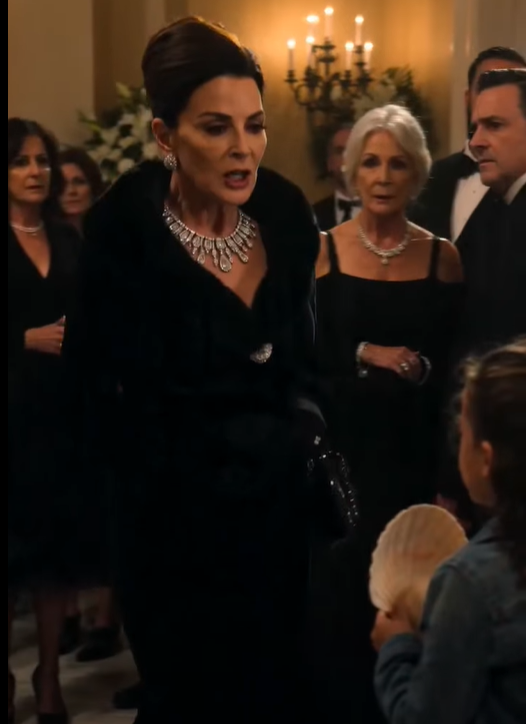
Victoria Carter, his widow, moved through the room like a predatory bird. She was draped in custom-made black silk and enough diamonds to light a cathedral, her expression a masterclass in calculated grief. To the outside world, she was the grieving queen; to those who knew the cold reality of her marriage, she was the architect of Vincent’s isolation.
The memorial was proceeding with military efficiency until the heavy oak doors groaned open.
The room fell silent. Standing on the threshold was a child, no older than seven, wearing a coat that was two sizes too big and carrying a simple, sun-bleached seashell in her small, trembling hands. She was a jarring stain of reality in a room of synthetic mourning.
“Who let that—that creature in here?” Victoria hissed, her voice a serrated blade. Before the security detail could move, Victoria strode across the marble floor, her heels clicking like gunshots. She grabbed the child’s shoulder, her manicured nails digging into the thin fabric of the coat. “You don’t belong here. Leave.”
The girl looked up, her eyes wide and glassy with unshed tears. “I just wanted to give him… he said he’d keep it safe.”
“He is dead!” Victoria spat, grabbing the seashell from the child’s hand. With a cruel, dismissive flick of her wrist, she hurled the shell against the cold marble floor.
It didn’t just crack; it shattered.
From the pulverized calcium and dust, something else tumbled out—a strip of fragile white lace, a garter, frayed at the edges and yellowed with time. Attached to it was a small, engraved silver tag: To Clara, My Heart. 1995.
The room went deathly still. Julian, Vincent’s estranged brother—a man who had been cast out of the empire years ago for questioning Victoria’s influence—stepped forward. He picked up the lace, his eyes hardening as he recognized the handwriting etched into the silver. It was Vincent’s, from a time before the cold, industrial machine of his career had consumed his soul.
“Clara,” Julian whispered, the name hanging in the air like a curse. “The woman he was supposed to marry before he met you, Victoria. The woman you told him had died in a fire.”
Victoria’s face drained of color, her poise fracturing. “That’s a lie. A plant. A disgusting stunt.”
But the child—the daughter of the woman they had all believed was dead—stepped forward, pointing to the memorial registry displayed by the casket. “My mother didn’t die in a fire,” she said, her voice small but piercing. “She died last week. I found this address in her desk. She said to tell him he was never alone.”
Julian spun toward the registry. His fingers flew across the paper, searching until he found the name he feared and hoped for. Clara Vance. The signature was fresh, written in the shaky hand of someone who had spent decades living in the shadows of a lie.
The chaos that erupted was not of shouting, but of cold, hard realization. The guests, the elite who had come to pay homage to the Carter legacy, began to back away. The facade wasn’t just slipping; it was disintegrating. Vincent had lived his entire life believing his true love had perished, a tragedy that had turned him into the hollow, ruthless man he became. And Victoria had known. She had fueled his grief to steer his ambition toward her own hunger.
The aftermath was a whirlwind of legal fire. The investigation into the Carter estate was ruthless, fueled by the evidence Julian and the young girl, Sophie, provided. Victoria was stripped of her title, her assets frozen under the weight of the fraud she had orchestrated. The “Empire” was dismantled, but in its ruins, something else began to grow.
Five years later, the Carter Estate was no longer a museum of grief.
It had been converted into a foundation—a sanctuary for children and families who had been displaced by the cold machinations of corporate greed. The ballroom, once a place of hollow performance, now rang with the sound of music, laughter, and the chaotic, messy beauty of a community center.
Julian stood on the terrace, watching the sunset. He was no longer the angry, estranged brother; he was the director of the foundation, a man who had finally found purpose in repairing what had been broken.
He heard the crunch of gravel and turned to see Sophie approaching. She was a teenager now, her eyes bright and filled with a quiet strength. She held a new shell—a perfect, spiral treasure from a beach they had visited that summer.
“Is he still in there?” she asked, nodding toward the house.
“He’s everywhere,” Julian replied softly.
He didn’t mean Vincent. He meant the memory of the life that might have been—the life of love and truth that had been suppressed by greed.
The house was full of light. The lilies were gone, replaced by wild, vibrant sunflowers that spilled over the edges of the garden. Victoria was a distant, bitter memory, a ghost of a past that had no power here.
Sophie walked up to the terrace and placed the new shell on a small table near the door. It was a simple act, a way of grounding herself in the present. They had faced the truth, however jagged and painful, and it hadn’t destroyed them; it had refined them.
As the evening air cooled, a group of children ran past, shouting in joy, their voices echoing through the halls where once only lies had lived. Julian watched them, feeling a profound sense of peace. The secrets that had once held the house in a grip of iron had been replaced by the rhythm of a life honestly lived.
The dead didn’t stay buried, and that was the blessing. They returned in the form of truth, breaking the shells of the past to reveal the seeds of a future. They hadn’t just survived the burning of the facade; they had built a home from the ashes, a place where, finally, the echoes of grief had been silenced by the harmony of home.