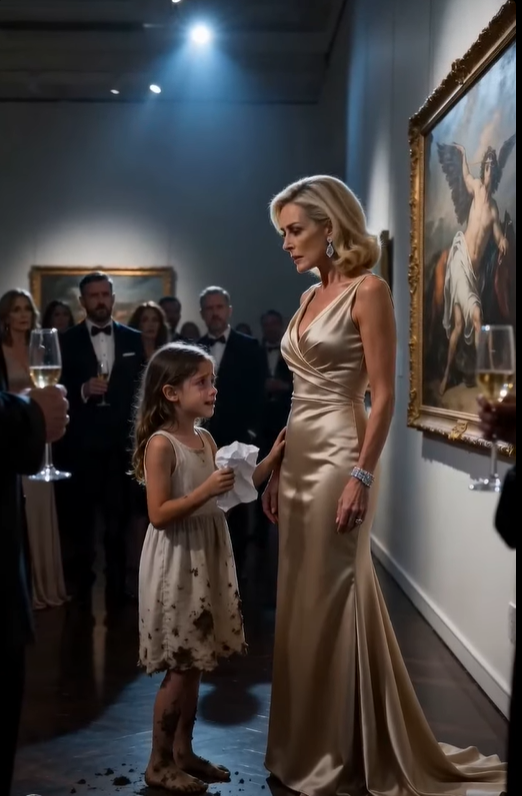
The Gala of the Century at the Vane Gallery was a spectacle of blinding privilege. The walls, painted a stark, gallery-white, were adorned with works that cost more than most people earned in a lifetime. In the center of the room stood Isabella Vane, the woman who dictated what was art and what was mere trash. She wore a dress the color of vintage champagne, dripping with diamonds that caught the spotlight and threw it back at the gawking crowd.
Isabella was a woman carved from ice. She viewed the world through the frame of a curator, categorizing people into things that were “curated” and things that were “debris.”
Then, the debris walked in.
Valentina was seven years old, her hair matted with the grit of the city streets, her feet bare and calloused. She didn’t belong in the Vane Gallery; she belonged in the shadows. When she stepped onto the polished hardwood, the gallery guests recoiled, their designer heels clattering away from her. Valentina didn’t care. Her eyes, wide and luminous despite the exhaustion, were fixed on the woman in the champagne-gold dress.
She approached Isabella with a wobbling gait, her small hand extending a piece of paper that had been folded and unfolded a thousand times.
Isabella didn’t see a child; she saw a smudge on her perfect evening. She didn’t look at the paper; she looked at the security guard, her voice a whip-crack in the silent hall. “Remove this filth at once! She is defiling the sanctity of this collection.”
But as the guard reached for her, Valentina’s voice, small and trembling, pierced the air. “Grandma said… she said this is the only thing left of who you really were.”
The guard hesitated. Isabella, annoyed by the delay, snatched the paper from the girl’s hand, intent on crumpling it and throwing it back into the mud. Her diamond-encrusted rings caught the light as she snapped the paper open.
Her breath vanished.
It wasn’t just a paper. It was a charcoal sketch—the original study for the very painting she was standing in front of. It was a portrait of a woman, much younger, with a smile that Isabella had long ago traded for a boardroom scowl. And at the bottom, in the frantic, fading script of a woman who had died in a hospice ward three days ago, were the words: “Isabella, I couldn’t keep her. Valentina is your daughter. She has your eyes. Please, don’t leave her to the world that left us behind.”
The room, once filled with the clinking of champagne flutes, went deathly silent. Isabella looked at the sketch, then at the painting, then at the girl. The resemblance was an absolute, terrifying mirror. The icy composure that had defined Isabella’s career—the shield she had built against her own humanity—shattered. She looked at Valentina, really looked at her, and saw the version of herself she had tried to bury decades ago.
“My… my daughter?” Isabella whispered. The paper fluttered to the floor, forgotten. She fell to her knees, the expensive fabric of her gown pooling on the dirty, scuffed hardwood. She pulled Valentina into her arms, ignoring the gasp of the socialites, the cameras, and the scandal that would be front-page news by morning.
The Aftermath
The scandal was, as predicted, catastrophic. The Vane Gallery’s stock plummeted, and the society pages feasted on the downfall of the “Ice Queen.” But Isabella didn’t look at the papers. For the first time in twenty years, she wasn’t looking at anything through a curator’s frame.
She moved out of the penthouse and into a house with a garden—a place where feet could be bare and grass could stain knees. She stepped away from the Vane Gallery, handing the reins to an assistant who actually cared about artists, not just their price tags.
The transition was not a fairy tale. Valentina was haunted by the coldness of her early years, and Isabella was haunted by the coldness of her own heart. There were nights of tears, arguments, and long silences where the ghost of the woman Isabella had been clashed with the mother she was trying to become. But they learned.
Isabella learned how to cook dinner without worrying about the presentation of the plate. Valentina learned that she didn’t have to carry a crumpled piece of paper to prove she existed.
Five years later, the Vane name had been scrubbed from the art world, replaced by the “Valentina Foundation.” The foundation didn’t sell art; it gave it. It funded after-school programs for children who, like Valentina, were talented but overlooked.
On a sun-drenched Saturday afternoon, Isabella sat on a bench in the foundation’s community garden. She wasn’t wearing diamonds anymore; she wore a simple linen shirt, her hair pulled back in a loose, comfortable braid. She watched as Valentina—now a tall, confident teenager—taught a group of younger children how to mix colors on a canvas.
Valentina looked over and saw Isabella. The girl didn’t run to her with the frantic need of a lost child; she walked to her with the steady, calm pace of someone who knew exactly where she belonged.
“The light is perfect today, Mom,” Valentina said, sitting down beside her.
Isabella looked at her daughter, noticing the way Valentina held her brush—with the same intensity Isabella had once used to sign billion-dollar contracts, but directed toward something that actually created joy.
“It is,” Isabella agreed.
“Are you ever sorry?” Valentina asked, her voice soft. “About the gallery? The life you lost?”
Isabella reached out, taking Valentina’s hand. Her rings were gone, but her grip was firm, grounded. She thought about the woman who had walked into that gallery in a champagne-gold gown, terrified of being human. She looked at the garden, at the children laughing, at the life she had chosen—the life that had chosen her.
“I spent twenty years curating a collection of things,” Isabella said, her voice steady. “I thought I was powerful because I owned the walls that held the art. I was wrong. The art isn’t the painting on the wall, Valentina. It’s the grace we show each other when the walls fall down.”
Valentina leaned her head on Isabella’s shoulder. They sat in the quiet of the garden, two survivors of a cold past, existing in a warm, messy, beautiful present. The empire had fallen, the diamonds had been sold, and the gallery was a memory. But as the sun set, casting long, golden shadows across the canvas of their life, Isabella knew she had finally curated something that would last forever: a home.
The silence between them wasn’t heavy with judgment anymore; it was full of peace. And for the first time, Isabella Vane, the woman who had once needed a shield to survive the world, was finally, truly, unrefined, uncurated, and completely whole.