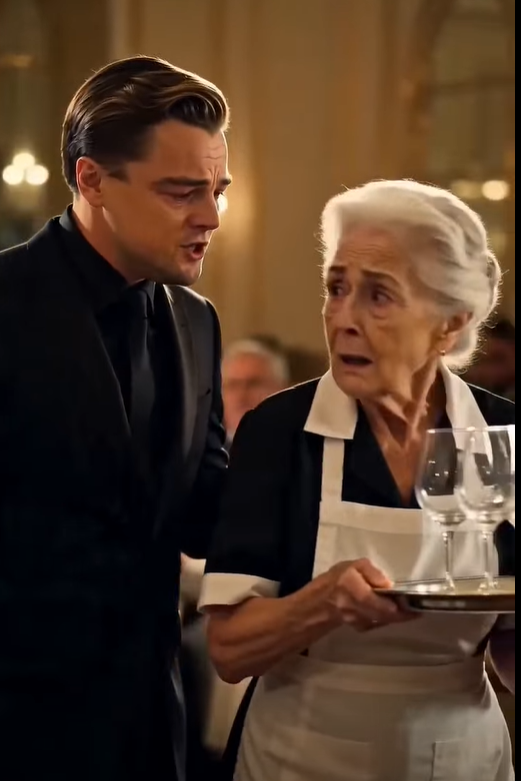
The chandelier above cast a warm, honeyed glow across the dining room of L’Aube, one of the city’s most prestigious establishments. Here, the air smelled of expensive perfume, reduction sauces, and the quiet arrogance of success. For the patrons, the evening was a choreographed dance of privilege. But for Mrs. Elena, it was simply another night of aching joints and the rhythmic, exhausting slide of her rubber-soled shoes against the polished marble floor.
Elena was sixty-eight, though her spine, perpetually curved from years of balancing heavy trays, suggested a much older soul. Her silver hair was pulled back into a tight, utilitarian bun, and her hands—spotted with age and mapped with prominent, blue-tinged veins—often betrayed her with a subtle, involuntary tremor. She had worked at L’Aube for nearly fifteen years, but her history in service stretched back much further. She had been a cook, a dishwasher, a busser, and a waitress. She was the invisible architecture of other people’s comfort.
Tonight, the restaurant was crowded. Elena moved with the practiced, mechanical precision of someone who had long ago stopped trying to hide her fatigue. She approached a table near the back, her tray heavy with fine crystal and a vintage Bordeaux. As she reached the table, her concentration wavered; the weight of the tray seemed to pull at her shoulder with an unusual, sharp intensity. Just as she braced herself to set the glasses down, a hand—firm, manicured, and adorned with a heavy gold watch—reached out and steadied the tray.
“Let me take that, Elena,” a deep, controlled voice said.
Elena blinked, her vision momentarily blurring in the dim light. She looked up, expecting a complaint from an impatient diner. Instead, she met the eyes of a man in his mid-forties, wearing a tailored charcoal suit that commanded the room. He was handsome, with an air of absolute authority, yet his gaze was soft, anchored by a memory that had nothing to do with this restaurant.
Elena squinted, searching the contours of his face. She saw the jawline, the way his brows arched, and suddenly, the sterile luxury of L’Aube vanished. She was transported back thirty years to a cramped, dimly lit diner in a forgotten neighborhood. She saw a skinny, frightened boy sitting at a corner booth, his coat frayed at the cuffs, his stomach rumbling in the silence of the night. She remembered sliding a warm plate of eggs and buttered toast toward him, pretending it was a “mistake” from the kitchen so he wouldn’t feel the sting of charity. She had done it every Tuesday for a year until he stopped coming.
“Julian?” she whispered, the name feeling foreign on her tongue.
The man smiled, and the transformation was complete. The successful businessman was gone; in his place was the boy who had once believed the world had nothing for him. “You remembered,” he said quietly.
The dining room seemed to fall silent, or perhaps, Elena simply stopped hearing the clinking of crystal. Julian took the tray from her trembling hands and set it aside, not on the table, but on a nearby service station. He didn’t just take the tray; he took the weight of those thirty years of labor.
“I spent a long time looking for you,” Julian said, his voice thick with emotion. “I became an architect, Elena. I build things now. But every house I’ve ever designed, every bridge I’ve mapped out—I built them on the foundation of the kindness you gave me when I was empty.”
He reached into his breast pocket and pulled out a small, leather-bound case. He didn’t hand it to her; he took her weathered, calloused hand in his and pressed the object into her palm. As she felt the cold, jagged teeth of a key, he leaned in, his voice a low, gentle whisper: “It’s time for you to rest.”
Elena looked down. Attached to the key was a small keychain with the address of a modest, light-filled cottage on the edge of the city—a place with a garden, a porch, and enough silence to heal a tired spirit. It was a home she had once dreamt of but had long ago dismissed as an impossible fantasy.
“I can’t,” she began, her voice cracking. “I have my shift, I have the rent…”
“You have nothing but peace from this moment forward,” Julian interrupted, his eyes searching hers with fierce sincerity. “The lease is settled. The garden is waiting. You served me when I had nothing, Elena. Now, let me serve you.”
Around them, the restaurant had begun to notice. The hum of conversation had died down into a respectful, collective hush. Nobody was ordering wine; nobody was complaining about the service. They were witnessing the sudden, seismic shifting of a human life.
Elena looked at the key, then at the man who had traveled a lifetime to find her. The tremor in her hands slowly began to subside. For the first time in three decades, she realized she didn’t have to carry the tray. She didn’t have to navigate the long, lonely walk to the bus stop in the freezing rain. The burden of survival, which she had carried like a second skin, was finally shedding.
She looked at Julian and saw the man he had become, but more importantly, she saw the boy she had once nurtured. She realized that kindness is never truly spent; it is invested. It grows in the shadows, waiting for the right moment to bloom into a miracle.
“Thank you,” she breathed, the words carrying the weight of a prayer.
Julian stood up straight, his hand resting briefly on her shoulder—not to weigh her down, but to steady her. “Go home, Elena. Your life is waiting for you.”
As Elena walked toward the exit, she didn’t look back at the tables, the crystal, or the patrons who had once defined her existence. She walked through the heavy glass doors of L’Aube and stepped out into the night. The air was cool and crisp, smelling of jasmine and promise. She gripped the key tightly, feeling its sharp edges against her skin. It wasn’t just metal; it was the promise of a sunrise she wouldn’t have to spend working.
The next morning, Elena stood on the porch of the cottage. The garden was wild but beautiful, overflowing with untamed roses and sunlight that seemed to dance in the leaves. As she opened the front door, she heard the sound of birdsong—a melody of freedom. She sat on the porch swing, the wood creaking softly beneath her, and watched the neighborhood wake up. She had no tray to carry, no orders to take, and no rush to beat. She had only the morning, the light, and the quiet, profound joy of a life finally reclaimed.
The seed of kindness she had planted thirty years ago in the heart of a hungry boy had returned to her as a harvest of peace, proving that while we may often feel forgotten by the world, the love we give away eventually finds its way back home.