The afternoon sun hung low over Willow Creek Park, casting long, amber shadows across the manicured lawns. It was a day of routine—the sound of distant lawnmowers, the laughter of children on the playground, and the rhythmic, steady pace of Officer Miller, who was walking his K-9 partner, Kaiser, along the perimeter. Kaiser was a creature of absolute discipline, a massive German Shepherd with a coat like polished mahogany and a reputation for being the most fearsome asset on the police force.
Suddenly, the atmosphere shifted. Kaiser’s ears pricked forward, stiff as antennas. A low, guttural growl vibrated deep within his chest—a sound that usually signaled the presence of an armed threat or a fleeing suspect. Officer Miller tightened his grip on the heavy-duty nylon leash, his muscles bunching with instinctual tension.
“Kaiser, heel!” Miller barked, but the dog didn’t respond.
The German Shepherd surged forward, his powerful legs eating up the grass. Miller was dragged, his boots carving deep furrows into the earth as he fought to maintain control. The park, previously a sanctuary of peace, erupted in chaos. Mothers snatched their children to their chests; joggers sprinted in the opposite direction; and a collective gasp rippled through the crowd as they realized the target: an elderly man sitting alone on a weathered wooden bench.
The man was frail, draped in a coat that had seen too many winters. He didn’t move as the massive dog bore down on him. He didn’t cower; he simply sat, his gaze fixed on the distance, his hands resting on a cane that trembled slightly in the cool breeze.
“Get back! Stop the dog!” someone screamed.
Officer Miller, desperate to avert a tragedy that would end his career and shatter a life, prepared to tackle his own partner. He was inches away from throwing his body weight into the fray when everything, quite suddenly, stopped.
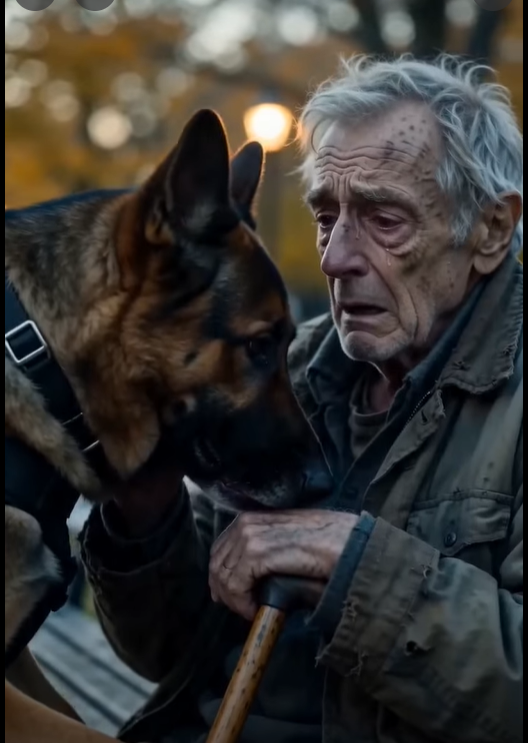
Kaiser didn’t leap. He didn’t bare his teeth. As he reached the bench, the dog’s posture underwent a violent, beautiful transformation. The aggression that had been vibrating through his frame simply evaporated, replaced by a profound, almost reverent gentleness. Kaiser lowered his massive head, his ears folding back against his skull, and he pushed his wet nose firmly into the old man’s weathered, shaking hands.
The dog let out a high-pitched, thin whimper—a sound so human and so heartbreaking that the shouting in the park died down, replaced by a stunned, heavy silence.
The old man’s eyes, milky with age and clouded by years of loneliness, filled with sudden, brilliant clarity. He didn’t look afraid. He dropped his cane and reached out, his fingers burying themselves in the thick fur behind Kaiser’s ears.
“Good boy…” the old man whispered, his voice cracking like dry leaves. “You’ve found me. You finally found me.”
Officer Miller stood frozen, the leash slack in his hand. He had spent three years training Kaiser to be a weapon, to ignore everything but the command to hunt. But here, the dog was acting like a long-lost son returned from war.
The man, whose name was Arthur, had been a retired master trainer for the K-9 unit decades ago. He had raised Kaiser’s sire, and in the months before his forced retirement and his subsequent descent into the isolation of poverty and memory loss, he had worked with the puppy that would eventually become the department’s top dog. They hadn’t seen each other in years—the dog had been moved to a new handler, and Arthur had retreated into a world of quiet obscurity.
“I thought I’d lost you to the system, just like I lost everything else,” Arthur sobbed, leaning his forehead against the dog’s neck. Kaiser stood perfectly still, a silent sentry, licking the salt tracks from the old man’s cheeks.
The tension in the park had been replaced by a palpable, shimmering awe. The onlookers, who moments ago were bracing for a bloodbath, were now wiping away tears. Even the hardened Officer Miller felt a lump in his throat that he couldn’t swallow. He had seen Kaiser take down suspects without a second thought; he had never seen the dog show love.
Miller approached slowly, kneeling beside them. “Arthur?” he asked softly. “Is this… do you know him?”
Arthur looked up, his smile thin but radiant. “He’s the only part of my life that remembered the truth, Officer. The world forgets you when you get old. People walk past you like you’re just part of the scenery. But he… he didn’t forget.”
From that day on, the dynamic of the precinct changed. The story of the “Miracle at Willow Creek” spread through the city, reaching the ears of the Police Commissioner. It wasn’t long before bureaucratic red tape was cut with unprecedented speed.
The ending was as bright as the day they reunited. Arthur was not returned to his lonely apartment. With the help of the department’s veteran support program, he was moved into a small, sun-drenched cottage on the edge of the K-9 training facility. His days of solitude were over.
Officer Miller became a fixture at the cottage, bringing Kaiser for “duty” every afternoon. But it was never work; it was a homecoming. Arthur, rejuvenated by the presence of his old friend, began to consult for the unit, using his decades of wisdom to help train the next generation of K-9s.
In the evenings, as the sun dipped low and painted the sky in shades of violet and gold, you could find them on the porch—Arthur in his rocking chair, Kaiser lying contentedly at his feet, his chin resting on Arthur’s shoe. The dog had traded his armor for companionship, and the old man had traded his silence for a voice. They proved to the world that some bonds are not merely biological or professional; they are anchors of the soul, designed to hold fast against the currents of time, distance, and even the harshest of training. They had both been found, and for the first time in a long, long time, they were truly home.