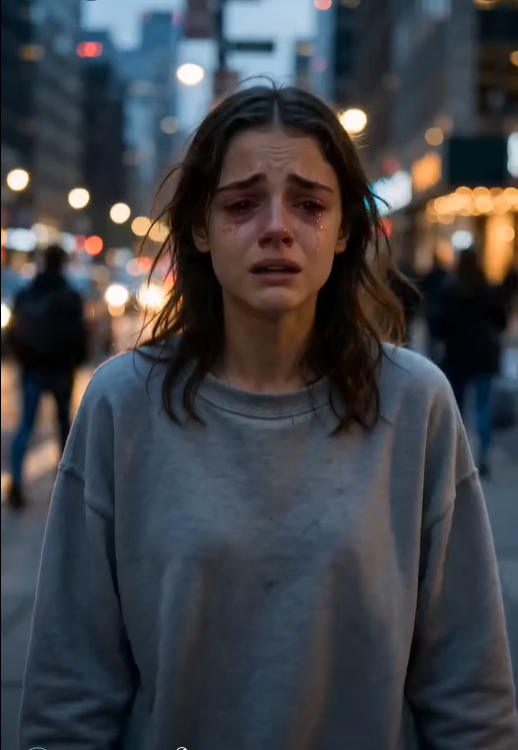
The city of Seattle was a labyrinth of gray concrete, cold glass, and a million hurried footsteps. To Clara, it was a graveyard of dreams. Walking through the downtown corridor, she felt like a ghost haunting her own life. In her pocket, her phone felt like a ticking bomb, loaded with notifications from the hospital: Overdue bills. Urgent surgery required. Prognosis critical. Her mother was the only family she had, and the weight of her medical bills was a tide rising far above her head.
Clara’s vision was fractured by the sting of unshed tears. She stumbled, her shoulder bumping into a businessman who didn’t even glance back. The world was a relentless machine of indifference. She reached a crosswalk, her legs trembling with a fatigue that went deeper than muscles—it was the exhaustion of a spirit that had fought for too long. She leaned against a rusted streetlamp, the city’s roar—the honking cabs, the drilling of construction crews, the mindless chatter—blurring into a singular, agonizing hum.
Suddenly, a sharp, golden-brown blur darted from the shadows of an alleyway. A dog, a sturdy retriever mix with eyes like molten amber, lunged with precise, calculated speed. He didn’t bark; he didn’t growl. Instead, he clamped his jaws firmly onto the strap of Clara’s heavy messenger bag and pulled, gently but insistently, dragging her back from the curb.
Clara gasped, the sudden movement snapping her out of her stupor. She fell to her knees, the pavement biting into her jeans. The dog didn’t retreat. He sat before her, his tail giving a single, tentative wag, his head cocked in a gesture of profound, ancient intelligence.
“I have nothing for you,” Clara sobbed, the dam finally breaking. She buried her face in her hands, her voice lost in the cacophony of the street. “I can’t even save her. I can’t save anyone.”
She spoke the words into the hollow space between them, a desperate prayer to a god she wasn’t sure was listening. “My mother needs help… she’s all I have left.”
The dog let out a low, grounding huff. He stepped closer, nudging her shoulder with his warm nose. That was when the ambient noise of the city seemed to undergo a strange, localized muting. The sirens and the shouting faded into a dull background thrum.
“How much do you need?”
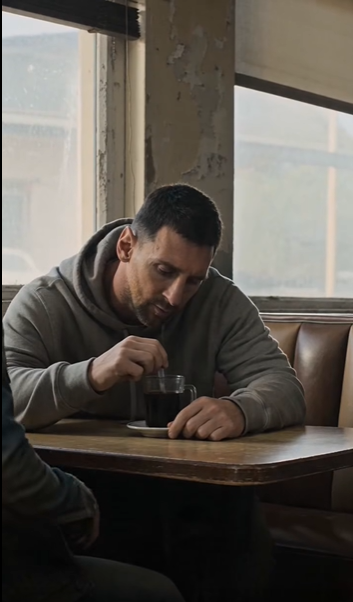
The voice was calm, resonant, and devoid of the frantic energy that defined the city. Clara looked up, her lashes wet. Standing a few feet away was a man in his mid-fifties, wearing a worn denim jacket and carrying a heavy leather satchel. He wasn’t a tycoon or a celebrity; he looked like a man who had seen his share of hard winters. The dog looked at him, then back at Clara, a silent bridge between two strangers.
Clara blinked, her throat tight. “I… what?”
“You were talking to the dog,” the man said, offering a small, sad smile that reached his eyes. “And you said your mother needs help. How much?”
Clara felt a flicker of defensive pride, but the image of her mother’s hospital monitor flashed in her mind. She whispered the sum—a number that felt astronomical to her, but mere air to the world.
The man didn’t laugh. He didn’t offer platitudes. He simply reached into his satchel, pulled out a notepad, and began to write. “My name is Elias,” he said. “And this is Barnaby. He’s got a talent for finding people who are at the very edge of the map. He’s done this twice before.”
He ripped the page from the pad and handed it to her. It wasn’t just a number; it was a check, and underneath it, a business card for a reputable local charity foundation. “I don’t give money to people because I’m rich,” Elias said, his voice lowering. “I give it because ten years ago, I was sitting on this exact sidewalk, and someone stopped to ask if I was okay. I’m just paying back the interest.”
Clara stared at the check, then at Barnaby. The dog let out a satisfied huff and sat back on his haunches, his golden eyes filled with an unsettlingly human warmth.
“Why?” Clara breathed.
“Because the city is too big to be lonely,” Elias replied. He whistled low, and Barnaby trotted over, leaning against his leg. “Go to the hospital, Clara. The surgery is the only thing that matters today.”
As the pair walked away, disappearing into the sea of pedestrians, Clara remained on the sidewalk. She wasn’t drowning anymore. The weight that had been crushing her chest had lightened, replaced by a terrifying, beautiful sense of possibility.
Two weeks later, the hospital room was filled with the scent of lilies and the rhythmic, steady beep of a heart monitor that was finally playing the song of recovery. Clara sat by her mother’s bed, holding her hand. The crisis had passed. The surgery had been a success, and the recovery was steady.
But the real change wasn’t just in the hospital room. Clara had gone to the foundation listed on the card. She found that Elias was the director of a small but powerful network of “street angels”—men and women who wandered the city, guided by the intuition of rescued dogs like Barnaby. They didn’t just hand out checks; they provided resources, jobs, and a community for those the city had deemed invisible.
Clara started volunteering that same week. She learned that Barnaby had been a stray, picked up from a kill shelter minutes before his time was up, and had somehow learned to read the sorrow in a human heart better than any trained professional.
One Saturday afternoon, Clara stood at the same corner where she had once fallen to her knees. She felt different—not because her problems had vanished, but because she now understood that the city wasn’t a maze, but a web. Every thread was connected.
She watched a woman walking past, head down, shoulders hunched under the crushing weight of a hidden storm. Clara felt a tug on her own leash. Beside her sat a small, scrappy terrier she had rescued from the same shelter Barnaby had come from. The dog looked up at her, sensing the shift in her focus.
Clara smiled, tightened her grip on the leash, and began to walk toward the woman. She didn’t have all the answers, and she didn’t have millions of dollars to hand out. But she had the one thing that had saved her life: the willingness to stop, to look, and to say the words that shatter the silence.
She walked over, stood beside the stranger, and did what Elias had done. She didn’t talk about money or miracles; she simply asked, “It’s a tough day, isn’t it? Do you want to talk?”
As the woman looked up, her eyes widening in surprise, Clara realized the miracle wasn’t the check she had received. The miracle was the chain of kindness that had been started by a dog who refused to let her vanish. The city was still crowded, the footsteps were still hurried, but for the first time, Clara wasn’t a ghost. She was part of the light.