The gala at the Sterling Art Gallery was the kind of event that smelled of expensive cologne, old money, and the suffocating perfume of vanity. Under the vaulted ceiling, the city’s elite mingled, sipping vintage champagne and exchanging social currency. They didn’t see people; they saw assets and liabilities.
In the center of the room hung “The Silent Horizon,” a controversial piece of modern art that had everyone whispering. Standing before it, looking like a misplaced smudge on a masterpiece, was Elara. She wore an oversized hoodie stained with oil paints, her hair tied up in a messy, careless knot. She looked like she had just wandered in from a construction site, not a high-profile gallery opening.
Julian, a real estate mogul whose ego was matched only by the price of his tuxedo, drifted toward her. He was currently trying to impress a group of investors, and he needed a victim to boost his own perceived dominance. He noticed Elara looking intently at the painting, her head tilted as if she were dissecting the brushstrokes.
“It’s a bit much for someone like you, isn’t it?” Julian said, his voice loud enough to draw a crowd. He swirled his glass, a smirk playing on his lips. “This isn’t an exhibit for the help, sweetheart. Why don’t you find the loading dock? They usually need someone to sweep the floors after we leave.”
The surrounding guests chuckled. It was the easy, cruel laughter of people who had never known a day of struggle.
Elara didn’t flinch. She didn’t look offended. She turned her head slowly, her eyes—a striking, cold shade of slate gray—settling on Julian. She didn’t look like a woman who had just been insulted; she looked like a scientist observing a particularly dull specimen of bacteria.
“You think this piece is about the aesthetic, don’t you, Julian?” Elara asked, her voice calm, devoid of the tremor of fear.
Julian blinked, surprised she knew his name. “I think you should leave before security tosses you into the alley.” He stepped closer, attempting to loom over her, his polished shoes scuffing the expensive marble. “Do you have any idea how much money is in this room? You’re not even a rounding error to us.”
Elara finally turned fully toward him. She reached into her hoodie pocket and pulled out a small, encrypted tablet. With a few taps, she didn’t reveal a secret bank account, but rather a live feed.
The large projector screens in the gallery, which were supposed to showcase the gallery’s marketing materials, suddenly glitched. The images of gold-leaf frames and wine glasses vanished, replaced by a complex network of bank routing numbers, offshore property transfers, and signatures—Julian’s signatures—on illegal land acquisition documents.
The laughter in the room died instantly. Julian’s face turned the color of ash.
“You asked what the painting is about,” Elara said, her voice now ringing with an authority that silenced the entire hall. “It’s a digital map. A cryptographic key, actually. I spent the last three years tracking the systematic dismantling of the city’s public housing funds. And you, Julian, are the primary architect of that theft.”
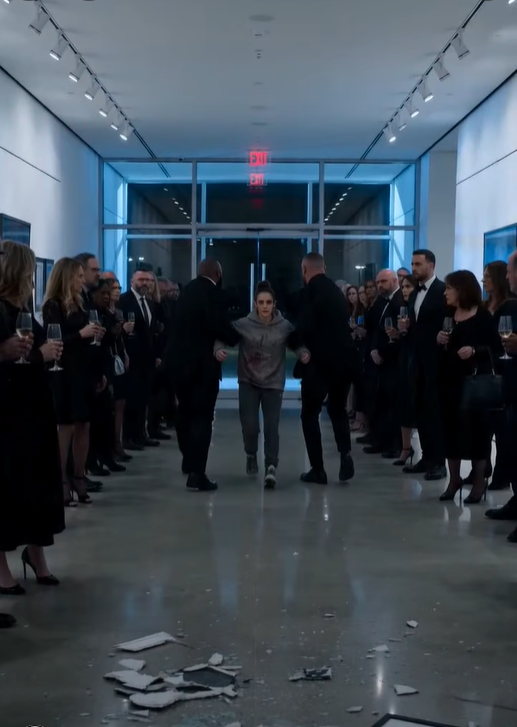
Julian lunged for the tablet, his composure completely shredded, but before he could touch her, two men in sharp, charcoal-colored suits—men who had been standing in the shadows—stepped forward. They weren’t gallery security. They were federal agents.
“Mr. Sterling,” one of them said, his voice polite but firm. “You’re under arrest for embezzlement, racketeering, and money laundering.”
The elegance of the evening shattered. The investors Julian had been courting backed away as if he were radioactive. The woman in the hoodie, the ‘smudge’ on the masterpiece, was Elara Vance—the lead auditor for the Department of Financial Oversight. She had spent months going undercover, living in workshops, eating in diners, and learning the rhythm of the city’s underbelly to trace the corruption that reached the very top.
As Julian was dragged out of the gallery, his protests echoing off the crystal chandeliers, Elara stood alone in the center of the room. The silence was absolute. The elite who had laughed at her moments ago now wouldn’t even meet her gaze.
She walked toward the exit, her work here finished. But just as she reached the door, she felt a hand on her shoulder. It was Marcus, her supervisor, holding a long, tailored trench coat.
“Well done, Elara,” he whispered. “The board is impressed. You’ve cleared the path for the housing reconstruction project.”
Elara slipped into the coat, the hoodie and the paint-stained life falling away. She walked out of the gallery and into the cool night air. The city skyline twinkled before her, no longer a backdrop for greed, but a project she had just saved.
Three months later, the construction on the East District Housing project began. It was a day of celebration, not for the rich, but for the families who had been displaced by Julian’s greed. Elara stood at the podium, now in a sharp, navy blazer, looking out at a sea of smiling faces. She wasn’t the girl in the hoodie anymore, and she wasn’t the auditor hiding in the shadows.
She looked to her right and saw her family—the people she had been protecting all along. Her brother, who had been struggling to keep their home, was there, his eyes bright with pride.
As the ribbon was cut, Elara realized that power wasn’t about who held the loudest voice in the room. It was about who held the truth when the room went quiet. She had played the part of the invisible worker to ensure the real work got done.
The nightmare of corruption had ended, replaced by the foundation of something far more enduring. As she laughed with her brother, watching the children play in the newly opened park, she knew the price of her deception had been worth every second. They were home, they were safe, and for the first time in her life, the future was exactly as bright as she had painted it.