The Shadow in the Suburbs
The suburban paradise of Oakhaven was the kind of place where people left their front doors unlocked and the most pressing crime was a neighbor’s overgrown hedge. It was a sterile, pristine landscape of manicured lawns and forced smiles. But for Officer Elias Thorne and his K-9 partner, Rex—a German Shepherd whose nose for criminal intent bordered on the supernatural—the silence of Oakhaven felt less like peace and more like a held breath.
It was a Tuesday afternoon, the kind where the sun felt too bright, when Rex suddenly slammed on the brakes. They were patrolling near the cul-de-sac of the upscale Blackwood Estate when Rex’s ears flattened. A low, guttural growl vibrated through the leash and into Elias’s arm. Rex didn’t just bark; he pulled aggressively toward a sleek, black Mercedes parked in the driveway of the most prominent house on the street.
Rex began to howl—a high, piercing sound that cut through the suburban lull like a siren. He was fixated on the trunk.
“Rex, easy,” Elias commanded, his hand instinctively dropping to his service weapon.
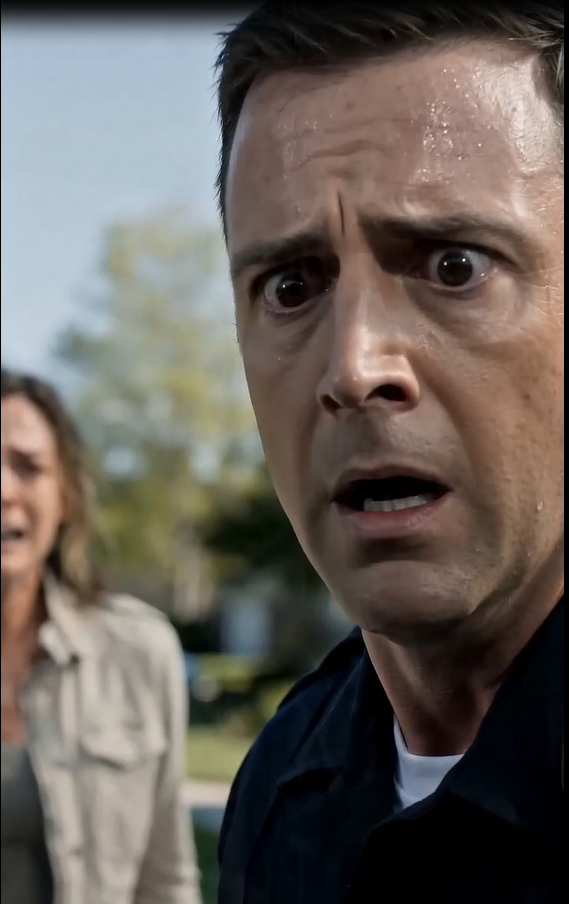
Suddenly, a door slammed open. A woman, Clara Blackwood, sprinted down the driveway, her face a pale, ghostly mask of pure, unadulterated terror. Her designer heels snapped, but she kept running, stumbling toward Elias.
“Don’t!” she shrieked, her voice cracking. “Please, don’t open it! You don’t understand what you’re doing!”
Elias felt the hair on the back of his neck stand up. The air seemed to turn frigid, the scent of expensive roses in the garden replaced by the metallic, stagnant odor of something trapped. “Ma’am, stay back! Rex is signaling something in the trunk. Step away from the vehicle.”
“You’ll destroy everything!” Clara collapsed to her knees, her hands clawing at the manicured grass. “It’s not what you think. Please, just walk away.”
Elias was caught in the crucible of duty. His gut screamed that this wasn’t a narcotics bust or a report of stolen goods. It was something far darker. With a heavy hand, he reached for the trunk release. The mechanism clicked with an agonizing slowness. As the lid rose, a heavy, velvet-like darkness poured out.
It wasn’t an empty space. It was a custom-built, soundproofed isolation chamber, tucked into the chassis of the car. Inside, huddled in the fetal position, was a young boy—the neighbor’s son, who had been reported missing forty-eight hours ago. But he wasn’t alone. Beneath the boy lay a series of files, encrypted drives, and a ledger that mapped out a sprawling, high-stakes human trafficking operation involving some of the city’s most influential elite.
The darkness wasn’t just physical; it was systemic. As the boy looked up, his eyes wide with a mixture of trauma and disbelief, Rex finally stopped barking. He stepped forward and gently licked the boy’s hand.
Clara began to sob, a soundless, heaving rhythm of a woman who had been living in a golden cage, too terrified to speak until the weight of the secret finally crushed her.
The Aftermath: The Light Breaks Through
The unraveling of the Blackwood secret did not stop at the driveway. Elias knew he couldn’t trust the local precinct, which had been systematically ignoring the disappearances for months. He bypassed his superiors, reaching out to federal contacts he had kept in his back pocket since his days in a specialized task force.
Within hours, the quiet streets of Oakhaven were crawling with federal agents. The files found in the Mercedes trunk were the “Rosetta Stone” of the city’s underground. They didn’t just contain evidence; they contained names, bank accounts, and video logs that implicated the city’s district attorney, the police chief, and several prominent local businessmen.
The trial that followed was the most explosive in state history. Clara Blackwood, once a prisoner in her own home, turned state’s witness. She revealed that she had been forced to facilitate the operation by her husband, the mastermind behind the ring, to protect their own child. Her testimony, combined with the encrypted drives, dismantled the network from the inside out.
Six months later, Elias stood in a local park. He was no longer patrolling the streets of Oakhaven, but he was still a guardian. Beside him, Rex was playing fetch with Leo—the rescued boy—who was running with a freedom that had once been stolen from him.
Clara approached them. She looked different; the frantic, haunted woman on the lawn was gone, replaced by someone who walked with the tentative steps of someone learning to be free. She had started a foundation for missing children, using the very wealth that had once been stained by her husband’s crimes to fund safe houses and recovery programs.
“He’s doing well,” Clara whispered, watching Leo and the dog.
“He’s a survivor,” Elias replied, his hand resting on Rex’s head. “They both are.”
The Oakhaven community had been permanently scarred by the exposure, but it was a necessary wound. The silence of the suburbs had been replaced by a newfound vigilance. People were checking on their neighbors, looking out for one another, and no longer turning a blind eye to the things that didn’t “belong in the sunlight.”
Elias Thorne learned that day that the darkness wasn’t something you could ever fully hunt out of existence. It was always waiting in the trunks of sleek cars and the quiet corners of “perfect” neighborhoods. But he also learned that as long as there was someone willing to listen to the warning signs—and a partner loyal enough to bark at the void—the light would eventually find its way in.