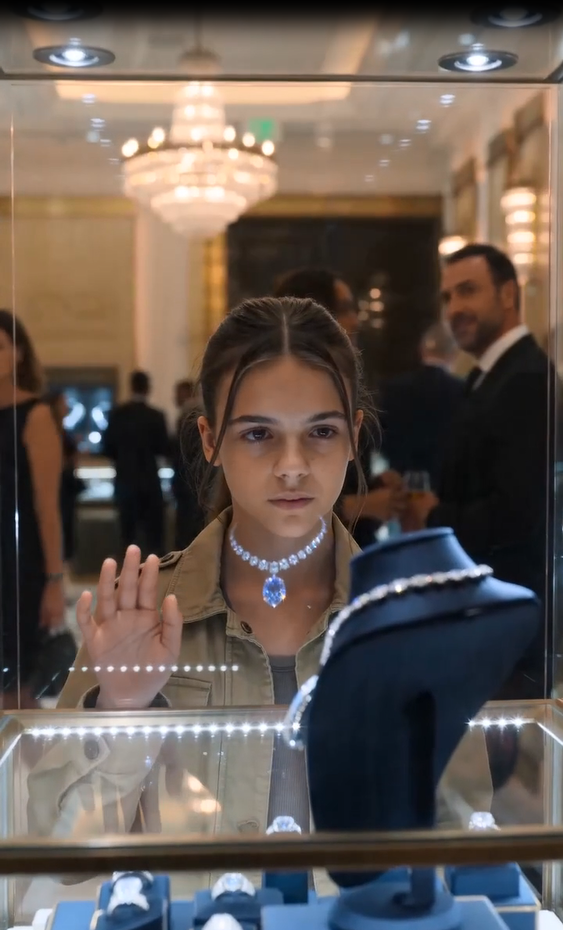
The boutique, “L’Éclat,” was a sanctuary of glass, velvet, and diamonds that cost more than most people earned in a decade. It was the kind of place where status was measured in the weight of gold on one’s wrist and the sharpness of one’s disdain for others.
Elena stood by the display case, her attire a deliberate contrast to the surroundings. She wore a worn, field-grade khaki jacket, her hair pulled back into a messy, utilitarian bun. She was there for a purpose, not a performance.
“Honestly, some people have no sense of decorum,” a voice cut through the air like a razor.
Elena turned to find a woman draped in silk, wearing so many designer logos that she looked more like a billboard than a person. Beside her, a man in a tailored suit snickered, his eyes scanning Elena’s scuffed boots with open contempt.
“I think you’ve stumbled into the wrong neighborhood, sweetie,” the woman continued, her voice dripping with artificial sweetness. “The clearance racks are two blocks down. This is an establishment for people who actually understand the value of a legacy.”
Elena didn’t flinch. She simply adjusted her glasses, her face a mask of serene neutrality. “I’m just waiting for my appointment.”
“Appointment?” The man barked a laugh, loud enough to turn heads. “The only appointment you have is with reality, and it seems you’re failing to show up.”
The woman stepped closer, her nose wrinkled in mock disgust. “Look at this jacket. Did you steal it from a construction site? You’re making the air in here stale. Do us all a favor and leave before the security guard has to embarrass himself by dragging you out.”
The shop fell into a hush. The staff, usually trained to be invisible, hovered nervously, but no one moved. They knew what the woman didn’t: the VIP suite was occupied by the person who owned not just this store, but the global conglomerate that built it.
Elena sighed—a soft, weary sound—and checked her watch. “Everything has its time,” she whispered, more to herself than to them.
Suddenly, the heavy double doors at the back of the boutique swung open with a rhythmic click of brass. The manager, a man of impeccable stature who had treated the wealthy woman with cold efficiency moments before, practically sprinted toward them. He stopped in front of Elena, bowed so deeply his head nearly brushed his knees, and gestured toward the suite.
“Madame Elena,” he said, his voice trembling with a mixture of reverence and terror. “My deepest apologies for the delay. The master collection you requested has been prepared. We were worried you might have been deterred by the… congestion in the main floor.”
The color drained from the woman’s face, leaving her looking like a wilting lily. Her companion, the man who had been laughing, suddenly found his shoes to be the most interesting objects in the universe.
Elena didn’t gloat. She didn’t raise her voice. She simply looked at the woman, her gaze steady and calm. “Confidence is silent,” she said, her voice echoing in the sudden vacuum of sound. “Insecurities, however, are deafening. I suggest you find some silence.”
She walked past them, her khaki jacket brushing against the woman’s expensive silk, and disappeared into the sanctuary of the VIP suite. The boutique remained paralyzed. The manager turned to the couple, his previous veneer of service replaced by a cold, sharp-edged professionalism. “I believe your business here is concluded. Please do not return.”
The weeks that followed were a quiet, surgical dismantling of the woman’s social veneer. It turned out that the couple’s “influence” was built on fragile debt and public perception—things that crumbled the moment Elena’s board of directors decided to pull their business contracts from the firms the man represented.
But the story didn’t end in the wreckage of their reputation.
A month later, a charity gala was held—an event hosted by Elena’s foundation to support underprivileged artisans. She stood on the stage, the same khaki jacket tucked away in her closet, now wearing a simple, understated evening gown.
As she looked out into the crowd, she saw a familiar face. It was the woman from the jewelry store, now dressed in simple, modest clothing. She looked thinner, her eyes stripped of the arrogance that had once defined her. She had lost the wealth, the status, and the shallow friends who had fled as soon as the money dried up.
During the intermission, the woman approached Elena. She didn’t ask for a favor or beg for a return to her old life. She simply stood there, humbled by the crushing weight of her own past actions.
“I spent my whole life thinking that being seen meant I was powerful,” the woman said, her voice shaking. “I realized too late that I was only ever loud.”
Elena looked at her. She saw the genuine pain of someone who had lost everything but had finally found their conscience. Instead of turning her away, Elena signaled to her assistant.
“The artisan collective in the southern district is looking for someone to manage their logistics,” Elena said softly. “They don’t pay in silk or prestige. They pay in purpose. Are you interested?”
The woman froze, her eyes welling with tears. “Why?”
“Because,” Elena replied, “the most luxurious thing you can ever own is the ability to change who you are.”
Years later, the “L’Éclat” incident was spoken of only in hushed, legendary tones. The boutique became a place where wealth was celebrated, but arrogance was treated as a social death sentence. Elena continued to build her empire, but her greatest legacy wasn’t the jewelry she sold; it was the people she empowered.
The woman who had once been the bully became the foundation’s most loyal advocate for humility. She worked in the dirt of the southern district, her hands calloused, her clothes stained, and for the first time in her life, she felt truly expensive.
Elena sat in her office, high above the city, looking out at the skyline. She didn’t need the validation of labels or the noise of public approval. She had found something better: a world that was a little kinder, a little more grounded, and a legacy that was built not on what she possessed, but on what she had given back.
The silence of her office was her greatest treasure, a quiet, golden peace that no amount of money could ever buy.