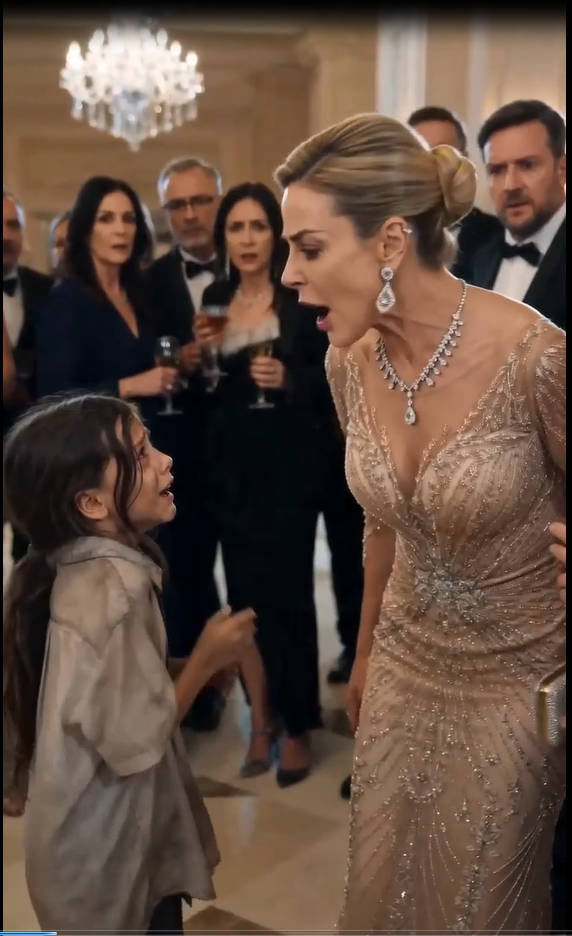
The Grand Aurora Hotel was a temple of artifice. Everything about it—the vaulted ceilings, the gold-leafed moldings, the air that smelled faintly of expensive vanilla and absolute indifference—was designed to make the people inside feel like gods. Isabella stood in the center of the lobby, her champagne-gold silk gown catching the light like a shimmering trap. She was a woman who had curated her life with the precision of a diamond cutter, removing every jagged edge, every inconvenient truth, every ghost that dared to haunt her upward trajectory.
She was currently discussing a merger with a group of investors when a movement at the edge of her vision snagged her attention. It was a child, no older than seven, standing near the towering mahogany doors. The girl was barefoot, her floral dress frayed at the hem, and her skin was smudged with the honest, gritty dust of the city’s outer districts.
Isabella’s lip curled. She gestured sharply to the hotel security, her voice a cold whip. “Marcus, remove that thing. It’s a health hazard, let alone an eyesore. I don’t know how she slipped past the velvet ropes.”
The girl didn’t run. She didn’t cower. She walked forward with a strange, gravity-defying stillness, clutching a piece of paper that looked as if it had been folded and unfolded a thousand times.
“Ma’am,” the girl said, her voice small but steady. “I have a letter for you.”
Isabella didn’t take it. She waved at the security guard to intervene, but the girl was faster. She dropped the note at Isabella’s feet and turned, her bare heels silent against the marble. The guard moved to grab her, but Isabella, driven by a sudden, inexplicable jolt of irritation, signaled him to stop. She would deal with this herself, cast the note into the trash, and be done with it.
She picked up the paper, her diamond-encrusted fingers recoiling from the grime on the edges. She unfolded it, expecting a plea for money or a prank.
Her breath stopped.
Isabella, the handwriting began—a jagged, familiar script she hadn’t seen in seven years. You told me you couldn’t be a mother because you were meant for greatness. You told me the world would never forgive a girl from the slums who walked away from her own blood. I kept my promise. I stayed silent. But I am dying now, Isabella. And I have nothing left to give her but the truth of who she is. This child is Valentina. She is your daughter.
The world inside the Grand Aurora Hotel didn’t just stop; it fractured. Isabella looked up, her vision blurring, and saw the girl—Valentina—standing by the door, waiting. The girl wasn’t looking at the luxury; she was looking at Isabella, her eyes wide, deep, and hauntingly familiar. They were the same eyes Isabella looked at every morning in the mirror, searching for flaws to fix.
Isabella walked toward her. The investors, the champagne, the prestige—it all faded into a dull roar in the background. As she reached the girl, Isabella saw the truth etched into the child’s features: the shape of the jaw, the curve of the brow. Valentina was a living, breathing testament to a life Isabella had tried to erase.
“Valentina?” Isabella whispered.
The girl nodded. “My mama said you’d know who I was.”
Isabella reached out, her hand trembling. She didn’t care about the mud on Valentina’s dress; she didn’t care that the elite of the city were watching. She pulled her daughter into her arms. The silk of her gown began to stain, but for the first time in her life, Isabella felt clean.
Five years later.
The transition had not been easy. It had been a chaotic, painful, and beautiful earthquake. Isabella had stepped down from the board of the Aurora Hotel, trading the hollow prestige of the boardroom for the messy, unscripted reality of motherhood. She had liquidated a significant portion of her assets to ensure Valentina had a life where she didn’t have to grow up wondering if she was wanted.
It was a Saturday morning in the countryside, miles away from the city’s neon-drenched vanity. Isabella was sitting on the porch of a farmhouse, a property she had bought not for its status, but for its garden. She was wearing a simple cotton shirt and denim jeans, her hair pulled back in a messy bun.
Valentina, now twelve, was running through the tall grass with a golden retriever, her laughter ringing out across the fields—a sound Isabella had once deemed “unrefined” but now considered the most beautiful music she had ever heard.
“Isabella!” Valentina called out, sprinting toward the porch. “Look! I finished the sketch!”
Valentina held up her sketchbook. It was a drawing of the farmhouse, the garden, and a woman standing on the porch—not as a socialite, but as a mother.
Isabella took the sketchbook, her heart swelling. “It’s perfect, Val.”
“Are you still sad about the hotel?” Valentina asked, sitting on the step and leaning her head against Isabella’s knee.
Isabella looked out at the rolling hills. She thought of the woman who had walked the halls of the Grand Aurora, draped in champagne gold, terrified that someone might see through the silk to the void beneath. “I’m not sad about the hotel, baby. I’m just grateful I realized that you can’t be great if you’re empty inside.”
“I like us better this way,” Valentina said softly.
“Me too.”
A car pulled up the gravel driveway—an old, reliable truck. Out stepped Julian, a man who had been the local veterinarian, the person who had helped Isabella navigate the early, terrifying days of learning how to be a parent when she had no blueprint. He wasn’t a billionaire. He wasn’t a tycoon. He was a man who spent his days caring for living things and his evenings debating literature with Isabella on the porch.
He walked over, carrying a basket of peaches from the orchard. “The harvest is early this year,” he said, offering a smile that made Isabella feel more seen than any gala guest ever had.
“Perfect timing,” Isabella replied.
As Julian sat down beside them, watching Valentina chase the dog back into the orchard, Isabella felt a profound sense of completeness. She hadn’t just saved her daughter; she had saved herself. She had learned that the “greatness” she had chased was a mirage, a trick of the light in a room filled with mirrors. The real wealth was in the soil, in the laughter of her child, and in the quiet, steady love of a man who didn’t care about her designer gowns.
She had been a woman who feared the dirt, never realizing that you couldn’t grow anything without it. She had finally walked home, not to a palace of marble, but to a home built on truth.
As the sun began to set, casting a golden glow over the farm, Isabella looked at her hands. They were no longer manicured and polished; they were calloused and sun-kissed, stained with the soil of a life that was finally, truly her own. She closed her eyes, listened to the wind in the trees, and knew that the ghost of the woman she used to be had finally been laid to rest. She wasn’t Isabella the socialite anymore; she was simply Mom, and for the first time in her life, that was more than enough.