The Song That Silenced The Town And Exposed The Arrogant Groom
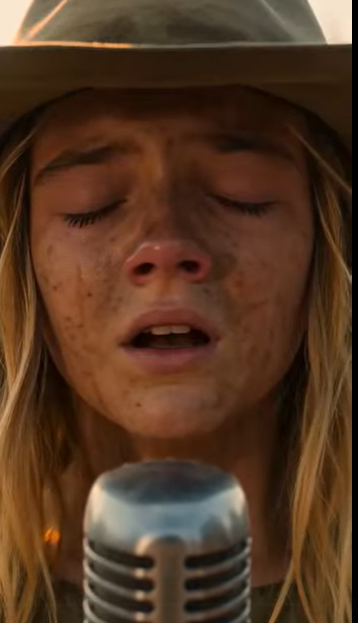
The first note didn’t just drift over the crowd; it hooked into them. It was a low, aching melody, the kind that reminded people of things they had spent years trying to forget. I kept my eyes closed, shielding myself from Jake’s sneering face.
He had expected me to stammer or cry. He had expected the caricature of a broken girl he had spent months crafting for the town’s amusement. As the chorus built, the wood of the stage seemed to vibrate beneath my boots, resonating with the raw, untamed power I had been forced to bury in the dust of these stables.
I felt the shift in the square before I heard it. The heavy, shuffling silence of a hundred men who had suddenly remembered they were human. Jake didn’t move. I could hear his shallow, jagged breathing through the silence, his arrogant confidence dissolving as the melody demanded more than just his mockery.
When I finished, the silence lingered for ten heartbeats, profound and absolute. Then, from the very back of the stands, an elderly rancher stood up. He removed his hat, his face creased with a lifetime of sun and hardship, and simply nodded at me. Then another man stood, and another, until the entire square was filled with men who weren’t looking at me with pity anymore.
I opened my eyes and looked for Jake. He was backed into the corner of the platform, his red shirt looking garish and cheap in the fading orange light. He looked smaller, the microphone in his hand dangling at his side like a useless toy.
Sing, Jake, I whispered into the mic, my voice steady, no longer trembling. You said if I sang, you’d marry me. The microphone amplified my words, carrying them across the square like a verdict.
He didn’t speak. He looked at the crowd, searching for the familiar laughter, the cheers that usually bolstered his ego. There were none. The men were staring at him now, their expressions hardening into something dangerous and protective.
I reached up and unpinned my faded cowboy hat, letting my blonde hair fall over my shoulders. I saw the look on Jake’s face then—the reveal. It wasn’t just shock. It was recognition. He hadn’t just been mocking me for fun; he had been trying to keep me from being seen because he knew exactly who I was.
Ten years ago, my father had been the most respected man in this territory, a cattle baron who had disappeared during a land dispute, leaving his fortune to be devoured by the vultures who claimed to be his friends. Jake was the son of the man who had orchestrated my father’s fall. He hadn’t married me to possess me; he had married me—or tried to—to keep me silenced so I could never claim what was stolen.
The realization hit me with the force of a landslide. Every cruel comment, every forced labor shift in the stables, every moment of humiliation—it was all a strategy to keep me broken so I would never look into my family’s records.
I walked off the stage, my boots clicking firmly against the wooden floor. I didn’t head for the stables. I headed straight for the sheriff’s desk, which sat near the front of the stands. Sheriff Miller had been my father’s deputy once, back when this town had a soul.
Sheriff, I said, my voice cutting through the remaining whispers. I have a question about my father’s estate. And I believe the man on that stage has all the answers.
Jake tried to bolt, but two of the ranch hands who had listened to my song blocked his path. They didn’t hit him, but they didn’t let him pass. They looked at me, waiting for a command.
I didn’t want violence. I wanted the truth. I walked up to Jake, standing just inches away from him. He smelled of cheap cologne and desperation. You thought I was a punchline, Jake, I said. But punchlines are only funny if you keep the audience from seeing the truth.
I reached into his coat pocket—the one he always kept guarded—and pulled out a small, leather-bound book. He had dropped it once near the feed bins, and I had recognized the crest on the cover. It was my father’s ledger. The one that detailed every single land grab, every bribe, and every illicit contract signed during the months leading up to his disappearance.
The crowd surged forward, the murmurs turning into a roar. The men who had been Jake’s drinking buddies a few minutes ago were now the ones shouting for the ledger to be read aloud. They weren’t just protecting me; they were claiming back their own dignity, the dignity he had eroded by turning their home into a playground for his own cruelty.
I handed the ledger to the sheriff. It’s all in there, Sheriff. The signatures, the dates, the offshore accounts. The man who orchestrated my father’s death and the man who currently sits in the governor’s office.
The shift in the room was palpable. Jake didn’t try to argue. He knew that the moment that ledger was opened, his life as the town’s golden boy was over. He sank to his knees, his face pale and sweating, realizing that the girl he had tried to bury under layers of dust and silence was the one holding the shovel.
I walked away from the stage, away from the square, and toward the house on the hill that had been empty for a decade. It was overgrown, the windows shattered and the porch rotted, but it was mine. I didn’t look back at the chaos I had left behind. I heard the sirens in the distance, the sound of the world finally righting its axis.
When I reached the top of the hill, the sun had fully set. The stars were out, piercing the darkness with a cold, clear light. I felt lighter than I had in years. The hunger, the fear, the shame—it was all gone.
The next morning, the town began to change. The vultures were fleeing, and the people who had been quiet for too long were starting to speak. I sat on my porch, drinking coffee from a chipped ceramic mug, watching the sunrise. I wasn’t the girl in the moss-green dress anymore. I was the woman who had reclaimed her voice, and with it, her future.
I didn’t need the fortune, not really. I just needed to know that I hadn’t been forgotten, and more importantly, that I hadn’t forgotten myself. The house needed repairs, the fields needed to be tilled, and the town needed to be rebuilt from the ground up. I had the ledger, I had the support of the people, and for the first time in my life, I had the freedom to be exactly who I was meant to be.
I closed my eyes, listening to the wind move through the pines. It was a quiet sound, steady and persistent. It wasn’t a song of mourning, or a song of defiance. It was a song of beginning. I took a deep breath, the air clean and crisp, and started to hum. It was just a small, simple melody, but as it drifted down the hill and toward the town, I knew that this time, it wouldn’t just be heard. It would be followed.