The Anchor in the Asphalt
The city of Oakhaven was a relentless machine of steel, glass, and indifference. It thrived on momentum, a blur of yellow cabs, urgent pedestrians, and the hum of a million lives moving too fast to notice the one breaking down in the shadows. For Elena, the city was no longer a home; it was a weight.
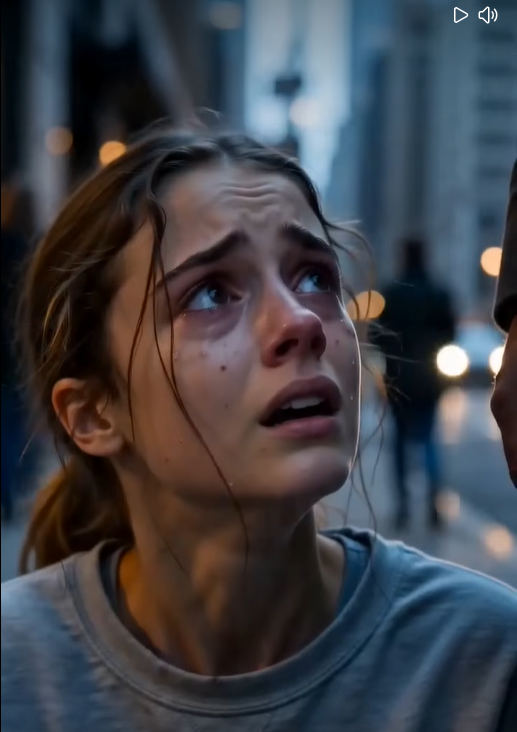
She stood at the edge of a concrete plaza, the evening air biting into her skin. For months, she had been drowning in the quiet, suffocating desperation of a life dismantled. She had lost her job, her small apartment, and the fragile sense of security that had anchored her to the world. She felt like a ghost haunting her own existence, a face in the crowd that no one would miss if she simply vanished into the neon-lit haze.
Her hand tightened around the strap of her bag—the only thing she had left. Tears, hot and jagged, blurred her vision until the streetlights became smears of sickly yellow. She was at the precipice. Her heart felt like a hollow cavity, echoing with the sound of every door that had been slammed in her face. Just one more step, she thought, her feet inching toward the busy intersection where the traffic roared like an angry ocean. Just let go.
Suddenly, a sharp, insistent tug pulled her backward.
Elena stumbled, a gasp escaping her lips, and she braced herself for a struggle, convinced a thief had finally decided to finish off her remaining pride. She spun around, ready to scream, ready to fight, but the sight that met her eyes froze the breath in her chest.
It wasn’t a person. It was a Golden Retriever, his fur matted with the grime of the city, his eyes an intelligent, soulful amber. He wasn’t growling; he was sitting firmly, his teeth gently gripping the strap of her bag, pulling her away from the curb and back toward the safety of a stone bench.
“Hey,” a voice came from the darkness nearby. It was low, gravelly, and laced with a surprising warmth.
Elena blinked, wiping her eyes frantically. A man stepped out from behind a concrete pillar. He was older, wearing a worn-out coat that had seen better decades, but he possessed a stillness that felt entirely alien to the frantic energy of Oakhaven. He didn’t look at her with pity or judgment; he looked at her with a profound, quiet recognition.
“Barnaby doesn’t take things,” the man said, gesturing to the dog. The retriever let go of the strap, wagged his tail once, and sat perfectly still, resting his chin on Elena’s knee. “He just likes to make sure people know where they’re standing.”
Elena felt her knees buckle. She sank onto the bench, the weight of the last few months crashing down on her all at once. The sobs she had been suppressing for weeks tore through her, raw and unvarnished. She didn’t know this man, and she didn’t know the dog, but the presence of the animal—the steady, warm pressure of his head against her leg—acted like a physical anchor, keeping her from drifting away into the dark.
The man sat at the far end of the bench, giving her the space to fall apart. He didn’t speak for a long time, allowing the sounds of the city to swallow her grief. Only when her breathing began to hitch into uneven gasps did he reach into his pocket and pull out a thermos, pouring a cup of tea that smelled faintly of chamomile and earth.
“I’ve been where you are,” he said softly, looking out at the skyline. “I spent a year believing the world was better off without me. But then I found Barnaby in a dumpster behind a diner, and he reminded me that even in the middle of a concrete jungle, life still wants to breathe.”
He held out the cup. Elena took it, her fingers trembling. The heat seeped into her palms, a small, tangible miracle.
“My name is Elias,” he continued. “I run a small community kitchen on 4th Street. It’s not much, but we have a spare room for someone who needs a moment to catch their breath. No strings, no expectations. Just a place to be until you remember who you are.”
Elena looked down at Barnaby. The dog looked up at her, his amber eyes blinking slowly, as if he knew exactly what she was deciding. For so long, she had felt like a burden—to her family, to her friends, to the world. But here was a stranger offering a lifeline, not out of obligation, but out of a shared understanding of the darkness.
“Why?” she whispered.
Elias smiled, a small, weary expression that didn’t reach his eyes but reached his heart. “Because the world is too loud to be lonely in, Elena. Sometimes, the universe sends you a sign, but you have to be the one to reach out and take it.”
She looked at the busy intersection, then back at the man and the dog. The chaotic, uncaring city was still roaring, but the center of her world had shifted. The decision felt heavy, but for the first time in an eternity, it wasn’t a decision to end, but to begin.
Five years later, the city of Oakhaven was still loud, but it was no longer a place of fear for Elena.
She stood in the doorway of a bright, bustling community center on 4th Street. The space was filled with the smell of fresh bread, the sound of laughter, and the hum of people who had once been lost but were now finding their footing.
Elena adjusted her apron, watching as a group of volunteers unpacked crates of fresh produce. Beside her, a slightly greying Golden Retriever nosed at her hand, his tail thumping rhythmically against the floorboards.
Elias walked into the room, leaning on a cane but moving with a grace that came from a life of purpose. He paused beside her, watching the vibrant chaos of the kitchen.
“You know,” Elias said, “I still remember the night we found you. Barnaby knew before I did.”
Elena reached down and scratched the dog behind his ears. Barnaby leaned into her touch, his eyes still holding that same profound, grounding intelligence.
“I was so ready to give up,” Elena said, her voice steady and full of life. “I thought miracles were just fairy tales told to people who were still hopeful.”
“They aren’t fairy tales,” Elias replied, patting her shoulder. “They’re just people, showing up for each other when the night gets too long.”
As the sun began to set, casting a golden glow over the city skyline, Elena didn’t see a landscape of cold glass anymore. She saw a tapestry of stories, each one a thread in a larger, more resilient fabric. She had been saved by a stranger and a dog, but she had stayed because she realized that she was now that anchor for someone else.
In the heart of the city that never stops, she had found something more permanent than success or status. She had found a purpose, a community, and a family that had started with a single, desperate moment on a dark bench. She looked at the door, ready for the next person who might walk in, ready to offer the same miracle that had once saved her.
The city was vast, and the world could still be incredibly lonely, but for the first time, Elena knew that as long as they kept showing up for each other, no one ever really had to walk the dark alone.