The gallery was a sterile expanse of white marble and hushed whispers, a place where the elite came to confirm their own importance. Julian Vane moved through it like a predator in bespoke tailoring. To Julian, art was not a medium for expression; it was a commodity, a currency of status he used to reinforce his standing in the high-stakes world of international finance and political maneuvering.
Standing before a canvas tucked away in the gallery’s most secluded alcove, he sneered. The painting was chaotic, a violent fusion of geometric blueprints and organic, swirling pigments that seemed to vibrate against the canvas. It was the work of Elara Vance, a young woman who spent more time covered in industrial grease and acrylics than in cocktail dresses. To Julian, it was an eyesore—a jagged, nonsensical smudge that offended his sense of rigid order.
“Trash,” he muttered, his voice echoing in the minimalist hall.
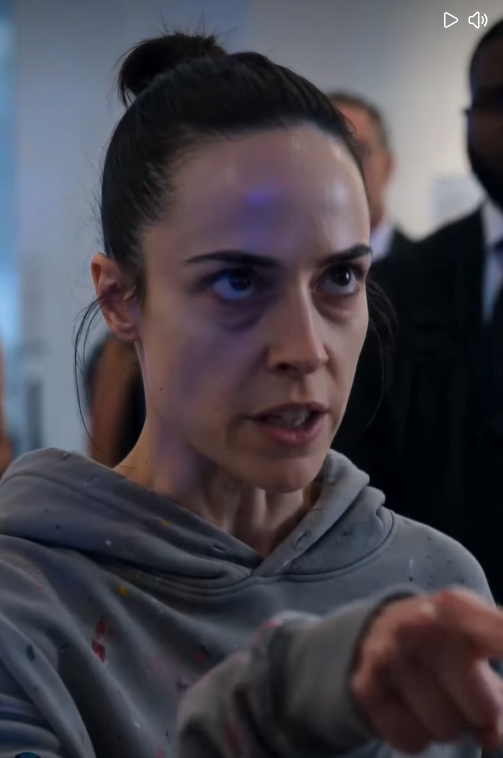
Elara stood nearby, her hands shoved into the pockets of her paint-splattered hoodie. She was slight, unassuming, and watched Julian with a gaze that was disturbingly placid.
“It is a draft,” Elara said, her voice steady. “I wouldn’t touch it if I were you.”
Julian turned, his lip curling in contempt. “Do you think your little protest art holds any weight here? You are a guest in my world, girl. People like you exist to provide décor, not to dictate terms.”
With a sudden, calculated movement, Julian swept his arm across the canvas, knocking the easel over. The frame hit the marble floor with a sickening, crystalline crunch. Shards of protective glass scattered like diamonds, shredding the center of the painting. Julian stood over the ruin, breathing heavily, feeling the intoxicating surge of dominance. He had silenced her. He had imposed his will upon her mess.
Elara didn’t scream. She didn’t weep. She simply looked at the wreckage and then back at Julian. A strange, eerie silence filled the room—a vacuum that seemed to suck the warmth out of the air.
“You’re making a mistake,” she whispered. It wasn’t a plea; it was a cold, objective fact.
Suddenly, the heavy glass doors at the entrance burst open. The sound was not the polite chime of a gallery opening, but the heavy, rhythmic thud of combat boots. Within seconds, the room was flooded with the sharp, clinical light of tactical flashlights. Federal agents in dark windbreakers moved with surgical precision, encircling the room, but their weapons were holstered. They were protecting, not attacking.
Julian blinked, his arrogance faltering as a man in a sharp charcoal suit—a man Julian recognized as the Chief Liaison to the Ministry of National Security—strode toward them. Julian straightened his silk tie, his chest puffing out. “About time. This girl was vandalizing the—”
The Liaison ignored him entirely. He bypassed Julian as if he were a ghost, stopping directly in front of Elara. He pulled a pristine, white cloth from his pocket and, with a gesture of profound reverence, cleared a space on a nearby pedestal. He then bowed—a deep, professional, and entirely genuine bow.
“Director Vance,” the official said, his voice echoing in the hushed room. “We have been waiting for the final schematics. The decryption key was embedded in that canvas, wasn’t it?”
Julian’s face went bloodless. “Director? She’s… she’s an artist.”
Elara wiped a smudge of oil paint from her cheek, her eyes fixed on the man who had just destroyed her work. “I am an architect of kinetic defense systems, Mr. Vane. The government commissioned that piece because it was a visual representation of the city’s new power-grid encryption. Every brushstroke was a line of code. Every color was a firewall.”
She gestured toward the jagged hole in the center of the shattered painting. “You didn’t just ruin a painting. You tore out the core processor of the national defense infrastructure. That canvas was the only physical copy of the Master Key. The digital backup was synced to its structural integrity.”
The Liaison’s eyes turned toward Julian. The look was not one of anger, but of cold, bureaucratic finality. “Mr. Vane, do you have any idea what happens when a national security asset is destroyed on your watch? You have effectively sabotaged the defense of this city. You’ve just committed an act of state-level treason.”
Julian’s knees buckled. He reached out to grab the edge of the pedestal, but the weight of his own ignorance pressed down on him like a physical mountain. The “power” he had felt moments ago vanished, revealed as nothing more than the fragile vanity of a small man playing in a world he didn’t understand.
“I… I didn’t know,” Julian stammered, his voice cracking.
“That is exactly why you are dangerous,” Elara said softly. She walked toward the exit, pausing only to look at the destruction one last time. “Some people play with fire, Julian. They forget that others spend their entire lives mastering the flame.”
As the agents moved in, the gallery lights dimmed. The scene was a stark, final image: the elite man, broken and trembling, surrounded by the very status symbols he once worshipped, and the young woman in the hoodie, walking out into the night to begin the task of rebuilding a safer world.
Six months later, the city stood transformed. The “trash” that Julian had tried to destroy had been translated into a marvel of modern engineering—a resilient, impenetrable grid that kept the city’s heart beating.
Elara sat in a sun-drenched studio, far from the cold marble of the gallery. Her new project, a complex geometric installation, hung on the wall. It was vibrant, alive, and protected.
She picked up a letter on her desk—a formal notification from the courts. Julian Vane had been sentenced to years of supervised rehabilitation and full restitution, his assets liquidated to fund the very projects he had once mocked. He had spent his life valuing the gilded frame over the truth within, and in the end, the truth had dismantled him.
Elara smiled, picking up her brush. She didn’t hold grudges; she held blueprints. She dipped her brush into a deep, defiant crimson, looking out at the skyline of a city that was now secure, vibrant, and entirely, beautifully her own. The storm had passed, and in its wake, she had built a legacy that no amount of arrogance could ever shatter.