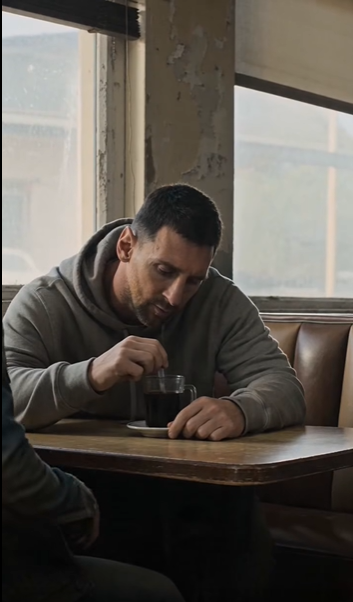
The air inside L’Éclat, the city’s most exclusive dining establishment, was thick with the scent of truffle oil and the heavy, expensive perfume of the social elite. Crystal chandeliers cast dancing reflections over diners who held their forks like scepters. At the center table sat Julian Vane, a titan of industry known for his ruthless corporate takeovers and his cold, calculating gaze. Today, he was hosting a celebratory luncheon, the air vibrating with the hollow laughter of sycophants who hung on his every word.
The double doors of the restaurant swung open with a violent thud.
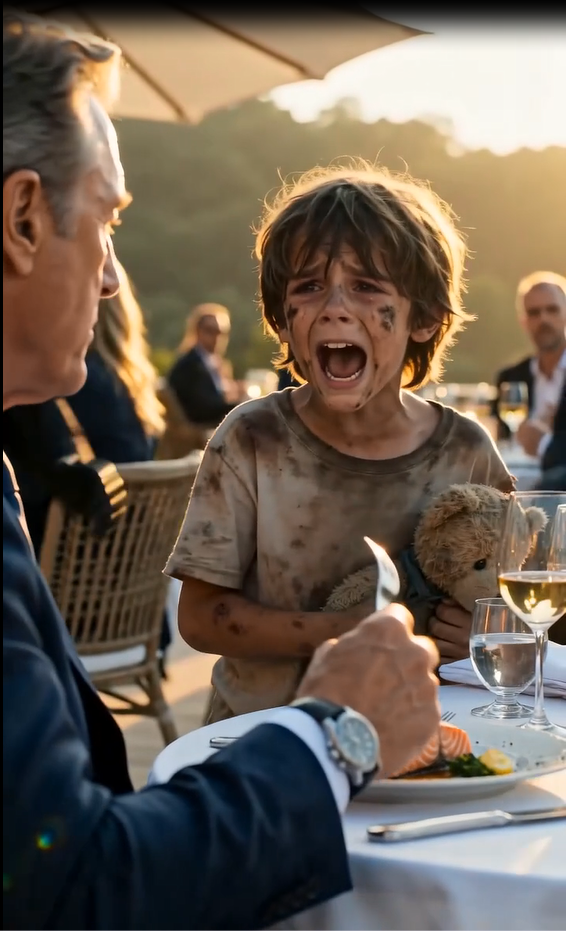
The security guards moved with practiced, predatory grace, but they were a second too late. A boy, no older than ten, scrambled into the room. He was a portrait of chaos in a place defined by order. His clothes were torn, caked in dried mud from the nearby construction site, and his face was smeared with soot. He clutched a tattered, one-eyed teddy bear to his chest as if it were a shield against the world.
“Get him out of here!” one of the waitstaff hissed, moving to intercept the boy.
The boy ignored them. His eyes, wide and frantic, darted across the room until they locked onto Julian Vane. He lunged forward, breaking through the perimeter of the security guards who were too shocked by the intrusion to react immediately.
“Stop!” the boy screamed, his voice cracking. He didn’t care about the gasps from the surrounding tables or the way the patrons recoiled as if he were carrying the plague. He reached the table, his hands trembling as he pointed a mud-stained finger at the crystal goblet of vintage wine currently being lifted to Julian’s lips. “Don’t drink it! It’s poisoned!”
The silence that followed was absolute. It was the heavy, suffocating silence of a grave.
Julian Vane paused, his glass halfway to his mouth. He looked down at the boy with a look of pure, unadulterated disgust. “Security,” he said, his voice a low, dangerous rumble. “Remove this filth from my sight before I lose my appetite.”
The boy didn’t retreat. He grabbed the tablecloth, his knuckles white. “I saw them, sir! The man in the gray coat in the alley. He put something in the bottle. I saw the powder—it was blue! Please, you have to believe me!”
A ripple of nervous laughter broke out among the guests, but it was hollow. Julian stared at the boy, his irritation warring with a strange, flickering intuition. The boy’s eyes weren’t those of a beggar; they were the eyes of a witness.
Just as the guards gripped the boy’s shoulders to drag him away, Julian’s long-time business rival—a man who had been sitting at the table, smiling thinly—suddenly stood up, his face losing all color. He made a sharp, panicked movement toward the door.
The shift in the room was palpable. Julian looked at his rival, then back at the boy, whose chest was heaving with exertion.
“Hold him,” Julian commanded, his eyes narrowing. He set the wine glass down on the white linen—a single centimeter away from his own lips. He signaled to his own security detail, who expertly blocked the rival’s path to the exit. “Test the wine,” Julian ordered.
The next few minutes were a blur of hushed whispers and cold, hard reality. A sommelier, shaking visibly, brought over a testing kit. As the solution touched the wine, the liquid turned a deep, bruised violet.
The room erupted. The rival tried to bolt but was tackled by Julian’s men. The police sirens began to wail in the distance, a screeching counterpoint to the quiet, dignified terror that had replaced the elegance of the lunch.
Julian Vane remained at the table, his face a mask of shock. He looked at the boy, who was still being held by the guards, his eyes still brimming with the terror of what he had seen.
“Let him go,” Julian said, his voice uncharacteristically soft.
He stood up and walked around the table. He stood before the child, the man who owned half the city’s skyline dwarfed by the boy in rags. He looked at the tattered teddy bear—a symbol of a childhood lost to the streets—and then back at the boy.
“Why?” Julian asked. “Why would you save me? I’m the man who pushed your family out of the tenement housing on 4th Street. You saw me on the news. You know who I am.”
The boy looked up, his voice barely a whisper but clear as crystal. “My mom told me that being poor doesn’t mean being heartless. She said that even if someone is a monster, you don’t let them die if you can stop it. She taught me to be better than the world treats me.”
Julian felt something shatter inside him—not his glass, but the armor he had built around his heart for thirty years.
The story didn’t end with a headline about a near-assassination. It ended with a quiet resolution. Julian Vane, moved by an act of radical, unearned mercy, changed his life that day. He didn’t just donate money; he took responsibility.
The boy, whose name was Leo, was never hungry again. Julian ensured that Leo was enrolled in the best school in the country, and he founded a scholarship program for the children of the tenement houses he had once callously dismantled. The tattered teddy bear was retired, kept in a glass display case in Julian’s office—not as a trophy of wealth, but as a reminder of the day a boy in mud taught a man in a suit what it actually meant to be powerful.
The world is full of people looking for power in boardrooms, wearing the sharpest suits and carrying the heaviest influence. But sometimes, the most important voice in the room is the one we ignore. And sometimes, the smallest hands are the ones that hold the fate of a titan. Julian learned that he wasn’t saved by his guards, his wealth, or his status. He was saved by the humanity of a child he had deemed “filthy.”
In the end, Julian realized that true luxury wasn’t in the wine, the chandeliers, or the prestige. It was in the grace of a second chance, gifted by someone who had absolutely nothing to gain and everything to lose. And he finally understood that the most dangerous thing on the menu wasn’t the poison—it was the arrogance that made him think he was too important to listen.