The suburb of Willow Creek was the kind of place where people painted their fences white and their lives in shades of beige. It was a neighborhood of quiet compliance, where the only thing louder than the lawnmowers was the unspoken agreement to mind one’s own business.
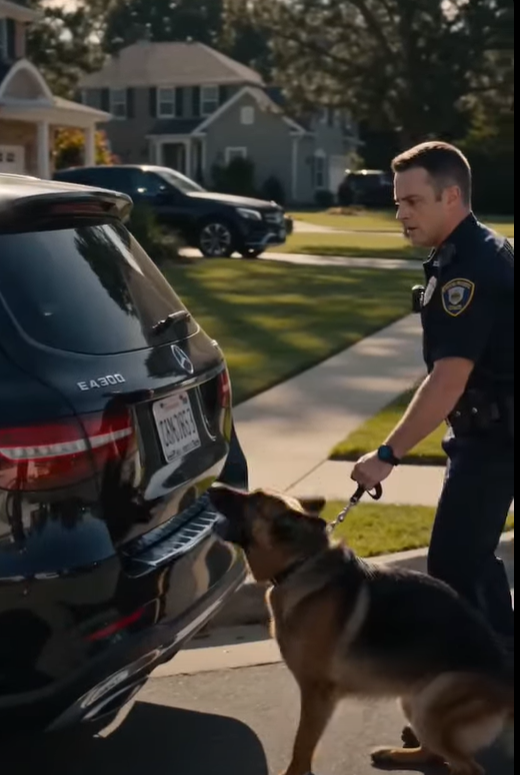
Officer Marcus Thorne, a man whose K-9 partner, a battle-hardened German Shepherd named Brutus, was legendary in the precinct for his nose, was conducting a routine traffic stop. The glossy black Mercedes had been swerving, its driver clearly agitated. When Marcus pulled the vehicle over to the curb—a pristine stretch of sidewalk framed by hydrangeas—he expected a DUI or perhaps a reckless driving citation.
He did not expect the dog to lose his mind.
As Marcus approached the rear of the car, Brutus didn’t just growl. He let out a low, guttural vibration that Marcus felt in his own marrow—a sound of primal, unadulterated terror. Suddenly, Brutus lunged, his claws screeching against the Mercedes’ expensive paint, his hackles raised so high he looked like a wolf caught in a storm. He was screaming, a sound that was less of a bark and more of a panicked plea.
“Brutus, sit!” Marcus commanded, but the dog didn’t listen. Brutus was fixated on the trunk, his body trembling, his eyes dilated to black pinpricks.
The driver, a woman named Clara, stumbled out of the car. Her face was a mask of jagged, broken glass. She wasn’t just nervous; she was vibrating with a secret so heavy it seemed to be crushing her ribs. “Officer, please,” she gasped, her hands hovering near her mouth. “You don’t understand. Just let me go. Please.”
Marcus felt the hair on his arms rise. The air around the Mercedes felt unnaturally cold, a localized pocket of winter in the middle of a July afternoon. He reached for his radio, but his hand stopped mid-air. He looked at the trunk, then at Clara’s pleading, terror-stricken eyes.
“Open it,” Marcus said, his voice barely a whisper.
“No,” Clara sobbed. “If you open it, it won’t be able to go back.”
Marcus didn’t wait. He moved with a practiced, heavy-footed caution, his hand resting on the holster at his hip. He pressed the trunk release.
The lid popped open with a hiss of hydraulic pressure.
Marcus braced himself for a body, a weapon, a stash of narcotics—anything tangible. But as the lid lifted, there was only a vast, pitch-black void. It wasn’t just darkness; it was an absence of light, a vacuum that seemed to suck the ambient warmth out of the street. Brutus let out a final, pained whimper and retreated, tucking his tail between his legs, hiding behind Marcus’s boots.
Marcus stared. Inside the trunk was not a cavity, but a portal—a swirling, viscous shadow that seemed to pulse like a living heart. He felt a tug in his chest, a sense of grief so profound it brought tears to his eyes, and he realized with a jolt of horror that he wasn’t looking at a crime, but a containment.
The Aftermath
The nightmare that came to light wasn’t a monster; it was a manifestation of trauma.
As the minutes stretched, Marcus realized the truth. Clara wasn’t a criminal. She was a curator of pain. She explained, through agonizing sobs, that she was a researcher—a scientist who had been studying the physical properties of grief. She had discovered a way to isolate the “weight” of human suffering, a byproduct of an experiment meant to help the chronically depressed. But the experiment had gone wrong. The grief had gained mass, a sentient, negative energy that was slowly consuming her life. She had been trying to drive it to a containment facility three states away, terrified of what would happen if the energy leaked into the world.
Marcus didn’t call for backup; he knew the precinct would only try to seize it, and he saw the ruin it had already inflicted on Clara. Instead, he called his brother, a physicist who had spent his life working in the shadows of theoretical science.
The containment took six hours. By the time they successfully stabilized the energy into a lead-lined canister, the street was bathed in the soft, bruised colors of twilight. Clara sat on the curb, her face finally reflecting a sense of peace she hadn’t known for years.
“I can breathe,” she whispered, her hands finally ceasing their tremors.
Marcus watched as his brother drove away with the canister, promising to place it somewhere it could be safely neutralized. He looked at Clara, then at Brutus, who had crept out from behind his legs, sniffing the now-empty trunk with cautious curiosity.
“You’re free,” Marcus said.
Clara looked up, the lines of terror around her eyes softening. “I’m free.”
In the months that followed, the story of the “Mercedes Void” was quietly hushed up, filed away under a classification that Marcus never talked about. But the change in his life was profound. He resigned from the force, feeling that he had stared into the heart of something that made badge-carrying feel trivial.
Clara and Marcus began to work together. Using the funding from a private foundation interested in the containment of “emotional energy,” they turned that research into a force for good. They created centers for grief-stricken families, places where they could “offload” their burdens into specialized, calming environments that helped people process trauma rather than letting it manifest.
A year later, Marcus stood in the center of one of these new clinics. The halls were bright, filled with the hum of gentle music and the smell of jasmine. He saw Clara in the distance, laughing—a real, vibrant sound—as she guided a young couple through a session. Brutus, now an older and wiser dog, was lying at her feet, basking in the sunlight that poured through the large, un-voided windows.
Marcus felt a hand on his shoulder. It was his brother.
“They’re doing good work, aren’t they?” his brother asked.
Marcus smiled, watching as a child ran across the lawn outside, free of the shadow that had once threatened to swallow his mother. “They’re turning the darkness back into light,” Marcus said. “And for the first time, it feels like the neighborhood is finally at peace.”
The black Mercedes was long gone, sold for parts, but the impact of that day remained. They had learned that even the darkest voids could be filled if you were willing to face them. In the quiet suburb of Willow Creek, the lawns were still perfectly manicured, the fences were still white, but now, for the first time, the people inside the houses felt just a little bit lighter. The nightmare had finally been brought to light, and in doing so, it had paved the way for a dawn that would never end.