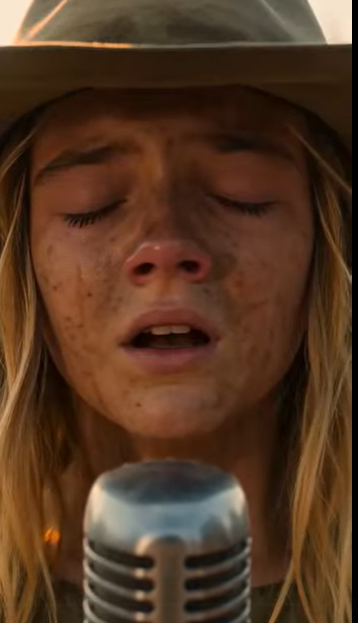
The desert heat in the Atacama Basin wasn’t just a temperature; it was an entity. It pressed against the skin, sucked the moisture from your lungs, and turned the horizon into a shimmering, deceptive lie.
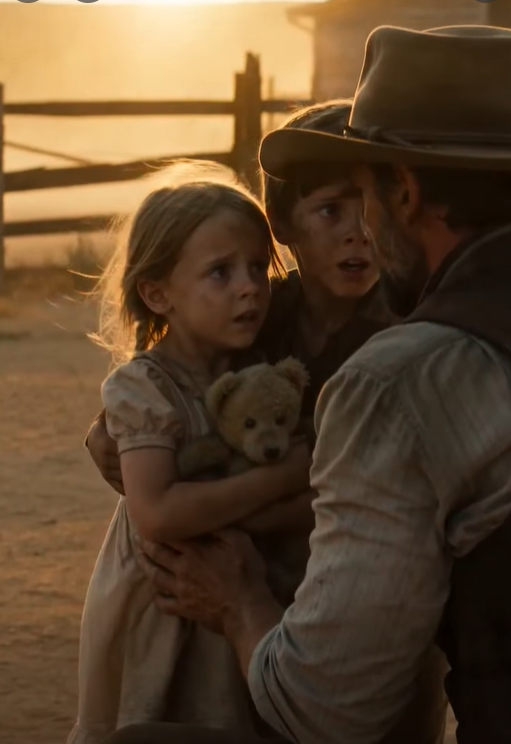
Ten-year-old Javi stood in the shade of a rusted corrugated tin shack, his hand clamped so tightly around his seven-year-old sister, Mia, that his knuckles had turned white. They had been walking for three days. Their water was gone, their shoes were soles-only, and behind them, the rhythmic, guttural hum of black SUVs had been closing the distance like sharks sensing blood in the water.
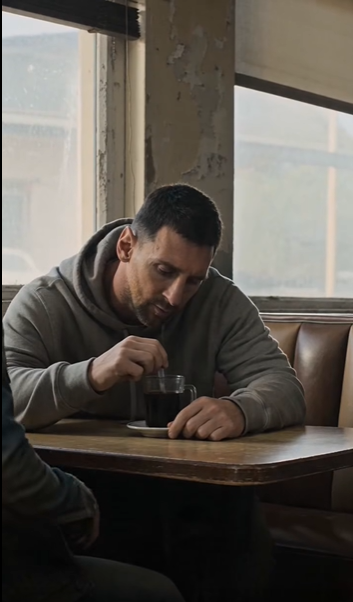
They had reached the only building for fifty miles—a weather-beaten outpost that looked like it had been discarded by time. On the porch sat a man. He didn’t look like a hero. He looked like the desert itself: cracked, weathered, and indifferent. He was sipping black coffee from a chipped mug, his eyes fixed on a point in the distance that Javi couldn’t see.
Javi stumbled onto the porch, his voice a dry rasp. “Please… hide my sister.”
The man didn’t flinch. He didn’t even turn his head. He looked at Javi, his eyes the color of flint—hard, grey, and utterly steady. He didn’t ask questions. He didn’t ask about the cartel scouts or the cargo Javi was carrying. He simply set his mug down on the wooden railing.
“Cellar,” the man said, his voice like rocks grinding together. “Bottom shelf behind the salt sacks. Don’t breathe until I say so.”
He moved with a fluid, predatory grace that betrayed his ragged appearance. Within seconds, the children were tucked away in the cool, subterranean dark. The man returned to his porch, retrieved his coffee, and sat back down.
Two minutes later, the peace of the morning was shredded.
Three matte-black armored trucks surged over the ridge, kicking up a wall of dust that blotted out the sun. They drifted to a stop in front of the shack, doors flying open. Six men in tactical gear emerged, weapons raised, led by a man in an expensive suit who looked entirely too clean for the middle of a wasteland.
The man in the suit strode toward the porch. “Where are the kids, Silas?”
Silas—the cowboy—took a slow sip of his coffee. He looked at the man, then at the dirt beneath his boots. “Hard to say,” he murmured. “Wind’s been blowing hard all morning. Could be anywhere.”
The man in the suit chuckled, a thin, cruel sound. “Don’t play the hermit with me. We know you were Special Ops. We know you’re not just a guy who likes bad coffee. Give them to me, and we won’t burn this place with you inside.”
Silas sighed, a sound of genuine disappointment. He set his mug down again. This time, he didn’t pick it up.
“You should’ve left the coffee alone,” Silas said.
In a blur of motion that defied human reaction time, Silas reached beneath the floorboards of the porch. When he rose, he was holding a customized carbine that looked like it had been forged in the depths of a nightmare. He didn’t fire wildly. He fired with the clinical, terrifying precision of a man who had spent his youth auditing death.
Three shots. Three men down.
The remaining mercenaries scattered, shouting orders. The man in the suit dove behind a truck, his composure finally shattering. Silas vaulted off the porch, his movements transitioning from the slow, deliberate pace of a shepherd to the lethal efficiency of a ghost. He became a shadow darting between the trucks, his rifle barking rhythmically.
The standoff lasted less than two minutes. When the last mercenary collapsed into the sand, silence rushed back into the desert, heavier than before. Silas stood amidst the wreckage, his chest barely rising, his face devoid of triumph. He walked back to the shack, his boots crunching on the spent casings.
The Aftermath
The cellar door creaked open, letting in a shaft of blinding, unforgiving light. Mia let out a small, terrified whimper, clutching Javi’s shirt.
“It’s over,” Silas said.
He didn’t bring them out into the sun right away. He brought them water—cold, life-giving water—and waited until their breathing leveled out. He didn’t tell them he was a hero; he told them he had been a man who had forgotten why he was alive until he saw a brother holding his sister’s hand.
Silas knew he couldn’t stay. He knew the people who sent those men wouldn’t stop at one group of scouts. He bundled the children into the back of one of the armored trucks, leaving his shack and his coffee behind.
He drove for fourteen hours until they reached the border of a sanctuary he hadn’t visited in years—a remote ranch owned by an old friend, a woman who ran a network for those who had nowhere else to go.
As the truck engine cut out, Javi climbed out, his legs wobbly, Mia still clutching his hand. The rancher, a kind woman with silver hair, was waiting at the gate. She didn’t ask questions either. She took the children, embracing them with a warmth that Javi hadn’t felt in a lifetime.
Silas stood by the truck, his hands deep in his pockets.
“You’re not coming in?” Javi asked, his voice thick with emotion.
Silas looked at the horizon. The desert sunset was beginning to bleed crimson across the sky. “My road’s a different one, kid. But you’re safe here. These people… they have a light that doesn’t go out.”
Javi looked at the man who had traded his quiet life for their safety. He didn’t know what to say, so he did the only thing he could. He walked over and hugged the man’s waist. Silas froze for a second, his shoulders rigid, before he slowly, tentatively, placed a hand on the boy’s head.
“Go on now,” Silas whispered.
As the children disappeared into the ranch house, Silas turned back to the truck. He looked at the empty seat, then at the endless, shimmering expanse of the desert. For the first time in twenty years, he wasn’t running from his past, nor was he hiding from his future. He was a man who had finally earned his rest.
He didn’t head back into the void. He pulled out his phone, dialed a number he had promised never to use again, and spoke only three words: “I’m coming home.”
He left the truck, walked toward the gate, and knocked. When his sister—the one he had lost track of a decade ago—opened the door, the look of shock on her face was worth more than all the gold in the world. He was still a man of few words, and his hands were still scarred, but as he stepped across the threshold, he knew the war was over. He had saved a brother and a sister, and in doing so, he had finally saved himself.
The desert wind howled, but for the first time in his life, Silas didn’t hear the ghosts. He heard the sound of a family dinner being set, and for a man like Silas, that was the greatest victory of all.