The hospital corridor of St. Jude’s Memorial smelled of antiseptic and panic. It was a sterile cage where life was measured in fluctuating heart-rate monitors and the rhythmic beep of monitors.
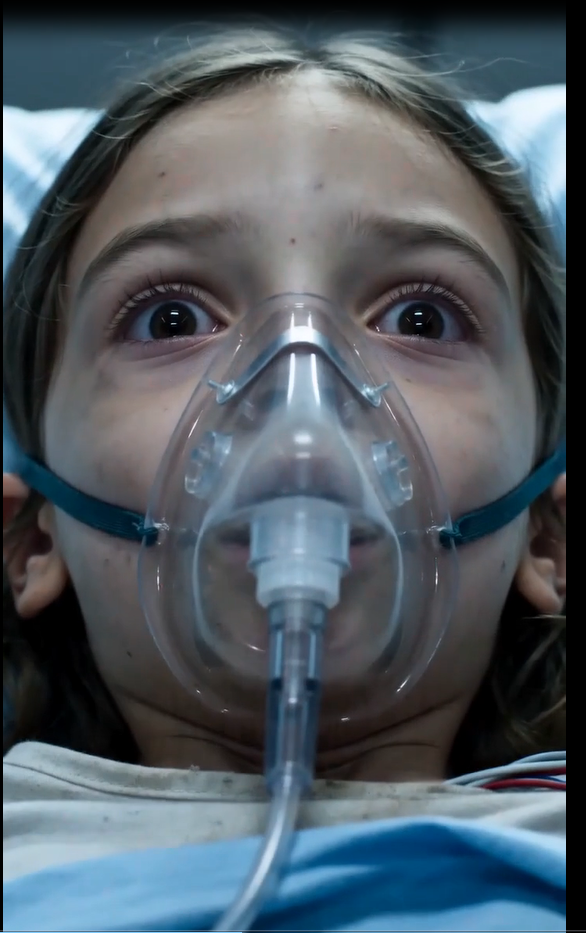
Julianna, the daughter of a titan, lay on the bed, her skin porcelain-pale, her breaths shallow, jagged gasps that seemed to tear at her frail frame. The lead physician, Dr. Aris, was shouting, his voice tight with the frantic edge of defeat. “Her systems are failing! She’s slipping away!”
Arthur, her father, stood pressed against the wall, his face a mask of primal terror. He had spent his fortune trying to buy her safety, but in this room, money was paper-thin.
Then, the doors burst open.
It wasn’t security. It was a boy, no older than sixteen, barefoot and caked in the grime of the local auto-shop where he labored. His clothes were oil-stained, his hair a mess of tangled dark curls. He didn’t look like a savior; he looked like a shadow.
“Get him out!” Arthur roared, lunging forward, his hands balled into fists. “Get this filth out of here!”
The boy didn’t flinch. He bypassed the nurses, his movements fluid and precise, as if he were guided by a map only he could see. He shoved past the doctor with a singular, ferocious purpose. He didn’t come to argue; he came to work.
“Don’t touch her heart,” the boy rasped, his voice sounding like gravel grinding against glass. “You’re pushing too much adrenaline. You’re racing her toward the end, not away from it.”
“Who are you?” the doctor spat, but he stopped, stunned by the boy’s authority.
The boy ignored him. He reached the bedside, his grease-stained fingers hovering over Julianna’s chest. He didn’t use the high-tech machinery; he used his own steady, grounding rhythm. He placed one hand on her sternum and one on her wrist, his eyes closing in deep concentration. He began to hum—a low, mournful vibration that seemed to synchronize with the stuttering monitor.
The room, moments ago a cacophony of beeps and screams, fell into a suffocating, unnatural silence. Arthur stood paralyzed, his rage replaced by a sudden, bone-chilling clarity. He watched as the monitor, which had been flatlining toward a steady, low-frequency warning, began to climb.
Beep. Beep. Beep.
The rhythm steadied. Julianna’s face, once waxen, regained a faint flush of color. Her eyes fluttered, searching the room, until they locked onto the boy.
He hadn’t performed a miracle; he had performed a return.
But the moment the monitor showed a stable, healthy pulse, the boy’s strength evaporated. The intensity that had held his frame together shattered. He stumbled backward, his knees hitting the cold tile floor with a sickening thud. He didn’t look at the doctors who were rushing to check their patient; he curled into himself, his hands trembling violently.
“I couldn’t,” he choked out, his voice breaking into a sob that tore through the room. “I couldn’t save her… not again. My sister… the fever… it was just like this. And I wasn’t there.”
The boy, Leo, was a ghost of a tragedy long buried. Every life he saved in these rooms was a desperate attempt to rewrite the day his own sister, Sarah, had slipped through his fingers. He carried the grief of a lifetime in a frame that was barely grown.
Arthur stepped toward him. The anger that had defined his earlier interactions with Leo had evaporated. He saw the scars—not on the skin, but on the soul. He knelt down, his expensive suit dragging in the grime Leo had tracked in, and placed a hand on the boy’s thin shoulder.
“You saved her,” Arthur whispered. “You saved her where I couldn’t.”
The recovery was long, but it was not lonely.
Six months later, the hospital wing was filled with sunlight. Julianna, now walking with the steady, confident gait of someone who had fought death and won, sat in a wheelchair turned toward the garden. Next to her sat Leo, his hands clean, wearing a crisp shirt—the uniform of a student, not a drifter.
Arthur had kept his word. He hadn’t just thanked Leo; he had invested in him. He saw the boy not as a miracle worker, but as a brilliant, traumatized mind that deserved a chance to heal. He established a scholarship fund, not just for the elite, but for kids like Leo, who saw the world in ways the experts often ignored.
“You saved yourself, too, you know,” Julianna said, looking at him.
Leo looked up at the sky. The weight of the past still haunted his dreams, but the edges had softened. He had learned that you cannot change the past, but you can build a bridge from it to a better future.
“I still see her sometimes,” Leo admitted, his voice quiet but lacking the jagged pain it once carried. “My sister. But now, when I see her, she’s smiling. She’s not afraid anymore.”
“Because you stopped holding on to the blame,” Julianna replied, reaching out to take his hand.
The hospital was no longer a place of sterile cages. Under Arthur’s patronage, it had become a center for holistic healing, where science met empathy, and where the ‘unlikely’ were welcomed as partners.
As they sat there, the sound of a distant ambulance wailed. In the past, that sound would have triggered a panic attack for Leo, a reminder of the frantic race against time. But as the sound faded, he didn’t bolt. He simply took a deep, steady breath, feeling the air fill his lungs—the air of a life reclaimed.
He had learned that his scars were not chains; they were the armor he had forged to protect others. The boy who was once an intruder was now the heart of the community. He had walked into the lion’s den of his own grief and, by saving a stranger, he had finally managed to save himself.
The sun set over the hospital, bathing the gardens in a warm, amber glow. For the first time in his life, Leo didn’t look back at the shadows. He looked forward, at the horizon, realizing that while he couldn’t rewrite his history, he had officially started writing a future that was entirely, beautifully his own.