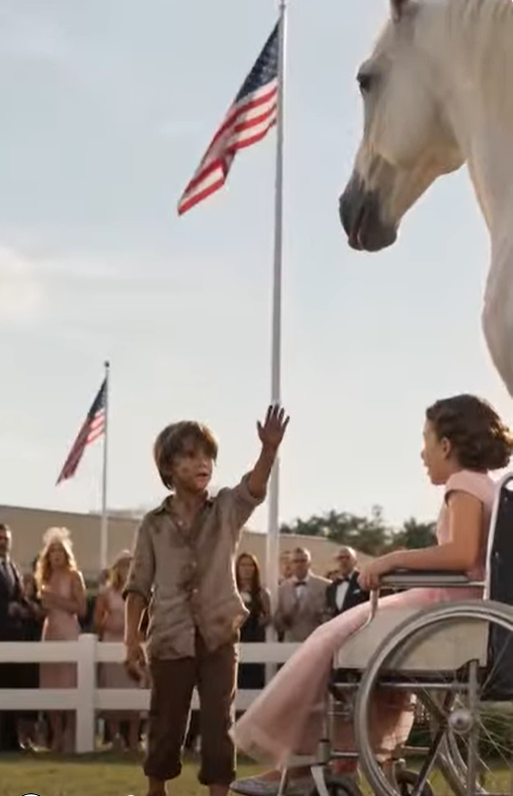
The Elite Equestrian Grounds were a testament to human vanity. Polished mahogany, acres of manicured emerald grass, and a crowd draped in silk and diamonds. At the center of it all stood Julianna, the daughter of the city’s wealthiest titan, confined to her wheelchair. She was a bird with clipped wings, her legs unresponsive, her spirit muffled by the suffocating weight of her father’s pity and the onlookers’ stares.
The disaster struck during the final showcase. A thunderous, terrified stallion—a beast of pure black muscle and wild, rolling eyes—broke its lead. It thrashed, rearing up in a display of raw, panicked power. The crowd erupted into screams, scrambling for the exits. Julianna’s father, Arthur, stood paralyzed, frozen by the sudden vulnerability of his world.
In the center of the chaos, Julianna was helpless, her chair stuck in the loose gravel of the arena. The stallion, foam flecked on its bit, turned its fury toward her. It stood on its hind legs, a monolithic shadow of death, ready to crash down.
Then, he stepped forward.
He was a ghost in the landscape of luxury—barefoot, clothes stained with the damp earth of the stables where he worked as a groom. He wasn’t running away; he was walking toward the center of the storm with a rhythmic, hypnotic slow pace. He didn’t carry a whip or a rope. He carried only a stillness that seemed to draw the oxygen out of the air.
The crowd went silent, breaths hitched in collective terror. The boy, Elias, reached the horse. He didn’t shout. He didn’t lunge. He simply placed a mud-caked hand on the stallion’s heaving flank and leaned his forehead against its neck, whispering something lost to the wind.
The beast trembled. Its frantic heartbeat, visible in the rippling of its muscles, began to slow. The wild fire in its eyes dimmed, replaced by a confused, weary recognition. The boy had spoken to the soul of the creature, acknowledging its pain, and in that acknowledgment, the fury vanished.
Arthur, finally finding his voice, lunged forward to pull his daughter away, but Elias signaled for him to stop. He knelt at Julianna’s feet, his eyes intense, devoid of the social hierarchy that governed this world.
“She’s not afraid of the horse,” Elias said, his voice ringing across the silent arena. “She’s afraid of her own body.”
Julianna looked down at him, her chest heaving. For years, her world had been defined by what she couldn’t do. She had spent a decade believing that her legs were dead weight, a betrayal by nature. But as Elias touched her ankle, pressing firmly against the dead nerve, something flickered. It wasn’t just a touch; it was an invitation.
“The horse was running because it was trapped,” Elias murmured, his eyes locking onto hers. “You’ve been trapped in the fear of the fall. The sensation never left you, Julianna. You just stopped looking for it.”
He pressed harder, and a jolt—sharp, electric, and terrifyingly real—shot up her spine. Julianna gasped, a sound that felt like a glass ceiling shattering. Her toes curled, instinctively, against the footrest of her chair. The agony of the realization was washed away by the sheer, overwhelming rush of sensation.
She wasn’t broken. She was just waiting to be woken up.
The aftermath was a blur of medical specialists, disbelief, and the quiet, crushing realization for Arthur that he had spent years managing his daughter’s disability rather than nurturing her potential.
Elias vanished back into the stables as quickly as he had emerged, a figure of mythic simplicity. But the seeds were sown. Julianna began the grueling, miraculous work of rehabilitation. It wasn’t a fairy tale—there were months of pain, of muscles screaming as they remembered how to hold weight, of falling and finding the courage to rise again.
But every day, she walked to the stables. She didn’t seek the doctors or the therapists; she sought the boy who had taught her to listen to her own pulse.
Six months later, the grounds were quiet. The elite had long since moved on to their next distraction, but the stables remained a sanctuary. Julianna walked, her gait still slightly uneven, leaning on a simple wooden cane—a mark of her journey, not her limitation.
She found Elias in the paddock, grooming the black stallion, which now stood with a gentle, placid grace.
“I did it,” she said, her voice steady.
Elias turned, a small, humble smile touching his face. He didn’t look at her as a heiress, and she didn’t look at him as a servant. They were two souls who had stared down a demon and found a new beginning.
“I knew you would,” he replied. “You were always capable. You just needed to realize that the fear was the only thing keeping you paralyzed.”
Arthur, watching from a distance, finally understood. He stepped forward, not with a checkbook, but with an open hand. He had spent his life buying influence, only to realize that the most profound change couldn’t be purchased. He offered Elias a role not as a stable hand, but as a partner in a new foundation—one dedicated to bringing animal-assisted therapy to those who, like his daughter, had been written off by a world that valued prestige over potential.
The final scene of this chapter was simple. Julianna stepped onto the back of the stallion, Elias steadying the harness. As she gripped the reins, she felt the horse’s heartbeat synchronize with her own. She wasn’t the broken girl in the chair anymore. She was a woman reclaiming her horizon.
The past—the fear, the confinement, the suffocating wealth—was left in the dust of the ring. As they trotted out into the open fields, the sun setting behind them in a blaze of gold, Julianna laughed—a sound of pure, unbridled freedom. They had learned that the most expensive things in life are often those we lose when we stop believing in miracles, and the most valuable things are those that cost us only the courage to let go of our own shadows.
The nightmare was over, and for the first time, the path ahead was entirely her own to ride.