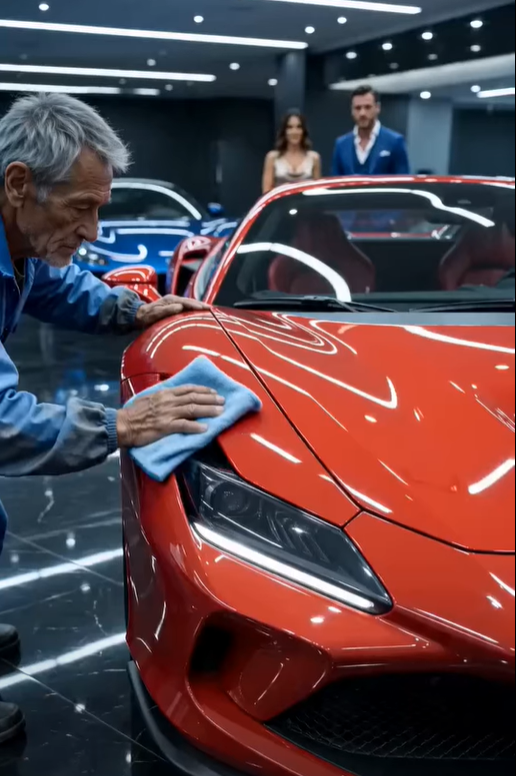
The ‘Apex Velocity’ showroom was a cathedral of carbon fiber and chrome. Beneath the high-intensity studio lights, the cars looked less like machines and more like apex predators waiting to be unleashed. The air smelled of expensive leather and ambition.
Marcus, a man whose hands were perpetually stained with the honest grime of a master mechanic, was currently bent over the engine bay of a limited-edition hypercar. He wore a faded navy work shirt with a grease-smudged name tag. To the casual observer, he was the guy hired to keep the engines humming. To Marcus, he was the man who had designed half the components that made these machines the fastest in the world.
The glass doors slid open with a whisper, and in walked a couple who moved like they owned the pavement they stepped on. The man, draped in a bespoke cobalt blue suit that probably cost more than Marcus’s truck, was checking his reflection in the hood of a nearby Ferrari. His companion, a woman wearing oversized designer shades indoors, tapped her manicured nails impatiently on the counter.
“Excuse me,” the man in the blue suit called out, not bothering to look at Marcus. “We’re waiting for the sales lead. Why is the cleaning staff touching the merchandise?”
Marcus didn’t turn around. He was tightening a fuel line with a torque wrench, his movements precise and rhythmic. “I’m not cleaning it,” he said, his voice level. “I’m calibrating it.”
The man in the suit chuckled, a sharp, patronizing sound. He walked over, invading Marcus’s personal space. “Calibrating? Listen, buddy, keep your hands off the paint. This isn’t a garage for your hobby projects. Some of us are here to actually purchase the dream you’re busy sweating all over.”
He gestured to the hypercar, a car valued at over three million dollars. “You couldn’t afford the tires on this thing even in your wildest, most delusional dreams. Now, go find someone in a suit who can help us, before you leave grease stains on the finish.”
Marcus stood up slowly. He wiped his hands on a rag, his face a neutral landscape of calm. He had heard these words before—not in these showrooms, but in the boardrooms where he actually sat. The man’s insults were like water off a duck’s back.
“The car isn’t for sale,” Marcus said softly.
“Oh, spare me,” the woman scoffed, stepping closer. “Everything has a price. My husband is a venture capitalist. We don’t just buy cars; we buy the brands that make them. If you’re the best they have, this place is going under.”
The man in the blue suit puffed out his chest, clearly enjoying the display of dominance. “Exactly. And I want the keys to this one. Now. Or I’ll make sure the regional manager knows exactly how poorly this showroom is staffed.”
The heavy silence that followed was broken by the sound of firm, rapid footsteps on the polished concrete. The showroom manager, a man who usually projected an air of untouchable authority, came rushing from the back office. He didn’t look at the couple. He walked straight to the man in the grease-stained shirt.
“Sir,” the manager said, his voice dropping to a tone of genuine respect. “The board members are on the line. They’re waiting for your final approval on the acquisition of the new engine plant in Germany. Also, the title for this unit is ready for your signature.”
The couple froze. The man in the blue suit’s smile curdled, turning into a rigid, painful grimace.
Marcus took the pen from the manager and signed the document with a steady hand. He then turned to look at the man in the suit, his eyes reflecting nothing but a quiet, profound patience. “This unit,” Marcus said, gesturing to the hypercar, “is the prototype for the new flagship line. I own this company. And frankly, your attitude is the only thing here that doesn’t meet our standards.”
The color didn’t just drain from the man’s face; it seemed to vanish into the floorboards. The woman’s jaw hung slightly open, her designer glasses sliding down her nose. The air in the room, previously heavy with their arrogance, now felt thin and suffocating.
“Security,” the manager said, his voice cold. “Escort these people out. They aren’t the kind of clientele we represent.”
Three years passed. The incident at Apex Velocity had become a quiet legend in the industry, a story told to remind new employees that true power doesn’t need a costume.
Marcus hadn’t let the ego of others change him. He still worked on engines, and he still wore his grease-stained uniform on the showroom floor. But his company had expanded, and with it, his influence. He had launched a program called ‘The Blueprint,’ which provided technical training, scholarships, and career opportunities to underprivileged youth—kids who, like him, had been judged by their clothes rather than their potential.
One afternoon, while inspecting a new facility, Marcus encountered a young man sitting on a bench outside, looking dejected. The boy was wearing a threadbare jacket, staring at a stack of rejected job applications.
Marcus sat down beside him. “Rough day?”
The boy looked up, his eyes weary. “People think because I look like this, I don’t know anything about engineering. I’ve been kicked out of three dealerships today for ‘loitering.’”
Marcus smiled, a genuine, warm expression that hadn’t changed in years. He reached into his pocket and pulled out a simple, unmarked business card.
“I used to get kicked out of places too,” Marcus said. “But here’s the thing about blueprints: the most complex work is hidden inside the machine, not painted on the hood.”
He handed the card to the boy. It wasn’t just an invitation; it was a promise.
Months later, Marcus stood on the floor of the expanded facility, watching a team of young engineers work on the next generation of electric propulsion systems. Among them was the boy from the bench, now wearing a crisp, professional uniform, his eyes bright with purpose.
He saw the boy demonstrating a complex repair to a high-ranking executive from a rival firm. The executive, who was also prone to the arrogance of his peers, started to interrupt, but the boy stopped him with a calm, quiet confidence. He spoke with the authority of someone who knew exactly how the machine worked because he had built it from the ground up.
Marcus leaned against the wall, watching the scene unfold. He realized that the greatest luxury he had ever earned wasn’t the empire, the hypercars, or the wealth. It was the ability to build a world where the ‘blue suit’ mentality didn’t matter anymore.
He didn’t need to shout to prove his worth. He simply looked at the team he had built—a team that represented the future—and knew that he had succeeded. The arrogance of the past had faded into irrelevance, and in its place, something far more valuable had grown: a legacy built on the quiet, steady hum of respect.
As the sun dipped below the horizon, casting long, golden shadows across the shop floor, Marcus turned the lights down. He was the owner, the designer, and the visionary, but as he walked out into the cool evening air, he was just a man who loved engines. And for Marcus, that was everything.