The patio of ‘Le Ciel’ was an oasis of refined decadence, perched high above the city skyline. It was the preferred haunt of the elite—men in suits tailored by Savile Row, women whose jewelry cost more than an average house.
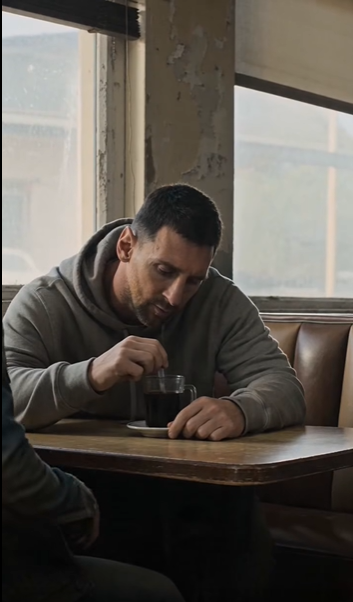
Arthur Vance, the billionaire CEO of a global logistics giant, sat at the corner table. Opposite him sat Clara, a woman he had been courting for months. She was elegant, sophisticated, and, according to the documents tucked into her designer handbag, currently waiting for him to take that first bite of his meal.
Arthur lifted his fork. The salmon, glazed in a delicate citrus reduction, looked perfect.
Then, the world erupted.
“Stop!”
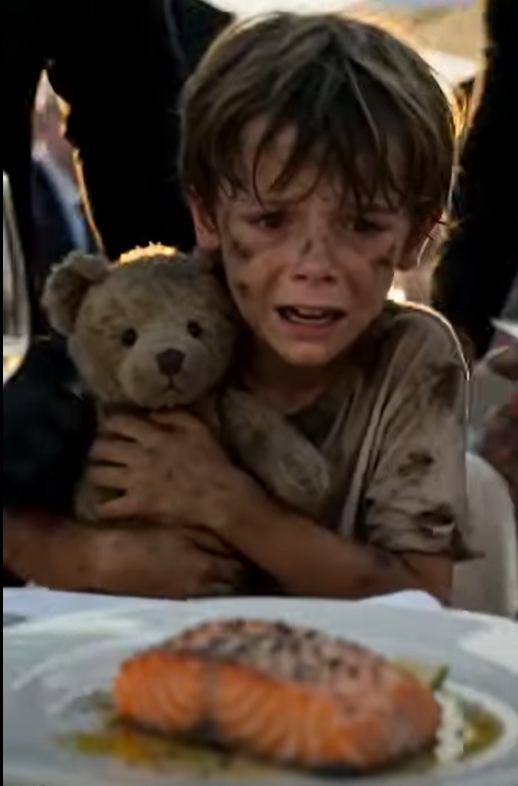
The voice was thin, frantic, and cut through the ambient jazz like a lightning strike. A boy, perhaps ten years old, burst onto the terrace. He was a creature of the streets, his skin smudged with the grey dust of the nearby construction sites, his clothes a collection of mismatched rags.
Before the waitstaff could blink, the boy had sprinted toward Arthur’s table. Two hulking bodyguards, their movements synchronized and lethal, surged forward. They grabbed the boy, lifting him off the ground, their hands tight around his scrawny arms.
“Get him out of here,” Arthur commanded, his voice cold, annoyance eclipsing any concern.
“Don’t eat it!” the boy shrieked, his eyes wide and locked onto Arthur’s. “It’s in the sauce! The lady—she put the blue vial in the kitchen! Please!”
The laughter that had rippled through the terrace died. The air grew heavy, static-charged. Arthur looked at the boy, then at Clara. Clara didn’t look back. She was staring at her phone, her thumb hovering over the screen, her expression suddenly devoid of any warmth.
Arthur’s intuition, the same sharp sense that had saved his company from hostile takeovers a dozen times, flared. He looked at the salmon. He looked at the boy’s terrified face.
“Put him down,” Arthur ordered.
The guards hesitated, then complied. The boy stumbled, gasping for air. Arthur pushed his plate away, his pulse accelerating. “What did you say?”
“I was hiding,” the boy whispered, trembling. “Behind the service door. I saw her. She paid the chef. It’s poison, sir. It stops the heart in ten minutes.”
Clara stood up, her grace shattered by a sudden, jagged movement. She didn’t offer a defense. She didn’t scream. She simply turned and began to walk toward the exit.
“Stop her,” Arthur said.
The guards were on her in an instant. When they pulled her sunglasses off, they found eyes that were cold, calculating, and empty of everything but a singular, brutal intent. When her handbag was searched, they found a small, empty blue vial tucked into a hidden compartment.
The aftermath was a whirlwind of police sirens, sterile questioning rooms, and the crushing realization that the person Arthur had trusted most was the one who had planned his funeral.
Clara was not just a lover; she was an operative for a rival conglomerate, a chess piece meant to eliminate the biggest player on the board.
Arthur sat in the back of his limousine three hours later, the city lights blurring past the tinted windows. The boy, who had been introduced as Leo, sat in the jump seat, clutching a bottle of water provided by the police.
“Why?” Arthur asked, his voice raw. “You’re a kid. You didn’t owe me a thing. You risked your life.”
Leo looked down at his mud-stained hands. “My mom,” he said quietly. “She used to work in a kitchen like that. She died because she was in the way of someone who had ‘big plans.’ I saw what happened to her, and I promised myself that if I ever saw someone trying to do that to someone else, I wouldn’t be the one who stayed silent.”
Arthur felt a strange, unfamiliar ache in his chest. For years, he had operated in a world of profit margins and bottom lines. He had forgotten that beneath the boardrooms and the scandals, there were human beings—children—who saw the world with a terrifying, beautiful clarity.
“You have a place to stay?” Arthur asked.
Leo shook his head. “I’m fine. I’m used to the street.”
Arthur leaned forward, tapping the partition to signal his driver. “You aren’t going back to the street, Leo. Not today. And not ever.”
The ‘happily ever after’ wasn’t a sudden explosion of fireworks; it was a quiet, steady transformation.
Arthur didn’t treat Leo like a project or a charity case. He saw a sharp, brave, and deeply intelligent survivor. He enrolled Leo in an elite academy, but he also did something more important: he took the boy under his wing, not as an heir, but as an apprentice of conscience.
Two years later, the offices of Vance Global looked different. The culture of cutthroat ambition had been replaced by something more substantial. Arthur had launched a massive initiative—a global effort to support displaced children and provide resources for those who, like Leo, had been lost in the shadows of the city.
One afternoon, Arthur stood on the balcony of his corporate headquarters. The city looked different from up here—less like a jungle of competition and more like a tapestry of lives.
Leo, now taller, more confident, and standing with a poise that had nothing to do with clothes or status, stepped out onto the balcony. He was holding a file.
“The final audit for the scholarship program is done, Arthur,” Leo said. “We’ve helped three thousand kids this year.”
Arthur turned, a smile touching his lips—the first true, unburdened smile he had worn in a decade. “Three thousand. That’s a good start.”
“It’s a start,” Leo agreed.
The poison that had nearly ended Arthur’s life had, in a strange twist of irony, served as the antidote to his own cynicism. He hadn’t just been saved from an assassination; he had been saved from the hollow, cold existence he had been building for himself.
As the sun began to set, casting a warm, golden glow over the office, they looked out at the horizon together. The boy who had once walked into a lion’s den to save a man he didn’t know was now a man himself, standing side-by-side with the one he had saved.
They had learned that while the world might be full of people wearing masks of politeness while hiding daggers behind their backs, it was also full of people who—given the chance—would risk everything just to say the truth. And for Arthur Vance, that was a discovery worth more than any empire.