The Doberman Who Remembered the Man the World Had Completely Forgotten
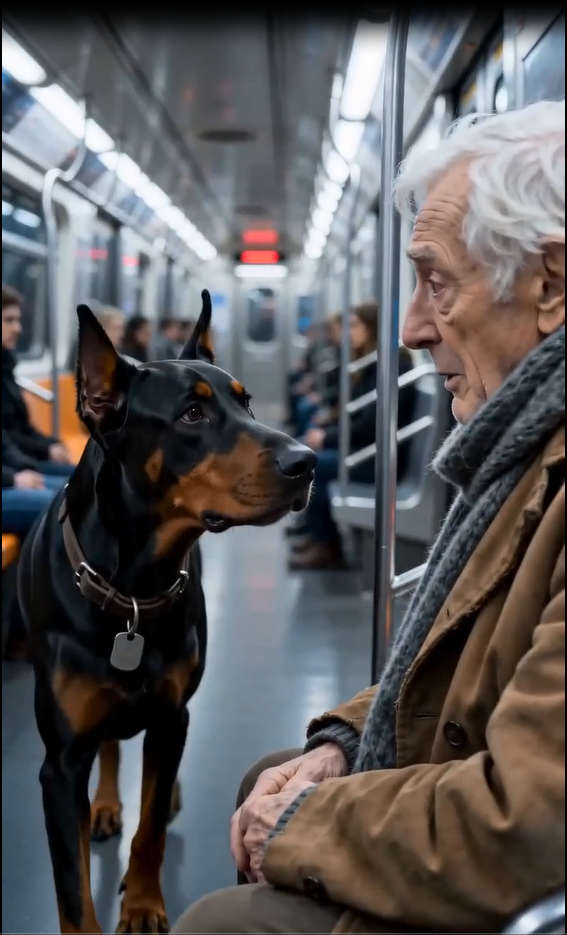
The stranger, a man in a sharp, expensive overcoat, stood paralyzed as the Doberman—named Brutus—pressed his massive frame against the veteran’s knees. The dog’s growl had subsided into a low, rhythmic whine, a sound of profound relief. The veteran, Elias, ran a trembling hand over the dog’s ears, his eyes wet and wide, as if he were touching a ghost that had suddenly regained its flesh and bone.
The stranger reached for the frayed end of the leather leash, but he stopped when Elias looked up. The veteran’s eyes were no longer dull with the apathy of the subway crowd. They were burning with a sharp, terrifying clarity. “You shouldn’t have bought him from that kennel,” Elias said, his voice quiet but carrying across the platform. “They didn’t tell you the truth, did they? They told you he was just another high-bred protector.”
“I paid five thousand dollars for that dog,” the stranger barked, though his voice lacked conviction. He kept glancing around the subway station, aware that the commuters were starting to pull out their phones, their attention shifting from the arriving train to the drama on the bench. “He’s mine. He belongs to the estate. We have the registration papers in the car.”
Elias stood up. He was shorter than the stranger, and his clothes were tattered, but he carried himself with the heavy, unshakeable gravity of a man who had survived things the other could not comprehend. He pulled a small, worn piece of metal from his pocket—a military identification tag, tarnished by time and saltwater. He held it out, showing the side with the engraving: Elias Thorne, K-9 Handler, 2014.
“Brutus didn’t come from a kennel,” Elias said. “He came from a deployment. He came from a Humvee that didn’t make it back from a canyon in Helmand. They told me he died in the blast, and they told the army I didn’t survive the crash. We both spent years being dead.”
The stranger’s face paled. He looked at the dog, then at the identification tag, and finally at the jagged, discolored scar that ran from the veteran’s hairline down to his jaw—a mark that perfectly matched the old photograph tucked into the dog’s original, leather collar. The stranger had seen that photo a thousand times, thinking it was just a piece of history that came with the dog’s pedigree, never realizing it was a map to a life that had been systematically erased by bureaucracy and clerical error.
“That’s impossible,” the stranger whispered. “The estate records… the private registry…”
“The registry was a cover for the sale of military surplus assets,” Elias continued, his voice hardening. “They processed him as a civilian animal to avoid the paperwork of a combat-trained veteran. And they processed me as a casualty to stop the disability payments.”
The crowd on the subway platform seemed to fade away. The stranger wasn’t just a rude commuter anymore; he was a beneficiary of a system that had traded living, breathing lives for profit. He took a step back, the expensive leather of his shoes scuffing against the grime of the subway floor. He had spent months training Brutus to be a status symbol, an accessory to his own carefully crafted importance, never knowing that the dog was actually a soldier waiting for his partner to return to the front.
Elias leaned down and whispered into the dog’s ear. Brutus let out a sharp, decisive bark and turned his back on the stranger, sitting firmly at Elias’s feet as if waiting for a command that had been delayed by a decade. The stranger looked at the leash in his hand, then at the phone in his pocket. He was a man of assets and contracts, and for the first time in his life, he didn’t know how to negotiate with the truth.
“Take the leash,” Elias said, pointing to the leather strap on the ground. “It’s not yours to hold. It never was.”
The stranger didn’t argue. He left the leash lying in the dust and walked toward the exit, his expensive coat suddenly looking like a costume he had outgrown. The subway train roared into the station, the doors sliding open to reveal a crowded car, but Elias didn’t move. He stood on the platform, his hand resting on Brutus’s neck. The dog was home.
As the train pulled away, taking the stranger and his hollow life with it, the station felt quiet, almost holy. Elias didn’t know where he was going, or how he would live, but the crushing weight of the last ten years had vanished. The bureaucracy that had declared him dead had been defeated by the simple, stubborn memory of a dog. He had been a ghost, and Brutus had been a secret, and now they were both finally tangible again.
Elias walked toward the stairs, the dog trotting by his side with a rhythmic, military precision. He passed the token booth, his movements fluid and purposeful. He wasn’t the broken man who had sat on the bench; he was a veteran returning to the world, and he had his partner back. The city outside was vast, loud, and indifferent, but it couldn’t touch them anymore. They were bound by a history that no ledger could delete and no purchase could supersede.
They stepped out into the daylight, the sun hitting their faces with the warmth of a long-overdue welcome. Elias looked up at the skyline, seeing the city not as a labyrinth of shadows, but as a place where they could start over. He stopped at a small park, found a bench, and sat down. He didn’t look for money or pity. He just watched the world move, his hand anchored in the thick, coarse fur of the dog he had been told was lost forever.
He didn’t need the stranger’s apology. He didn’t need the registry to recognize him. He had his dog, he had his breath, and for the first time in a decade, he had his future. He closed his eyes, listening to the heartbeat of the dog against his leg, a steady, pulsing rhythm that reminded him he was alive. The debt was settled, the war was over, and the only leash that mattered was the one made of trust and shared survival. They were ready for whatever came next, as long as they walked the path together.