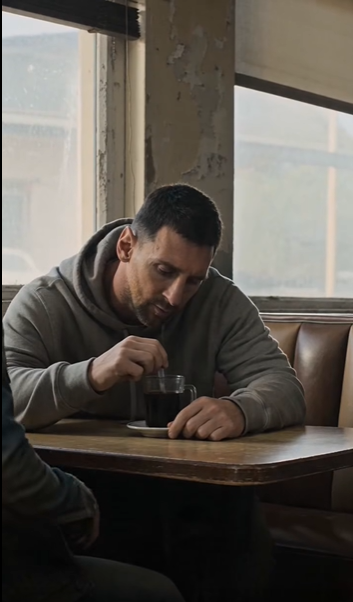
The bell above the door of Le Ciel Bakery didn’t just chime; it cut through the heavy, humid silence of the city night. Elias, the owner, was busy tallying his day’s profits. He was a man who measured his life in baguettes, gold-leafed pastries, and the pristine, polished marble floors he swept every hour. He had worked decades to escape the poverty of his youth, and he had no room in his tidy, successful world for the messiness of the streets.
When the two children stepped into the warm, golden glow of the shop, Elias didn’t see souls; he saw a liability.
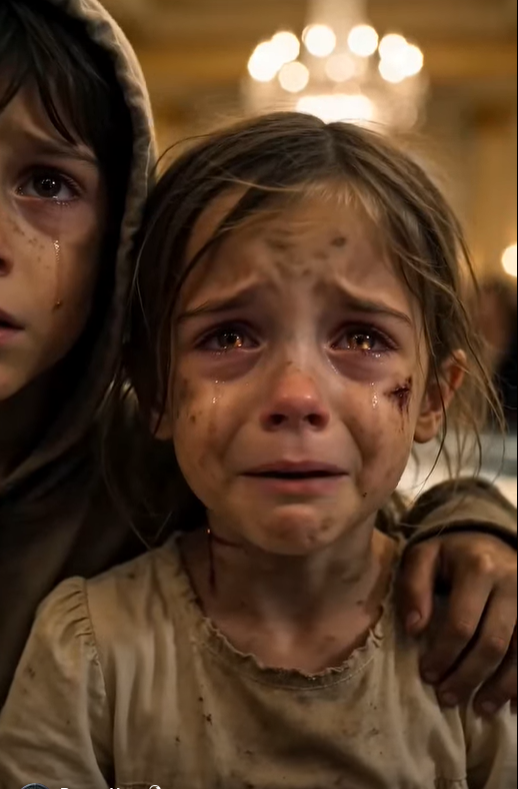
The boy, no older than ten, wore an oversized coat held together by safety pins. The girl, perhaps seven, clung to his hand, her eyes wide, sunken, and darting with the twitchy caution of a stray animal. They were hungry, the kind of deep, hollow hunger that etched itself into the frame of a child.
“We… we only need bread,” the boy whispered, his voice trembling. “Anything from yesterday.”
Elias didn’t even look up from his ledger. “This isn’t a charity. Close the door on your way out.”
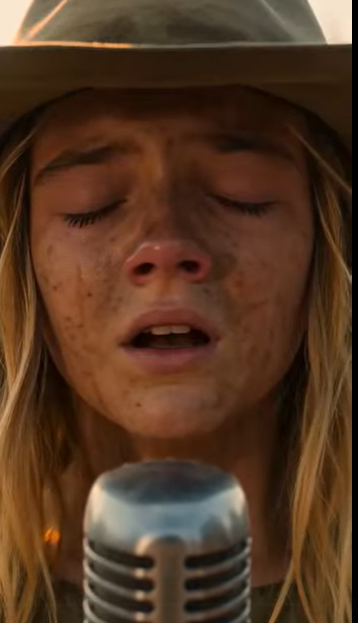
“Please,” the girl whispered. Her voice was thin, but it held a strange, melodic quality that made Elias’s hand pause over his calculator.
The boy stepped forward, desperate, and stumbled. As he tripped, he lunged for the counter to steady himself. His sleeve rode up, and the girl’s neck became exposed in the harsh light of the bakery’s hanging lamps.
Elias froze. His pen clattered to the floor, rolling into the shadows.
On the girl’s neck, just below the jawline, was a small, circular metallic implant—a silver star fused into the flesh. It wasn’t just a mark; it was a signature.
The blood drained from Elias’s face, leaving him looking like a ghost in his own shop. He knew that mark. He had been the one to design it, years ago, when he was a young, brilliant, and utterly ruthless engineer working for a shadow corporation that specialized in “biological optimization.” It was a prototype tracking device, one he had abandoned along with his entire life, his career, and his family, when he realized the monstrosity he was helping to create.
“Where did you get that?” Elias’s voice was a ragged croak.
The boy didn’t answer. Instead, his trembling fingers reached into his coat and produced a crumpled, yellowed envelope. It was sealed with a drop of hardened wax—a seal Elias hadn’t seen in over a decade.
“To the man who left us behind,” the handwriting read. It was his wife’s hand.
Elias’s legs gave out, and he sank onto a stool. He had spent ten years convincing himself that his wife and their children had died in the fire that destroyed their laboratory home. He had been so sure that the corporation had taken them. But as he tore open the envelope, he found a letter, a photo of his wife—older, tired, but alive—and a note: “They have been hunting us for the work you started. If you are alive, Elias, find a way to stop the ghost you created.”
The boy looked at him, his face hardening with a mix of fear and realization. “Are you… are you the man in the photo?”
Elias looked at his hands—hands that had made bread for years to cleanse the scent of machine oil and blood from his pores. He looked at the girl, his daughter, whose life had been dictated by the technology he had carelessly unleashed upon the world. The weight of his pragmatism, his desire for a simple life, collapsed under the crushing reality of his past.
“I am,” Elias whispered. He didn’t offer a hug; he didn’t know how. Instead, he walked behind the counter, grabbed the most expensive, freshly baked loaf of sourdough, and set it before them. “Eat. Then, we are going to the basement.”
The basement of Le Ciel was not a place for flour storage. It was a high-tech bunker, built over the years as a paranoia-fueled fortress. Elias worked with frantic, surgical speed. He utilized the equipment he had hidden away, scanning the children for the corporation’s signature frequencies. His heart hammered in his chest as he saw the alerts on his screen. They were being hunted. A signal was currently pinging their location.
“We have twenty minutes,” Elias said, his mind shifting back to the ruthless efficiency of his former life. He didn’t regret the man he had become, but he was suddenly grateful for the skills he had tried so hard to bury.
He gathered his weapons—not knives or guns, but EMP emitters and scrambling devices. He looked at his son, whose eyes were mirroring the same analytical intensity Elias himself possessed.
“I am sorry,” Elias said, his voice raw. “I thought I was keeping you safe by staying away. I thought the fire was the end.”
“The fire was a test,” the boy said, his eyes scanning the monitors. “They wanted to see if we would survive the vacuum. They wanted to see if the implants would hold.”
Elias felt a surge of pride and horror. They weren’t just his children; they were his greatest, most terrifying legacy.
When the corporate extraction team arrived at the bakery five minutes later, they didn’t find a frightened baker. They found a man who had reclaimed his genius. The bakery vanished in a flash of non-lethal, high-frequency light that fried the extraction team’s sensors, jammed their communications, and sent them scrambling in the dark.
Elias, the boy, and the girl stepped out of the back alley and into the black sedan he had kept hidden for years.
The Aftermath: A New Beginning
Three years later, the sun beat down on a small, secluded island in the Mediterranean. It was a place off the grid, a home built not of stone and greed, but of wood and light.
Elias sat on the porch, his hair grayer, his hands no longer trembling. He was no longer the man who measured his worth in pastries. He spent his days teaching his children the history of their bloodline and helping them learn to control the biological enhancements that had once been a prison.
The girl—Maya—was currently in the garden, showing her brother how to use a small, electromagnetic device to help the local flora grow at an accelerated, healthy rate. She was smiling, a real, full-hearted smile that no longer darted toward the shadows.
They had dismantled the corporation piece by piece from the shadows, using the very technology they had been forced to carry. They had exposed the truth to the world, and the shadow firm had crumbled under the weight of its own leaked experiments.
Elias heard the screen door creak. He turned to see his wife, Sarah, walking out with two cups of tea. She looked at him—not with the anger he had expected for his years of absence, but with a quiet, hard-earned forgiveness. She knew what he had done to protect them, and she knew the man he had become in the quiet sanctuary of the bakery.
He stood up, his wife slipping her hand into his. They watched their children playing—two survivors who had been marked by a cruel past, now thriving in a future they had carved out with their own hands.
The legacy of regret had been transformed into a legacy of resilience. The ghosts had been exorcised. As the Mediterranean sun dipped toward the horizon, painting the sky in colors of hope and forgiveness, Elias realized that his greatest invention wasn’t a device or a discovery. It was the family he had fought to reclaim. He was finally home, he was finally whole, and as he sat down to share a meal with the people who mattered most, he knew that the hunger of the past would never return. They were free, they were together, and the future was a loaf, still warm, waiting to be shared.