The winter wind in the city didn’t just blow; it bit, carving through layers of wool and silk like a serrated blade. In the forgotten district, where the brick walls were layered with years of graffiti and the dust never truly settled, seven-year-old Clara was a splash of soft blue. She looked like a fallen petal in a wasteland, her cream-colored trench coat pristine, her movements fluid with the grace of a life sheltered from the world’s harsher edges.
Her mother, Elara, a woman whose elegance was a fortress of blonde curls and expensive camel wool, trailed a few steps behind, her eyes scanning the alley with a mix of disdain and protective anxiety. To Elara, this part of the city was a map of dangers; to Clara, it was simply a place where people existed.
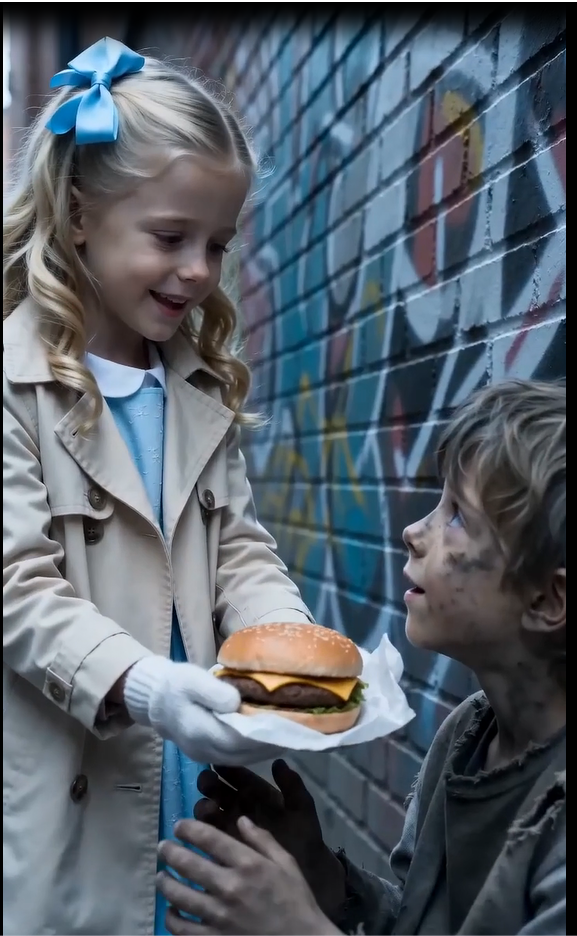
Clara stopped near a rusted dumpster, her gaze caught by a shadow. Tucked against a cold, spray-painted brick wall was a boy. He couldn’t have been more than eight, but he looked like a relic of a forgotten time. His clothes were a tapestry of rags, gray and stiff with grime. His hair was a matted mess, and his hands, clutched against his chest, were dark with the city’s soot. But it was his eyes—piercing, startlingly clear blue eyes—that held Clara’s attention.
Without a word, Clara reached into her bag. She pulled out a warm, foil-wrapped hamburger, the scent of seasoned meat and toasted bun cutting through the stale alley air. She didn’t see the dirt. She didn’t see the social divide. She only saw a child who was colder and hungrier than she had ever been.
“Here, take it,” she whispered, her voice like a soft bell.
The boy looked up, his movements hesitant, trembling like a leaf in a gale. His fingers, cracked and stained, brushed against hers as he accepted the offering. He didn’t say a word; he simply hugged the warmth to his chest as if it were a holy relic. In a burst of pure, unvarnished empathy, Clara leaned forward and wrapped her small arms around his neck, resting her head against his dirty cheek.
“Clara! No!”
Elara’s voice was a sharp fracture in the air. She lunged forward, her refined composure shattering into sheer, visceral panic. She grabbed Clara’s shoulder, yanking her back with a force that sent the girl stumbling.
“Get away from him!” Elara screamed, her eyes wide, her chest heaving.
Clara sobbed, her hand reaching toward the alley floor. “Mom, he’s hungry! He’s just a boy!”
The boy remained still, his head bowed, his shoulders hunched. He was used to the rejection; he was accustomed to the world pulling its skirts back to avoid his touch. But as the mother’s frantic eyes swept over him, ready to retreat, she froze.
The boy slowly lifted his head.
The movement was sluggish, but when he looked at Elara, the world stopped turning. The winter wind seemed to die in the alleyway. The blue of his eyes wasn’t just a color; it was a memory. It was the exact, impossible shade of the eyes of the child Elara had lost seven years ago at the crowded summer festival—the child who had vanished into the blur of a carnival and never returned.
Elara’s breath caught, a jagged sound that felt like glass in her throat. Her pupils dilated until the iris was nothing but a thin ring of gold against a sea of shock. Her knees felt weak, her soul reeling as the image of the boy before her—his jawline, the way his brows arched, the specific shape of his ears—collided with the face she saw every night in her dreams.
“Mom?…” Clara tugged at her sleeve, her small voice trembling.
Elara didn’t hear her. She didn’t hear the distant sirens or the wind. She stepped forward, her expensive camel coat brushing against the grime of the brick wall. Her hands, shaking with a terror that bordered on ecstasy, reached out. She cupped the boy’s dirt-stained face, her fingers tracing the sharp, hollowed-out cheekbones. She examined him, her touch desperate, looking for the tiny, crescent-shaped scar on his left temple—the scar from when he had tripped over the rosebushes in their old backyard.
There it was. Pale, jagged, and unmistakable.
A sound tore from Elara’s throat—a sob that had been building for two thousand, five hundred and fifty-five days. She collapsed onto the wet pavement, her elegant coat soaking up the alley’s filth without a second thought. She pulled the boy into her arms, burying her face in his neck, inhaling the scent of smoke, dirt, and him.
“My baby…” she wailed, her voice echoing off the graffiti-covered walls. “My baby… I finally found you!”
The boy was rigid for a heartbeat, his world turning upside down. He didn’t know the woman, but he knew the warmth. He knew the way she held him—not like a stranger, but like a treasure. Slowly, the fight left his small frame. He rested his head on her shoulder, his arms circling her neck, his eyes closing as the cold of the alley was replaced by the overwhelming heat of a mother’s love.
Clara stood by, bewildered and weeping, watching as the boy who had been a ghost in the alley became a child in her mother’s arms.
The Aftermath
The transition was not easy. There were months of doctors, authorities, and the slow, agonizing process of re-integrating a boy who had learned to survive as a stray into a world of softness and light. They named him Leo again, a name he had nearly forgotten, though he eventually reclaimed it with a shy, proud smile.
A year later, the alley was a distant, nightmare-like blur.
In the sun-drenched living room of their home, the piano played a soft, melodic tune. Leo—no longer the boy in rags—sat on the velvet bench. He was dressed in a crisp white shirt, his hair neatly combed, his blue eyes bright with a intelligence that had been honed by his years on the streets. He wasn’t just surviving anymore; he was thriving.
Elara sat on the sofa, watching him. She had lost the sharp edges of her aristocratic coldness. She held a book, but her gaze never strayed from her son. Beside her, Clara played with a set of building blocks, the girl who had brought a burger to an alleyway and changed the trajectory of the universe.
The doorbell rang. It was Arthur, Elara’s husband, home early from work. As he walked through the door, he didn’t head for his study. He walked straight to the piano, placing a hand on Leo’s shoulder, a gesture that was now second nature.
“How is the concerto coming along?” Arthur asked.
Leo smiled, his hands dancing over the keys. “It’s getting there.”
Elara stood up and joined them. She looked at her family—the husband she loved, the daughter who had guided her to the truth, and the son who had returned from the impossible. She reached out and took both of their hands.
The reunion hadn’t just healed Leo; it had healed them all. It had stripped away the superficial layers of their lives and forced them to find the core of what mattered: presence, grace, and the terrifying, beautiful realization that sometimes, the universe gives back what it takes.
As the music filled the house, Elara looked out the window at the garden. It was a beautiful day, but she remembered the alley. She remembered the cold. And then she looked at Leo, who was laughing at something Clara had said.
They were home. Not just in a house, but in the truth of one another. The boy who had spent years in the shadows was now the light of their lives, and as the evening sun bathed the room in gold, Elara knew one thing for certain: destiny didn’t just happen; it was something you had to be kind enough to invite in.