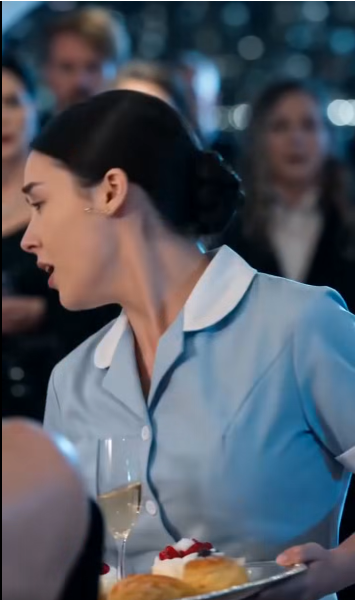
The rooftop garden of the St. Jude Hotel was designed for perfection. It was an ecosystem of white roses, gold-leafed hors d’oeuvres, and guests who measured their worth in net assets. At the center of this opulent theater stood Evelyn, her white lace wedding gown shimmering like fallen moonlight. Beside her was Julian, a man she had loved for three years, his hand squeezed tightly in hers, his eyes promising a lifetime of protection.
But the protection was a lie.
Standing opposite them was Julian’s mother, Beatrice. Beatrice was a woman who lived by a hierarchy of bloodlines and bank balances. To her, Evelyn—an orphan who had built her own small startup—was a smudge on the pristine ledger of the family legacy.
“It’s over, Julian,” Beatrice announced, her voice cutting through the soft jazz like a serrated blade. She didn’t look at her son; she looked at Evelyn with the same detached disgust one might reserve for a stray cat. “I’ve checked the registries. She is not fit to carry our name.”
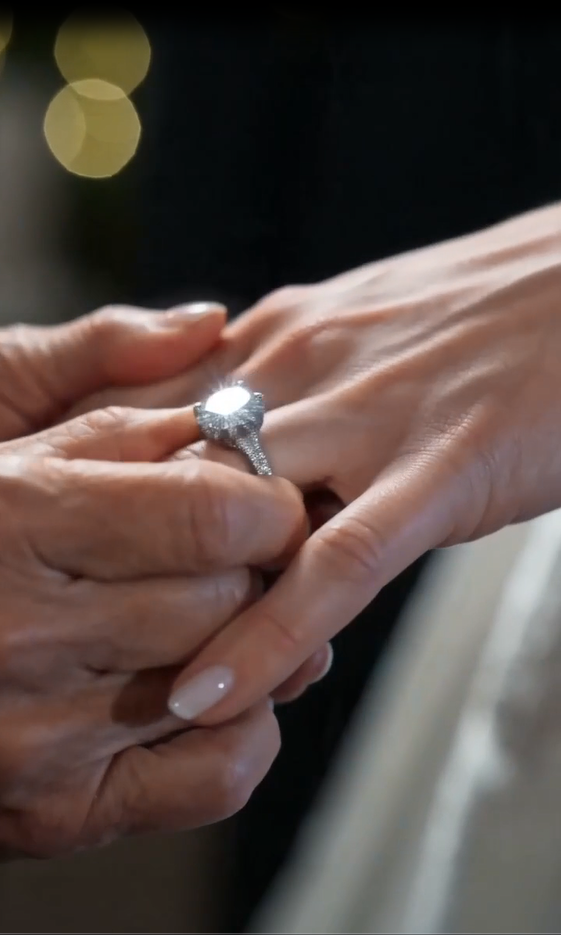
Before Julian could step forward, Beatrice lunged. It was a movement of practiced malice. She grabbed Evelyn’s left hand, her manicured nails digging into the skin, and wrenched the vintage gold ring from her finger.
The ring—an antique filigree with a teardrop sapphire—clattered against the marble floor, spinning into the silence.
“Get lost,” Beatrice sneered, her eyes gleaming with the predatory triumph of someone who had never lost a battle. “You are an insult to this family’s status. Consider this engagement liquidated.”
The guests stopped breathing. The silence was absolute, a vacuum waiting to be filled. Julian turned pale, his mouth opening to protest, but he was paralyzed by the weight of a lifetime of his mother’s psychological conditioning.
Evelyn didn’t scream. She didn’t crumble. She stood perfectly still, watching the ring settle near the edge of the fountain. Her breath, which had been ragged with shock, suddenly smoothed out. She bent down, her movements fluid and deliberate, and retrieved the ring. As she rose, she didn’t look like a weeping bride anymore. She looked like a judge.
She turned to Beatrice, and for the first time, Evelyn’s eyes were cold—a glacial, terrifying calm that made Beatrice take an involuntary step back.
“You called this an insult to your status, Beatrice?” Evelyn’s voice was soft, barely a whisper, yet it carried across the terrace with the force of a thunderclap. “This ring belonged to my grandmother. She was the woman who founded Rival Bank fifty years ago. She was the architect of the very trust fund that currently pays for your champagne.”
A murmur rippled through the crowd. The guests, who had been ready to mock the ‘poor bride,’ suddenly turned their gazes toward the shadows.
“Rival Bank?” someone whispered. “Isn’t that the institution that recently bought the majority stake in the Julian family’s shipping empire?”
Evelyn continued, her gaze locked on Beatrice. “My grandmother had a clause in her will. She didn’t want the bank to fall into the hands of those who worshipped gold over character. She granted me the absolute power of attorney over the family’s liquid assets. I didn’t come here to marry into your family, Beatrice. I came here to see if Julian had the spine to stand with me. It seems he doesn’t.”
She turned to Julian. He looked small, a man who had lost his soul in the pursuit of his mother’s approval.
“I hope the status is worth the bankruptcy, Julian,” she said, her voice devoid of heat.
Evelyn walked away. She didn’t run. She walked with the steady, rhythmic pace of a woman who had just checked her king.
Six months later, the fallout was legendary.
The Julian shipping empire hadn’t just dipped; it had collapsed under the sudden withdrawal of the Rival Bank credit lines. Beatrice, once the queen of the St. Jude ballroom, was selling off her private collection just to keep the lights on in the mansion. Julian, finally severed from the suffocating tether of his mother’s expectations, had walked away from the wreckage. He hadn’t fought for the money—he had fought for his freedom.
Evelyn was in her office, a light-filled space overlooking the city, when the door opened. It wasn’t her assistant.
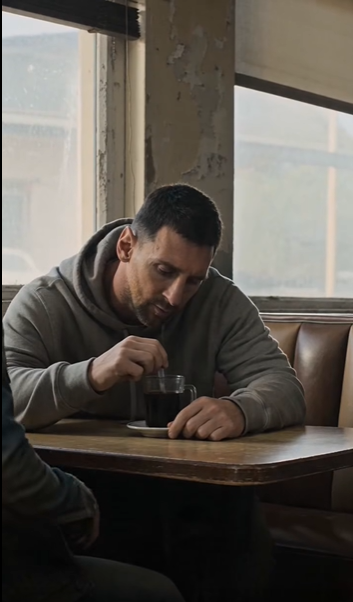
It was Julian. He looked different—his shoulders were lighter, his eyes clearer. He wasn’t wearing a designer tuxedo. He wore a simple sweater, the kind of clothing worn by a man who no longer had to dress for an audience.
“I didn’t come to ask for a loan,” he said, standing in the doorway.
Evelyn looked up from her desk. She hadn’t seen him since that night, but she had kept tabs on his quiet rebellion. “I didn’t think you would.”
“I took a job at a logistics firm in the Midwest,” he said, his voice steady. “It’s not an empire. It’s a career. I’m learning how to work for my own life, not for my mother’s reputation.”
He took a step forward, holding a small box. Not a ring—a box of chocolates from the corner store where they had had their first date. “I know I failed you on that rooftop. I froze. I was conditioned to fear her voice more than I loved you. It took me six months of silence to realize that if I didn’t learn how to stand up to her, I would never be the man who deserved to stand beside you.”
Evelyn studied him. She saw the humility that had been buried under the Julian-family-brand grooming. She saw a man who had been hollowed out by greed and was finally filling himself with something authentic.
“I don’t need Rival Bank to validate you,” Evelyn said softly.
“I don’t need you to need me,” Julian replied. “I just wanted to show you who I am when the chandeliers aren’t watching.”
Evelyn rose from her desk and walked to him. She didn’t take the chocolates, and she didn’t demand an apology. Instead, she took his hand—a hand that had been calloused by hard work over the last few months.
“The Midwest is a long way from here,” she said, a small smile playing on her lips.
“It is,” Julian agreed. “But the view from the ground is much better than the one from a pedestal that’s about to collapse.”
He didn’t ask for a second chance. He didn’t ask for her to fix his life. He simply stood there, an equal, a man who had chosen his own path.
In that moment, Evelyn knew that the ring she had held on the rooftop wasn’t just an heirloom—it was a key. It had unlocked the cage they were both trapped in. As they walked out of the office together, not to a banquet or a ballroom, but to a quiet dinner in the city they had both spent their lives trying to conquer, Evelyn felt a strange, wonderful lightness.
She had lost a wedding, but she had gained a partner. And for the first time in her life, the story was entirely hers to write.
The empire had fallen, but their life had finally begun.