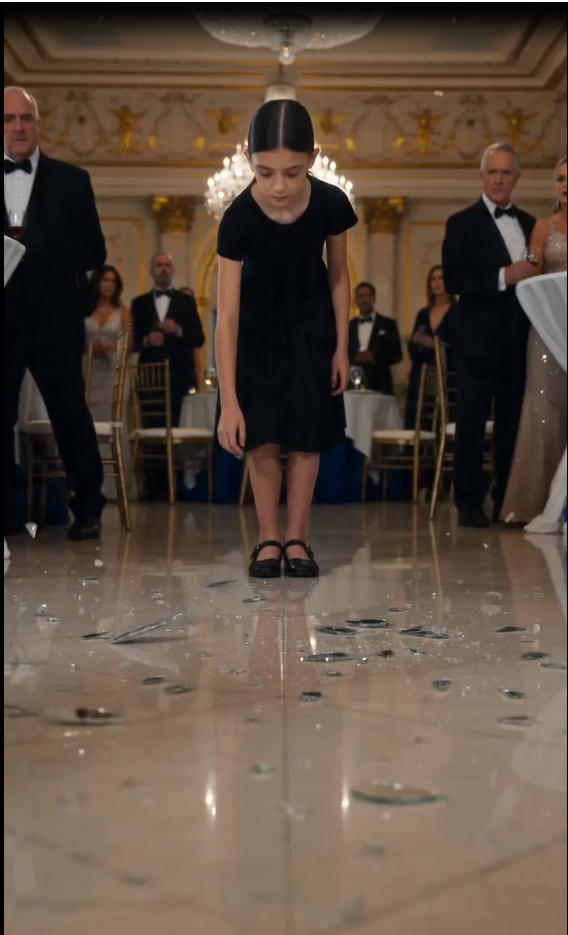
The Crystal Hall of the Grand Imperial Hotel was a masterpiece of opulence, a place where the chandeliers hummed with the electricity of a thousand ambitions. Tonight was the charity auction of the year, a gathering so exclusive that the waitlist alone held more wealth than most small nations.
Standing near the center of the hall was Beatrice, a woman who treated social standing like a contact sport. She was dressed in a gown of midnight-black velvet that cost more than a surgeon’s annual salary, and her jewelry—a waterfall of diamonds that dripped from her neck—seemed designed to blind anyone who dared to look her in the eye. To Beatrice, the world was divided into two categories: those who served, and those who were served.
Across the room, standing by the fountain, was a little girl no older than eight. She was dressed in a simple, yellow floral sundress that looked entirely out of place amidst the tailored tuxedos and designer gowns. She was clutching a small sketchpad, her eyes wide with the wonder of the architecture, unaware that she was trespassing on the dignity of the elite.
Beatrice, who had been nursing a glass of expensive Bordeaux, saw the girl. She didn’t see a child admiring art; she saw a stain on her canvas. As the girl stepped back to get a better view of a mural, she accidentally bumped into Beatrice. A tiny splash of wine darkened the hem of Beatrice’s velvet gown.
It was barely a drop, but for Beatrice, it was an excuse.
“You miserable little wretch!” Beatrice hissed, her voice cutting through the gala’s soft jazz like a serrated blade. She didn’t stop there. With a calculated, cruel movement, she took her own glass and poured the remaining contents directly onto the girl’s yellow dress.
The girl gasped, her eyes filling with tears as the stain spread like a bloom of dark blood across the bright fabric.
“There,” Beatrice sneered, loud enough for the entire room to turn. “Now you’re as stained on the outside as you are on the inside. Why are the staff letting peasants wander into a black-tie event? This isn’t a soup kitchen.”
A ripple of laughter went through the crowd—the nervous, shallow laughter of people who were terrified of Beatrice and eager to please her. The girl looked down at her ruined dress, her shoulders shaking, but she didn’t cry out. She just looked at Beatrice with an expression that was curiously devoid of fear.
“I’m sorry,” the girl whispered. “I just wanted to see the mural.”
“You want to see something?” Beatrice mocked, raising her hand to shove the girl toward the doors. “Look at the exit.”
Before Beatrice’s hand could make contact, the music abruptly cut out. A man in a charcoal suit, the Hotel Manager, emerged from the staff corridor. He was followed by a heavy-set man in a tuxedo, the Hotel’s Head of Security. Beatrice preened, expecting them to apologize for the intrusion and drag the “peasant” out.
“About time!” Beatrice declared, gesturing to the girl. “Remove this child immediately. She is ruining the ambiance of my evening.”
The Manager didn’t look at Beatrice. He walked straight past her, his boots clicking rhythmically on the polished marble. He didn’t stop until he was standing in front of the girl in the floral dress. To the absolute horror of everyone in the room, the Manager—a man notorious for his coldness toward billionaires—dropped to one knee.
“Are you alright, Miss Evelyn?” the Manager asked, his voice trembling with genuine concern.
The room went deathly silent. Beatrice’s glass slipped from her fingers, shattering on the floor.
The girl, Evelyn, wiped a tear from her cheek and looked at the Manager. Her face, once innocent, now carried a weight that made her look decades older. “I’m fine, Marcus. But this woman poured wine on me because I bumped into her.”
Beatrice’s mouth opened and closed like a fish out of water. “Miss… Miss Evelyn?” she stammered. “Who… who is she?”
The girl looked up, her gaze hardening. She reached into the pocket of her floral dress and pulled out a heavy, platinum-encrusted keycard—the master key to the Grand Imperial.
“My father passed away three months ago,” Evelyn said, her voice carrying across the silent hall. “He left this hotel, and the four sister properties in Dubai, Paris, and Tokyo, to me. I haven’t been here since the funeral because I’ve been in mourning. I came tonight because he loved this mural, and I wanted to see it.”
She stood up, and the Manager stood with her, acting as her shadow. “You asked why the staff let me in, Beatrice. They let me in because I own the building. They let me in because I pay their salaries. And as of this moment, you are no longer a guest of the Grand Imperial.”
Beatrice looked around for allies, but the guests were backing away, their faces pale. She had spent her life mocking people she thought were “lesser,” never realizing that she had been playing a game of chess with the architect of the board.
“Security,” Evelyn said, her voice unwavering. “Escort her out. And make sure she is blacklisted from every hotel in our portfolio, globally.”
Three years later.
The Grand Imperial Hotel was bustling with a new kind of energy. The gala tonight wasn’t for the elite—it was for the Foundations of Tomorrow, a project Evelyn had started to provide scholarships for children of service workers in the hospitality industry.
Evelyn, now a poised young woman of twenty-one, stood on the mezzanine. She wore a simple, elegant navy dress, and around her neck hung a small, gold locket—a picture of her father. She had learned that power wasn’t about the diamonds you wore, but the lives you improved.
The doors opened, and a man walked in. He wasn’t a guest in a tuxedo. He was wearing a sturdy, plain coat, and he looked like a man who had walked a long, hard road. It was Julian, a man Evelyn had met during her college years, back when she was keeping her identity a secret to ensure she made friends who liked her, not her bank account.
Julian had been her rock through the hardest years of her mourning. He was a teacher, a man who believed in the power of education, and he had never once asked her for a penny or a favor.
He walked up the stairs, and when he saw her, his entire face softened into a smile that reached his eyes.
“You look like a queen,” Julian said gently.
“I’m just a landlord, Julian,” she teased, taking his hand.
“No,” he said, pulling her into a soft embrace. “You’re a builder. And tonight, look at what you’ve built.”
Evelyn looked down at the ballroom. It was filled with kids laughing, parents smiling, and people who were treated with dignity. She had realized long ago that Beatrice was a ghost of a person—someone who had lost everything because she valued the surface of life more than the substance.
“I was worried,” Evelyn admitted, leaning her head on his shoulder. “I was worried that after what happened with Beatrice, and after losing my father, I would become cold. That I would only see people as assets or liabilities.”
Julian kissed her forehead. “You didn’t. You saw them as people, Evelyn. That’s why you’re still here, and that’s why you’re happy.”
She took a deep breath. She thought of the little girl in the floral dress, standing in the cold, being mocked by a woman who had nothing left to her name but her own bitterness. Evelyn had been terrified that night that she would be broken by the cruelty of the world. Instead, she had been defined by her own response to it.
“I’m happy,” she said, and for the first time, she meant it with every fiber of her being.
“Good,” Julian replied. “Because I think the kids are waiting for you to make the opening speech, and I think you’ve got a lot more to build.”
Evelyn smiled, straightened her locket, and walked down the stairs—not as a landlord, not as an heiress, but as a woman who had discovered that the most beautiful things in life aren’t the ones you own, but the ones you share. As she walked to the microphone, the hall erupted in applause—genuine, warm, and loud—a sound that, for the first time in her life, she knew she had truly earned.