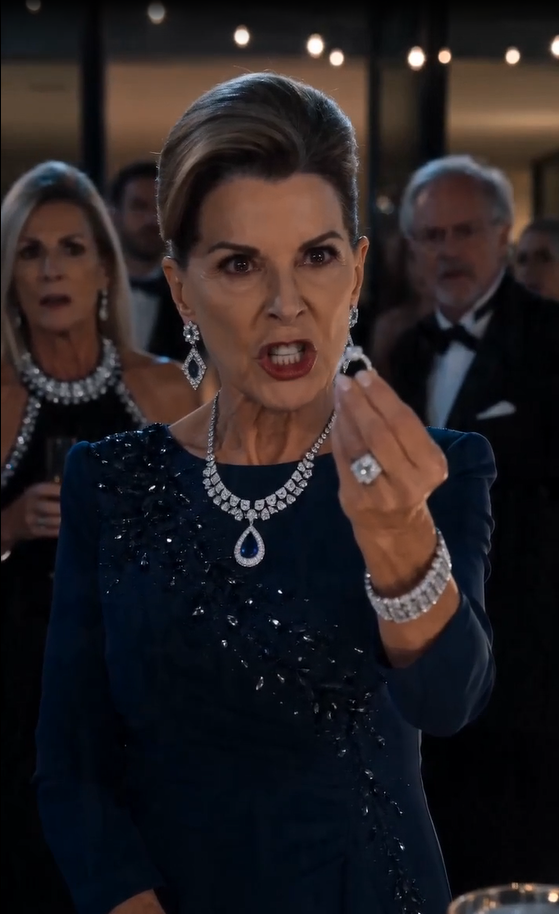
The night air over the city was electric, a tapestry of glittering skyline lights and the soft, rhythmic hum of urban life. On the sprawling rooftop terrace of the Obsidian Tower, the atmosphere was thick with the suffocating scent of lilies and the sharp, metallic tang of cold ambition. It was supposed to be the pinnacle of a social season: the wedding of Elena Thorne and Julian Sterling. But beneath the veneer of champagne and designer tuxedos, the foundation was rotting.
Elena stood at the altar, her breath hitching in her chest. She was a vision in silk and lace, but she felt entirely exposed. Standing opposite her was Julian, a man she loved, but whose spine seemed perpetually bent under the weight of his mother’s expectations.
Then, the music stopped.
It didn’t fade away; it was killed, as if strangled by the silence. Eleanor Sterling, the matriarch of the Sterling empire, stepped forward. Her movements were predatory, a calculated grace that had silenced boardrooms for decades. She walked toward the altar not as a guest, but as an executioner.
“This is an error,” Eleanor declared, her voice ringing across the rooftop like a gavel. She reached out, her gloved fingers gripping Elena’s hand with iron strength. Before anyone could react, she yanked the delicate platinum band from Elena’s finger.
“This heirloom belongs to a Sterling,” Eleanor spat, her eyes flickering with a cold, aristocratic disdain. “It does not belong to a girl who arrived at our doorstep with nothing but a pretty face and a desperate need for a name.”
The guests were statues, paralyzed by the audacity. Julian looked away, his shame a silent endorsement of his mother’s cruelty. Eleanor laughed—a sharp, jagged sound—and with a nonchalant flick of her wrist, she tossed the ring into the void. It disappeared into the darkness of the city abyss, swallowed by the lights below.
“Get lost, Elena,” Eleanor commanded, turning her back. “You are a stain on this lineage. We don’t build houses with mud.”
For a long moment, the world stood still. Elena’s eyes, which had been glassy with shock, underwent a profound transformation. The softness, the vulnerability, and the tremor of the jilted bride vanished, replaced by an arctic, unshakable composure. She didn’t cry. She stood taller, her presence suddenly eclipsing the woman who had just assaulted her.
She stepped toward Eleanor, her voice a calm, chilling whisper that carried through the silence of the rooftop. “You think you’ve discarded a burden, Eleanor. But you’ve just discarded your only lifeline.”
Eleanor scoffed, turning around with a sneer. “And what does a commoner know of lifelines?”
“I am not a commoner,” Elena replied, her voice steady. “My family didn’t build our fortune on flash and vanity. We built the institutions that support them. The trust, the holding company, the very real estate firm that currently manages every single property your family claims to own—that is my family’s legacy.”
She took another step, the silence of the room now heavy with the weight of her words. “That ring? It was a sentimental trinket. But that bank you rely on for your quarterly liquidity? That is under my signature. I am the sole heiress to the institution that has financed every single one of your family’s ventures for the past thirty years. When I walked down this aisle, I wasn’t just marrying a man; I was auditing your empire.”
The air left the room. Eleanor’s face, previously a mask of triumph, began to slacken. Her eyes darted around, seeking an ally, but she found only the horrified expressions of her guests. The realization hit her like a physical blow: she had just humiliated the woman who held the keys to their survival.
“You…” Eleanor stammered, her voice failing. “That’s impossible. You’re—”
“I’m the reason you have a roof over your head,” Elena said, her voice dripping with lethal grace. She pulled her phone from her bouquet and made a single, swift call. “Close the accounts. Freeze the assets. Execute the foreclosure on the Sterling estates, effective immediately.”
She hung up and looked at the crowd. “The wedding is off. But the audit is just beginning.”
Julian finally looked at her, his face pale with realization, but it was too late. Elena turned and walked toward the elevator. She didn’t look back at the Sterling family as they began to panic, their world crumbling in real-time as notifications flooded their phones, signaling the immediate collapse of their wealth.
Six months later, the city was different. The Sterling empire had become a case study in corporate dissolution, a cautionary tale of arrogance meeting an immovable force.
Elena sat in her office, high above the streets, overlooking the skyline. She had taken the reins of her family’s legacy with a firm, compassionate hand, restructuring the firms to ensure sustainability rather than just profit.
A soft knock at her door interrupted her thoughts. It was Marcus, the chief advisor she had relied upon during the transition. He wasn’t just an advisor; he was the person who had stood by her through the storm of the wedding night, the one who had helped her see that she didn’t need to fit into the Sterling mold—she needed to break it.
“The merger is complete, Elena,” Marcus said, placing a file on her desk. “And the ring?”
Elena smiled. She reached into her drawer and pulled out a small velvet box. It wasn’t the heirloom ring Eleanor had thrown away. It was a new piece—an elegant, custom-cut sapphire band she had commissioned herself.
“I didn’t need that old thing,” she said, sliding the ring onto her finger. “It was cursed by the values of a woman who thought gold was power. I’ve realized that true power is the ability to walk away from a cage, even when it’s gilded.”
Marcus moved to the window, standing beside her. “You’ve changed the way this city does business, Elena. You’ve given back to the community that the Sterlings ignored.”
“I haven’t just changed the business,” she said, looking at him with a warmth she hadn’t felt in years. “I’ve learned to build on a foundation that doesn’t crack under pressure.”
That evening, the two of them stepped out onto her own private balcony. There was no music, no crowd, no performative arrogance. Just the city lights shimmering below, not as a backdrop for a lie, but as a testament to a life she had finally built on her own terms. She had lost a marriage, but she had gained her autonomy. She was no longer a victim of a narrative written by someone else; she was the author of her own destiny, and for the first time, the future looked bright, steady, and entirely hers.