The lobby of the Grand Regent Hotel was a cathedral of marble, polished to such a high sheen that it reflected the chandeliers like a distorted mirror. It was the epicenter of the city’s elite, a place where people didn’t just walk; they glided, draped in couture and protected by the invisible armor of extreme wealth.
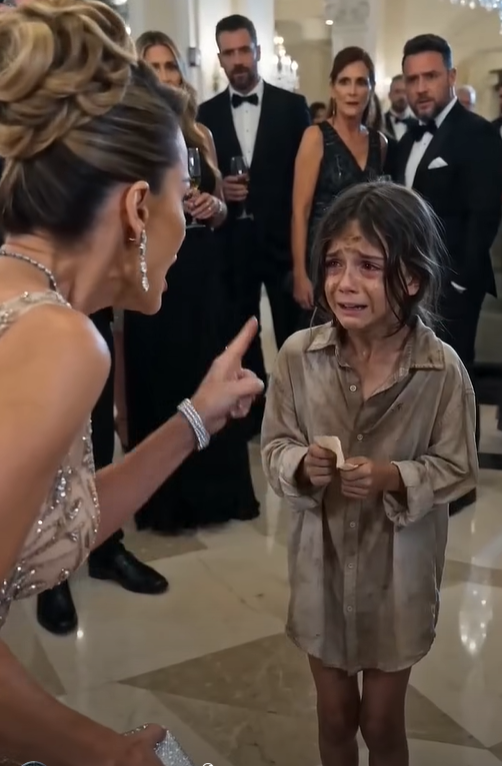
Isabella stood at the center of this golden cage. She was a vision in champagne gold, her hair sculpted into a perfect, frozen wave. She was hosting a charity gala—a performative display of altruism that masked the cold, sterile reality of her life. She was currently lecturing the hotel manager on the “unacceptable” presence of a delivery man in the main lobby, her voice sharp and clinical.
“This is a place of prestige, not a thoroughfare for the unwashed,” she said, her tone devoid of empathy.
Then, the doors swung open, admitting not a delivery man, but the city’s humid, chaotic air. And through that air stumbled a boy. He couldn’t have been more than seven. He was barefoot, his clothes a patchwork of rags caked in dried mud from the construction zones across the street. He looked like a smudge of charcoal on a pristine canvas.
The lobby’s chatter died instantly. Security began to converge, their heavy footsteps rhythmic and menacing.
“Get him out,” Isabella commanded, not even deigning to look at the child. “He’s ruining the aesthetic.”
“No!” the boy cried, his voice cracking. He ignored the guard reaching for his arm and sprinted—a frantic, desperate dash—until he was standing directly in front of Isabella. He didn’t look at her with fear; he looked at her with a profound, aching recognition.
He thrust a crumpled, tear-soaked piece of paper toward her. “They said… they said you were my mama. They said you had to know.”
Isabella recoiled as if the paper were made of fire. “Security! Remove him!”
“Read it!” the boy screamed, the sound echoing off the high, domed ceiling. “Please! She’s waiting!”
The head guard grabbed the boy, but Isabella, fueled by a sudden, inexplicable jolt of adrenaline, snatched the paper from the boy’s trembling hand. The security team froze, waiting for the order to drag him away.
Isabella unfolded the note. Her hand, usually steady enough to handle delicate crystal, began to shake violently. The ink was smeared, written in a shaky, frantic hand: “Isabella, I couldn’t protect him anymore. You gave him up to save your life, but you can’t give him up to save your conscience. He’s yours. Save him, or he dies.”
It was a letter from the woman who had acted as her foster mother decades ago, the woman Isabella had paid to “disappear” along with the secret of her humble, difficult origins. Isabella had spent ten years curating a persona of “old money” refinement, deleting every trace of the impoverished girl who had clawed her way out of the slums.
She looked at the boy. Up close, in the harsh glare of the lobby lights, she saw the undeniable curve of his jaw, the specific shade of his hazel eyes—eyes she saw in the mirror every morning.
The porcelain mask shattered. The air in the lobby didn’t just go silent; it turned to ice. Isabella felt the weight of the champagne gold gown suddenly become a shroud. She looked around at the faces of the socialites, their expressions shifting from amusement to whispered horror. She saw the manager, the guests, and the cameras of the press—the press she had invited to document her perfection, now documenting her complete destruction.
She didn’t scream. She didn’t faint. She fell to her knees, the silk of her dress pooling in the dust the boy had brought in. She wrapped her arms around him, pulling the dirty, shivering child into the expensive fabric of her gown.
“I’m sorry,” she sobbed, the sound raw and unfiltered. “I’m so, so sorry.”
The Aftermath: A Life Reclaimed
The news cycle was brutal. Within forty-eight hours, Isabella’s life as the “Queen of High Society” was over. Her husband, a man who valued image above all else, filed for divorce before the week was out. Her board positions were stripped away, and the glossy magazines that once praised her style turned their ink into venom.
But for the first time in her life, Isabella wasn’t hungry.
She took the boy—Leo—to the modest cottage she had kept in the countryside, a property she had bought as an investment but never visited. It became their sanctuary. She sold the diamonds, the couture, and the cars, using the proceeds to create a foundation focused on the very neighborhood she had tried to erase.
It wasn’t easy. The transition from a life of curated luxury to one of genuine, messy human connection was a crucible. She had to learn how to cook, how to comfort a child who had seen the worst of the streets, and how to look at herself in the mirror without the heavy application of makeup and artifice.
One year later, Isabella sat on the porch of the cottage, watching Leo play in a garden that was not manicured by a staff, but overgrown with wildflowers. She wore a simple linen shirt and jeans. She was tired, her hands were calloused, and her social calendar was empty.
Leo ran toward her, holding a handful of daisies. “Mom?”
“Yes, Leo?”
“Are you happy?”
Isabella looked at her son—at the child she had nearly left to die, the boy who had broken down her door to save them both. She thought about the lobby of the Grand Regent, the way the world had felt so hollow back then.
“I am,” she said, and for the first time, she meant it with every fiber of her being. “I’m finally real.”
She had lost the glitz, the status, and the worship of a society that didn’t know her name, only her face. But she had gained her own heart back. She had realized that the truth didn’t just break the door down; it opened the way for a life that was worth living.
The woman in the champagne gold gown was gone, lost to the memories of a lobby that no longer mattered. In her place was a mother, a survivor, and a woman who had finally learned that destiny isn’t something you curate—it’s something you embrace, in all its mud-stained, beautiful complexity. The nightmare was over, and as the sun dipped behind the hills, painting the sky in colors no diamond could ever replicate, Isabella knew she had finally come home.