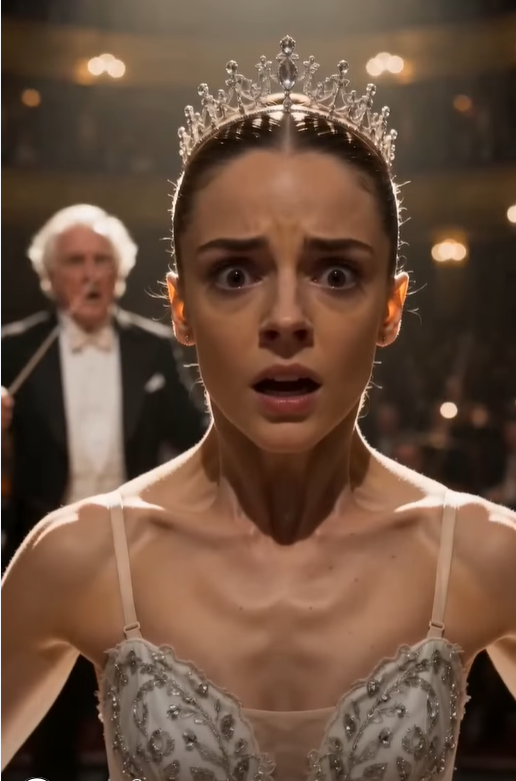
The velvet curtains of the Royal Opera House hung heavy with the scent of expensive perfume and the suffocating pressure of expectation. Tonight was the premiere of The Celestial Waltz, the crowning achievement of Isabella Laurent’s career. Isabella was not merely a prima ballerina; she was a brand. She was the face of luxury, the daughter of a dynasty, and a woman who had never known the sting of a struggle.
As the orchestra swelled into a crescendo, Isabella took her center-stage mark. She was a vision of perfection in a tutu hand-stitched with Swarovski crystals. But just as she began the opening sequence, a strange, rhythmic thud echoed from the wings—a sound that did not belong to the polished performance.
It was the sound of bare feet against hardwood.
The orchestra faltered. The conductor, confused by the lack of cue, tapped his baton in a sharp, stuttering rhythm. From the deep, dusty shadows of stage-left, a figure emerged. It was not a stagehand, but a girl—no older than twelve. She wore a dress the color of dried earth, ragged at the hem, and her feet were calloused and bare. In her hands, she clutched a pair of tattered, discolored ballet slippers that looked as though they had been rescued from a bonfire.
The audience, usually a sea of polite, frozen masks, began to murmur. Isabella stopped mid-pirouette, her face twisting with sudden, sharp indignation. “Security!” she hissed. “Get that gutter-rat off my stage!”
But the girl, Lily Harper, didn’t seem to hear. Her eyes were fixed on the rafters, her gaze distant and strangely ancient. She placed her tattered shoes on the stage floor, stepped into them, and then—the music didn’t matter anymore.
Lily began to move.
It was not the calculated, mechanical precision of Isabella’s training. It was visceral. It was a language of grief, joy, and raw, unadulterated fire. As she danced, the opulent lighting of the Royal Opera seemed to fade, replaced by a haunting, ethereal glow that seemed to emanate from the girl herself. She leaped, and it felt as though she defied the very physics of the earth. She spun, and the room felt as if it were rotating around her.
In the front row, the elderly maestros, men who had seen every great dancer of the last century, stood up slowly. One by one, the rest of the theater followed, drawn by an irresistible gravity. Isabella, forgotten in the corner, watched with a growing, sickly horror. She recognized those movements. They were the original, lost steps of The Celestial Waltz, the ones she had been told never existed.
Lily reached the finale, a sequence of jumps that culminated in a breathless, frozen pose. As she landed, the silence was absolute. Not a program rustled; not a cough disturbed the air.
Lily stood, her chest heaving, and turned toward the center box where the Board of Directors sat. She looked directly at Isabella, who had retreated into the wings, trembling.
“My grandmother, Elena Vance, wrote this music and choreographed these steps,” Lily said, her voice clear and carrying across the vast hall with the weight of a gavel. “She didn’t leave them in a vault for you to steal, Isabella. She left them for me.”
The name ‘Elena Vance’ acted like a lightning strike. Whispers erupted—Vance had been the greatest choreographer of her time, a woman who had vanished into poverty thirty years ago after a bitter falling out with the Opera’s management. Isabella’s facade crumbled. Her face, usually so composed, betrayed her in a single, devastating moment of vulnerability.
The scandal that followed was swift and absolute. Within 48 hours, Isabella Laurent was stripped of her titles. The provenance of the ballet was verified through long-lost journals discovered in the Opera’s own archives, proving that the original choreography had been systematically usurped by Isabella’s family for decades.
But the story did not end in the courtroom. It ended in the light of day.
Three years later, the Royal Opera House was under new, humble management. The atmosphere was no longer one of cold, expensive distance, but of artistic devotion.
Lily Harper sat in the dressing room that had once been Isabella’s. She was no longer a girl in a tattered dress. She was the Artistic Director of the company, and the first rehearsals for the autumn season were underway. She had brought with her a new generation of dancers—youths from the city’s forgotten neighborhoods who, like her, had possessed the fire but lacked the “prestige” to be seen.
The door opened, and a woman entered. It was Isabella. She looked different—humbled, dressed in simple rehearsal clothes, her hair pulled back without the usual artifice. She had spent the last few years teaching dance in rural communities, finding redemption in the service of the art she had once tried to hoard.
“The students are ready for the morning class,” Isabella said softly.
Lily looked up, a small, genuine smile playing on her lips. There was no bitterness left. The fire that had once burned down the old, corrupt empire had transformed into a warmth that now nurtured a new one.
“Let them in,” Lily replied.
As the new dancers flooded the stage, the room filled with the sound of laughter, struggle, and honest, unadulterated passion. The Royal Opera was no longer a place of hollow perfection; it was a sanctuary of truth.
Lily stepped out to the center of the stage, the same stage she had once claimed as a ghost. She looked out into the empty, sun-drenched house and finally understood. Genius was never about the crown you wore; it was about the courage to dance when the world told you that you didn’t belong. And as she began to move, she knew that this time, she was exactly where she was meant to be. The legacy was safe, the stage was hers, and the music—finally—was her own.