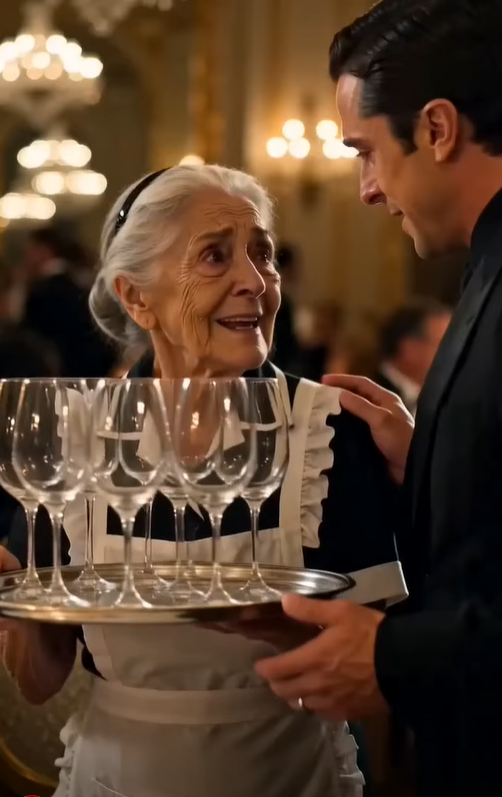
The chandeliers of L’Aube cast a warm, golden glow over the dining room, a sanctuary of velvet booths, starched white linens, and the soft, rhythmic clinking of fine crystal. For the city’s elite, it was a place to see and be seen. For Elena, it was a treadmill of exhaustion.
At sixty-eight, Elena moved with a practiced, heavy grace. Her uniform was crisp, but it could not hide the slight, permanent curve of her spine, earned through forty years of hauling trays and cleaning tables. Her hands, weathered by decades of hot water and harsh detergents, were her constant companions—they often trembled, a silent protest against a lifetime of labor that had never granted her the luxury of a rest.
Tonight, the restaurant was busier than usual. Elena navigated the maze of tables, her breath hitching in her chest as she approached a corner booth. The tray, burdened with heavy wine glasses and a bottle of vintage Bordeaux, felt like a physical weight pulling at her soul. Her vision blurred at the edges, a familiar symptom of long shifts and too little sleep. She focused on the table, willing her hands to remain steady, but they betrayed her. The tray wobbled.
Before the crash could occur—before the crystal could shatter against the floor—a firm, steady hand reached out and intercepted the weight.
“I have it, Elena. Let me take that for you.”
The voice was deep, resonant, and carried a tone of absolute authority. Elena blinked, her heart racing as she looked up. Standing before her was a man in his late forties, draped in a charcoal-grey tailored suit that shouted of success and boardroom dominance. He looked like the kind of man who owned half the city’s skyline.
Elena didn’t recognize him at first. The years had been a thick fog of survival. But as he stepped into the light of the chandelier, she saw the eyes—dark, intense, and filled with a depth of memory that made the busy restaurant fade into the background.
Thirty years ago, she had worked in a desolate, twenty-four-hour diner on the edge of town, a place where the lights buzzed like angry wasps. There had been a boy there—a runaway with hollow cheeks, trembling hands, and a hollow stare. He had come in every Tuesday, clutching a few coins that weren’t enough for a meal. Every Tuesday, Elena had slid a plate of hot eggs and buttered toast onto the counter, whispering, “It’s a mistake from the kitchen, honey. You have to eat it, or I have to throw it away.”
She had done it for a year until he simply stopped coming. She had always wondered if he had made it, or if he had become another lost soul swallowed by the city streets.
“Julian?” she breathed, the name surfacing from the depths of her past like a long-forgotten shipwreck.
The man’s face softened, the steely facade of the businessman dissolving to reveal the vulnerable boy who had once sat at her counter. “You remembered,” he said, his voice thick with emotion.
He didn’t hand the tray back. He set it gently on a side table and then, without hesitation, reached into the pocket of his jacket. He took Elena’s weathered, calloused hand in his. Her skin was dry and lined; his was smooth and manicured. He pressed a heavy, cold object into her palm and curled her fingers around it.
It was a set of keys. Attached was a small, ornate tag with an address she didn’t recognize, but the look in his eyes told her it was the destination of her life’s journey.
“You spent your life feeding others, Elena,” Julian whispered, loud enough only for her to hear. “You gave me the fuel to build my life when I had absolutely nothing. You were the only person who saw a human being instead of a nuisance. I’ve been looking for you for years. I finally found you.”
“I… I can’t,” Elena stammered, her gaze darting to the manager watching from across the room. “I have a shift. I have to work.”
“No,” Julian said firmly, squeezing her hand. “You don’t have to work anymore. The lease on that place is paid in full, for the rest of your life. There’s a garden, a porch, and a library. There is silence, Elena. You have earned a lifetime of peace.”
Around them, the restaurant had fallen into an eerie, respectful silence. The patrons, the waiters, even the manager—all had stopped their movements, drawn into the gravity of the reunion. They weren’t watching a waitress; they were watching a miracle.
Elena looked at the keys, then up at Julian. Tears carved tracks through the fine lines on her cheeks. For the first time in her life, the weight in her shoulders vanished. It wasn’t just the tray; it was the burden of survival, the constant, low-level hum of anxiety that had defined her existence since her youth. It was gone.
She took off her apron—not in shame, but in liberation—and laid it on the chair. “Thank you,” she whispered.
“Thank you, Elena,” Julian replied, bowing his head in genuine reverence. “For everything.”
The exit from L’Aube was not the end; it was the prologue.
Six months later, the sun rose over a small, stone-walled cottage tucked away in the rolling hills at the edge of the county. The garden was a riot of wild roses and fragrant jasmine. On the back porch, a woman with silver hair sat in a rocking chair, a warm cup of herbal tea resting in her steady, tremor-free hands.
The silence was the most beautiful thing she had ever owned.
Every Tuesday, a sleek car would pull into the gravel driveway. Julian would step out, not in his charcoal suit, but in comfortable clothes, carrying groceries, books, and sometimes, a box of old-fashioned pastries from the city. They would sit on the porch and talk—not about business, or the past, or the hardships—but about the simple, quiet wonders of the present.
Elena learned to paint. She learned the names of the birds that nested in the eaves of her roof. She learned what it felt like to sleep without the phantom sensation of a ringing bell or a demanding customer’s voice in her dreams.
She discovered that grace, once sown, has a way of multiplying. She began to host small dinners for other retired servers from the city, women who had spent their lives in service and had been left with nothing but aching bones. She used her home as a sanctuary, a place where they could come for a weekend, sit in the garden, and remember that their lives were worth more than the labor they had provided.
The miracle was not that Julian had become a wealthy man, or that Elena had been rescued from poverty. The true miracle was the realization that they had never really been apart. The love she had given him—that singular, quiet act of feeding a starving boy—had been the tether that kept him anchored to his humanity. In returning that kindness, he hadn’t just saved her; he had reminded the world that when we help others, we are actually building the very foundation upon which we stand.
As the sun set behind the hills, casting long, peaceful shadows over the garden, Elena felt a deep, profound sense of wholeness. She was no longer invisible. She was the matriarch of a quiet, beautiful revolution of kindness. She sat back, rocked gently in her chair, and watched the stars emerge—a map of light that, for the first time in decades, finally felt like home.