The Girl Who Saw Through the Shadow to Find a Lost King
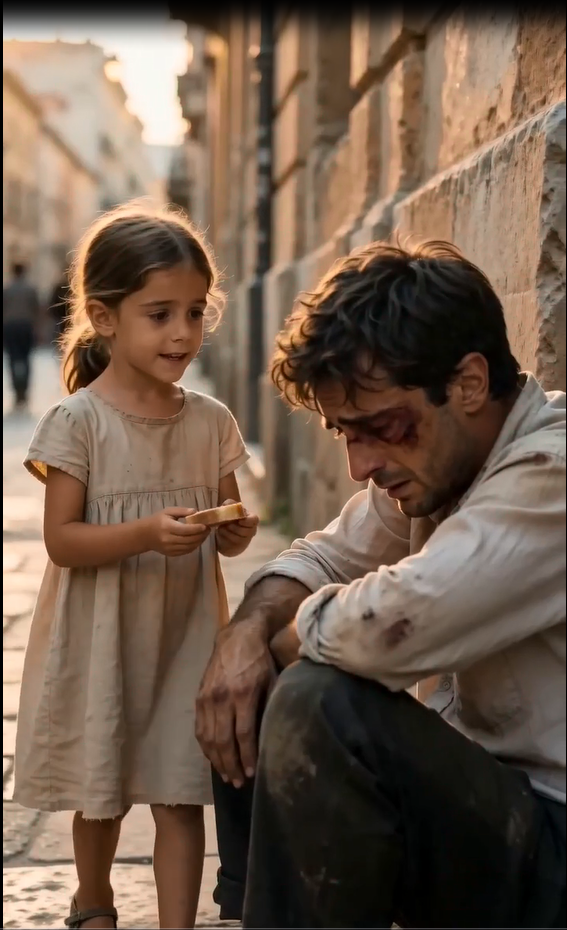
The man looked at the piece of bread, a rough, crusty heel that the girl held out with both hands. Her fingers were stained with the same gray dust that covered his own boots. For a moment, the bustling street noise seemed to dampen, as if someone had placed a glass dome over the corner of the alley where they stood. He tried to speak, but his throat felt as though it were filled with broken glass.
“I cannot take it,” he finally rasped, pulling his hands away from the offering. “It is your lunch.”
The girl didn’t pull her hand back. She tilted her head, her dark eyes unblinking, and she didn’t look like a child playing at kindness. She looked like someone waiting for the truth. “If you are not hungry, you would not be sitting on the ground,” she said, her voice devoid of any judgment. “If you are not sick, you would not be shaking. And if you have no reason to be here, you would not be crying.”
He looked away, his eyes scanning the passing legs of the crowd. Suits, worn-out work boots, polished heels—none of them mattered. To them, he was a smudge on the landscape, a failure of society tucked into the shadows. He had been a partner in a firm that crumbled overnight, a man who had trusted the wrong people until his life savings, his reputation, and his home had evaporated. He had spent three nights on this bench, watching the city live without him.
“Go find your mother,” he said, waving her away with a trembling hand. “I am just resting.”
“My mother is working,” the girl said, shifting the bread into her left hand and pointing toward a row of high-end storefronts across the avenue. “She sells flowers. She tells me that everyone has a story, but some people are just waiting for someone to ask them to tell it.”
She stepped closer, placing the bread firmly on the wooden slats of the bench beside his leg. Then, she reached into her pocket and pulled out a small, tarnished brass key. It was attached to a fraying ribbon of red silk. She dropped it into his lap. The metal was unnaturally cold, a sharp contrast to the biting heat of the afternoon sun.
“What is this?” he asked, startled. He picked up the key. It was heavy, far too heavy for its size.
“It belongs to the door behind the flower stall,” she said, backing away toward the sidewalk. “You look like you need a place to sit that doesn’t have people walking past you.”
He watched her disappear into the throng of people, her yellow sweater a final flicker of light before she vanished. He sat there, the brass key burning a hole in his palm. He looked at the bread. It wasn’t just food; it was a demand. He forced himself to take a bite. It tasted like nothing, then like everything.
He stood up, his legs feeling like lead. He walked across the street, dodging the flow of commuters, his eyes fixed on the flower stall. The woman behind the counter was middle-aged, her face etched with the same kind of fatigue that had nearly finished him off. He approached her, holding out the key.
She looked up, her expression shifting from customer-service indifference to something sharp and observant. She didn’t ask what he wanted. She simply stepped out from behind the counter and nodded toward a narrow, nondescript door tucked between a bakery and the flower stall.
He moved toward the door, his heart hammering against his ribs. He inserted the key into the lock. It turned with a sound like a heavy machine clicking into place. The door swung open to reveal a small, private office—not a squalid backroom, but a sanctuary filled with stacks of financial records, legal archives, and a desk that looked exactly like the one he had owned before his world fell apart.
His breath hitched. He walked to the desk and saw his own name engraved on a brass plaque.
The woman from the flower stall stepped into the doorway behind him. She wasn’t just a florist; she was the former head of the archival firm he had lost. She had been guarding the records, waiting for the one person who would have the integrity to fight for the truth behind the collapse.
“I found the documents that prove the fraud,” she said, her voice steady. “But I couldn’t reach them. The locks were changed, the legal teams were buried in paperwork, and I was just a ghost in the system. I needed someone who knew the codes, someone who knew how to reconstruct the books.”
He looked at her, his eyes wide. “Why me? I’m broken. I have nothing left.”
“You are the only person who refused to steal back what was yours,” she replied. “Every other partner involved in the collapse sold their share to the shell companies. You sat on a bench and starved because you wouldn’t sign a false affidavit. My daughter has a gift for seeing what people are made of.”
He looked down at the brass key still clutched in his fingers. The weight of it now felt like a responsibility rather than a burden. He pulled out the chair and sat down, the familiar scent of old paper and ink filling his lungs. It wasn’t just an office; it was the start of the audit that would strip the shell companies of their power and restore the accounts of every person who had been ruined alongside him.
The work was long. The days bled into weeks, then months. He moved from the bench to this room, living on coffee and the fierce, quiet resolve that the girl had sparked in him. He spent his nights in the small apartment above the florist, and his days systematically dismantling the web of lies that had once cost him his identity.
He didn’t need to be a partner in a prestigious firm anymore. He needed to be the man who made things right.
One afternoon, the girl returned. She sat in the chair across from him, reading a book while he finished the final report. He closed the binder and placed it on the desk. The evidence was ironclad. He looked at the girl, who was now a steady fixture in his life. He didn’t ask her for anything; he simply reached out and placed a small, silver coin on the desk. It was the first payment from the recovered funds, a symbolic return to a world of agency and strength.
“You changed everything,” he said softly.
She looked up, a small, knowing smile touching her lips. “I just asked a question. You were the one who had to decide to answer it.”
He walked her out to the flower stall. The city felt different now. It wasn’t a place of shadows anymore, but a place of light and potential. He had learned that the distance between a broken man and a functioning one wasn’t measured in money, but in the willingness to be seen. He had been invisible because he had stopped believing he was worth looking at. Now, as he watched the girl and her mother tend to the flowers, he understood that humanity was a gift to be traded, a cycle of grace that only worked if you were willing to participate.
He took a deep breath, the scent of fresh roses filling the air. He wasn’t a shadow. He was the man who had found his way back from the dust, and for the first time in a very long time, he was not afraid of the future. He walked back to his desk, took the brass key from his pocket, and placed it in the center of the wood. The lock was open, and he finally understood that the sanctuary he had been searching for wasn’t a room or a job; it was the simple, profound realization that his story was not over until he said it was.