The Boy in the Yellow Jacket and the Secret That Saved Them Both
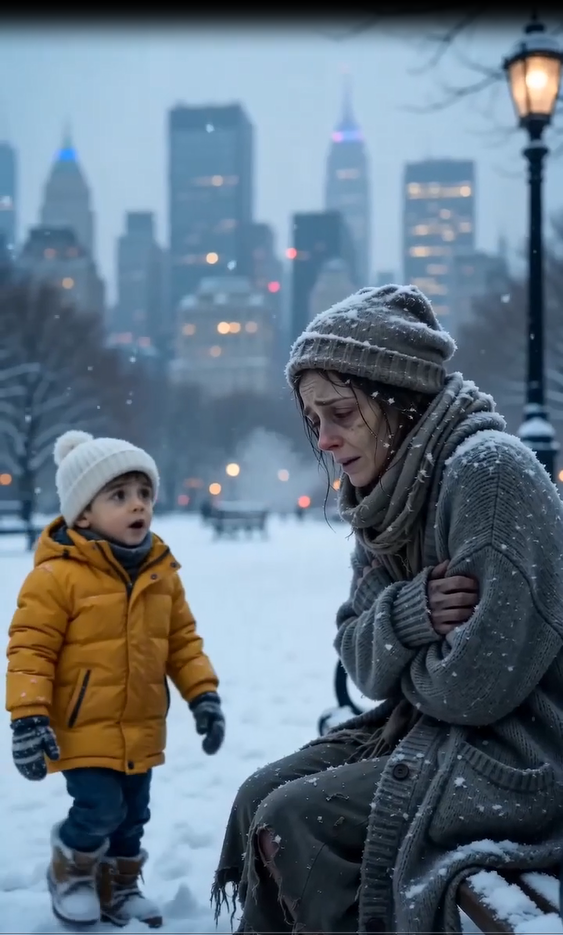
The woman, whose name was Clara, felt the sudden, stinging heat of the sandwich the boy had pressed into her hands. It was still wrapped in paper, the warmth seeping through her thin gloves, contrasting sharply with the biting air. She looked down at him. The boy, who could not have been more than seven, had bright, searching eyes that seemed to belong to someone much older. He wasn’t waiting for a thank-you. He was waiting for her to move, to stand up, to join him on the path away from the bench.
“My name is Leo,” he said, his voice small but steady. He pointed toward a cluster of distant buildings where the city lights were just beginning to flicker into existence. “There’s a place where they don’t lock the gates until the clock strikes eight. If we go now, we can make it.”
Clara stood, her knees popping and her joints aching from hours of stillness. She followed him. She didn’t ask why he was alone, or why a child in a pristine yellow jacket was talking to a stranger in a park. There was a pull to his presence, a magnetic certainty that made the usual caution she practiced seem unnecessary, even absurd.
They walked for blocks, weaving through the urban sprawl. The city seemed to narrow around them, the towering glass monoliths giving way to older, brick-lined streets. Leo didn’t stop for traffic or pedestrians. He navigated the sidewalk with a precision that bordered on the strange. Every time she faltered, he would turn back, his hand reaching out to touch the hem of her worn coat.
They reached a secluded brownstone set back from the road, tucked behind an iron gate that stood slightly ajar. It was a beautiful structure, though it had clearly seen better days. Leo pulled a heavy, tarnished key from his pocket and pressed it into Clara’s palm.
“This is the front door,” he said. “The lock sticks if you pull it too hard. You have to push it inward first.”
Clara looked at the key. It was heavy, made of solid brass, and engraved with a series of numbers she didn’t recognize. “Leo, why are you giving this to me? Where are your parents?”
The boy looked at the front door and then back at her. “They are inside. They haven’t been able to come out for a long time.”
A chill that had nothing to do with the winter wind crawled up Clara’s spine. She pushed the gate open, the hinges screaming in the quiet night. She followed Leo into a dimly lit hallway. The house smelled of lavender and old paper. It was clean—impossibly clean—given the state of the neighborhood.
She stepped into the parlor. A fire burned in the hearth, though no one was tending it. There were photographs on the mantle—dozens of them. They all featured the same man, a figure with a sharp jaw and kind eyes, looking out from different decades. As Clara moved closer, she saw a picture of the man standing in this very room, holding a younger version of herself.
She dropped the bread. Her hand flew to her throat. She hadn’t seen this man in twenty years, not since the night her family was torn apart by the fire that had claimed her own home, the night she had been separated from her father. The man in the photos was her father. The man she had spent two decades searching for, only to be told he had perished.
“He’s in the library,” Leo said, his voice now sounding hollow, echoing in the confined space.
Clara walked toward the back of the house. Her feet moved on their own. She pushed the library door open. The room was lined with books from floor to ceiling. Seated in a high-backed leather chair was an elderly man, his head tilted toward the window.
“Father?” she whispered.
The man turned. He was frail, his skin like parchment, but his eyes were unmistakable. He looked at Clara, and a slow, painful smile broke across his face. He didn’t seem surprised. He reached out a hand, his fingers trembling, and gestured toward the empty chair beside him.
“I knew you would come, Clara,” he said, his voice barely audible. “But I didn’t think it would be today. I didn’t think Leo would find you so quickly.”
Clara looked around the room, frantic. “Where is Leo? Who is he? How did he know who I was?”
The old man shook his head slowly. “Leo isn’t a neighbor, Clara. He isn’t a stranger. He’s the memory of everything we lost. He’s the version of you that I held onto when the world took you away from me.”
Clara turned back toward the parlor, but the room was empty. She ran to the hallway, calling his name, but there was no answer. She returned to the library, her mind spinning, trying to reconcile the impossibility of the moment.
“He’s been here for years, hasn’t he?” she asked, tears streaming down her face.
“He is the peace I finally found,” the old man said. “I’ve been waiting for you to see him, to see that even when we are lost, we are never truly gone.”
The revelation settled over Clara like a soft blanket. She sat by her father, taking his hand. The heat from the fireplace seemed to seep into her bones, washing away the cold of the park bench and the long, bitter years of homelessness. She realized then that the boy in the yellow jacket hadn’t just been a child passing by. He had been a guardian of the family’s spirit, a manifestation of the hope her father had kept alive despite the tragedy that had leveled their lives.
They spoke for hours. She told him of the years spent drifting, the jobs she had taken, the dreams she had put aside. He told her of his fight to keep the house, to keep the documents that proved who they were, and his refusal to believe she was gone. He had kept the house ready, hoping that one day she would find her way back, guided by the very things they had cherished together.
As the sun began to crest over the horizon, painting the library in shades of gold, Clara felt a lightness she hadn’t known in decades. The man who had been a tycoon in her memory was now just a father, a man who had sacrificed everything to ensure a piece of their legacy remained intact. She looked at the front door, half-expecting to see the yellow jacket, but the hallway remained still.
She understood then that the boy had served his purpose. He had bridged the gap between the frozen woman on the bench and the daughter sitting in the warm light of her father’s home. The cruelty of the city, the indifference of the people who had walked past her, the biting cold of the winter—it all faded into the background, rendered insignificant by the grace of this reunion.
She stood up and kissed her father’s forehead. She walked out to the garden, where the morning air was crisp and clean. She took a deep breath, the heavy weight of the past finally falling from her shoulders. She turned back to the house, her home, her foundation. She was no longer a stranger to the city; she was a woman reclaimed by her own history. She had been lost, but she had been found, not by chance, but by the persistent, unyielding pull of a love that refused to fade into the dark. The house stood solid against the waking city, a quiet testament to the idea that no matter how long the winter, the spring always finds a way to return.