The sun hung over the Painted Desert like a heavy, copper coin, baking the earth until it cracked. At “The Last Drop,” a solitary, ramshackle diner clinging to the edge of an abandoned mining town, the silence was total.
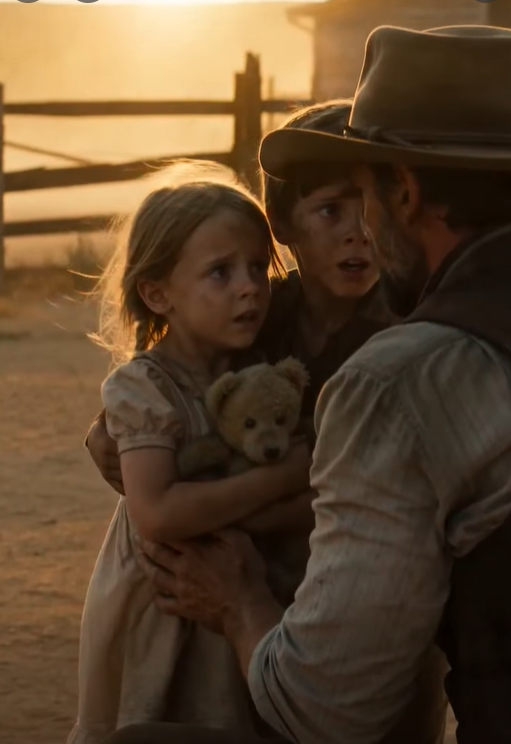
Caleb, a man whose skin had been turned to leather by decades of wind and hardship, sat on the porch. He held a tin mug of lukewarm coffee, his eyes tracking the shimmer of heat rising from the horizon. He wasn’t a man prone to surprises, but the arrival of the children had been an anomaly. They had stumbled out of the brush two hours ago, gasping, their clothes torn by thorns, their eyes haunted by a terror that only belonged to adults.
The boy, no older than twelve, had gripped Caleb’s calloused hand with a strength that betrayed his frailty. “Please,” he had gasped, his voice raspy from dehydration. “Hide my sister. They’re coming. They don’t stop.”
Caleb had simply nodded. He’d led them into the cellar beneath the floorboards, a dark, cool space filled with crates of dry goods and his own forgotten tools. As he lowered the heavy rug over the hatch, the boy had looked up, his eyes pleading. “Protect her.”
Now, back on the porch, Caleb let the coffee cool. He didn’t look like a hero. He looked like an old man who had outlived his purpose. But beneath his frayed denim jacket, the steel of his long-barreled Colt Peacemaker rested against his hip—an old friend that hadn’t seen the light of day in five years.
He heard them before he saw them. A low, guttural rumble that felt like the earth itself was groaning. Three black, armored SUVs cresting the ridge, kicking up a rooster tail of red dust that blotted out the sun. They didn’t slow down as they approached the diner; they skidded to a halt, the screech of tires sounding like a wounded animal.
Doors flew open. Men in tactical gear emerged, their silhouettes sharp against the golden light. They moved with the synchronized, predatory grace of a professional kill squad.
Caleb stood. He didn’t rush. He didn’t hide. He took a final, slow sip of his coffee and set the tin mug on the railing.
“Step aside, old man!” the leader barked, his voice amplified by a comms rig. “We’re looking for two runaways. You’ve seen them. We know you have.”
Caleb’s gaze was as steady as stone. “I see a lot of things out here in the desert,” he drawled, his voice a low, raspy velvet. “Mostly, I see dust. You boys are making a whole lot of it.”
“Last warning,” the leader said, raising a suppressed carbine. “Move, or you die.”
The calm vanished. Caleb didn’t blink. He didn’t reach; he moved with the blur of a man who had survived the frontier wars. The Peacemaker was in his hand before the leader’s finger could twitch.
Crack. Crack. Crack.
Three shots, three precise points of impact. The lead SUVs tires hissed as they blew out, and the squad scrambled for cover behind the heavy steel plating of their vehicles. For the next twenty minutes, the Painted Desert became a battlefield. Caleb moved through the diner, weaving between the support beams and overturned tables, a ghost in the crossfire. He didn’t waste ammunition. Every shot was a calculation. He drew them out, leading them into the open ground where the sun blinded them, then systematically neutralizing the threats one by one.
When the smoke cleared, the armored trucks were silent husks, and the squad was scattered. Caleb stood amidst the silence, his chest heaving, his shoulder bleeding from a graze, but his expression remained unchanged. He walked back to the porch, picked up his coffee mug—now stone cold—and waited.
The Aftermath
The boy had pushed the hatch open an hour later, his sister clutching his hand. They emerged into the quiet, looking at the wreckage, then at Caleb, who was busy reloading his revolver with rhythmic, practiced movements.
“They won’t come back,” Caleb said, his voice softer now. “Not for a long time.”
He took them to a ranch three states over, a place owned by a woman he had known in another life—a woman of kindness and quiet strength who had long ago asked him to settle down. He dropped the children at the gate, watching as they ran into the arms of safety. He didn’t stay for thanks. He didn’t stay for a reward. He turned his horse and rode back into the desert, back to the solitude that had been his only companion for years.
But the silence didn’t feel as heavy anymore.
Two years later, the desert was in bloom after a rare, heavy rain. Caleb was at the ranch, mending a fence line when a familiar engine rumbled up the gravel drive. A young woman stepped out, followed by a tall, confident teenager.
“You’re a hard man to find, Caleb,” the boy said, grinning.
Caleb wiped the sweat from his brow, his weathered face breaking into a rare, genuine smile. “I like it that way.”
They spent the evening on the ranch porch, not talking of the war or the dust, but of books, crops, and the future. Caleb looked at the boy and girl, now thriving, safe, and loved. He realized then that he hadn’t been protecting them that day in the diner; he had been protecting a future he didn’t know he was allowed to have.
As the sun began to set, turning the sky a brilliant shade of violet, Caleb realized he had finally found his home. He wasn’t just a drifter anymore. He was the grandfather of two children who owed him their lives, and in their presence, the shadows of his past were finally extinguished by the golden light of a new, peaceful day. The desert, once a place of death, was now a place of beginnings, and for the first time in his long, weary life, Caleb knew he would never have to be alone again.