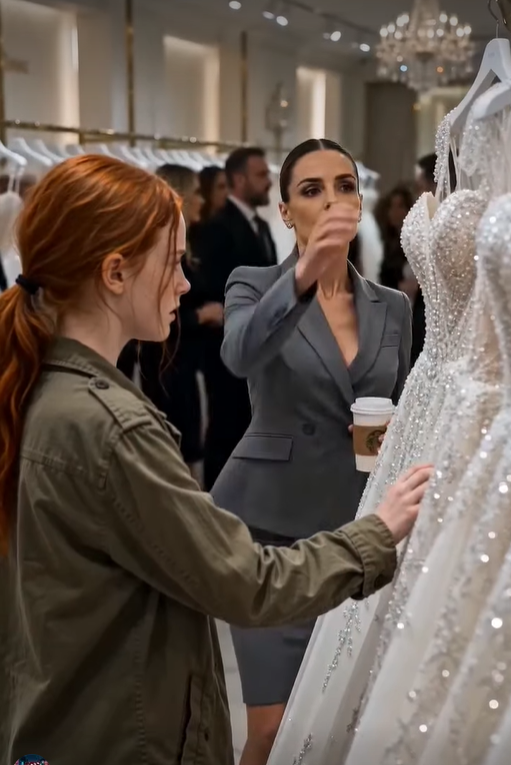
The “Lumière Bridal Atelier” was not just a boutique; it was a fortress of exclusivity located on the most expensive street in the city. To enter, one needed an appointment; to be served, one needed to look like they belonged to a pedigree that owned half the skyline.
Clara stood at the threshold, her hands buried deep in the pockets of a jacket that had seen three winters too many. She wasn’t there for a dress; she was there to finalize the acquisition of the building. But the morning rain had been relentless, and she had ducked inside to escape the deluge, accidentally brushing against a display of silk and crystal.
“Move it, sweetheart,” a voice dripped with condescension.
It was Julianna, the store’s manager, a woman whose face was as tight as her morals were loose. She held a steaming cup of artisan coffee. Behind her, a group of socialites—women who measured their worth in carats—giggled behind their manicured hands.
“I think you’ve got the wrong address,” Julianna sneered, walking toward Clara with predatory grace. “The bus stop is two blocks down. And you’re dripping on the floor. It’s an Italian marble, which you clearly couldn’t afford if you worked for a thousand years.”
Clara remained silent, her expression unreadable. She was weary; her father had passed away only two days prior, leaving her with a legacy that included half the commercial real estate in the city and a grief that felt heavy enough to anchor a ship.
“Let me help you,” Julianna laughed, and with a flick of her wrist, she “accidentally” tipped the cup. Hot, dark liquid splashed across Clara’s jacket. The boutique erupted in laughter. It was a symphony of cruelty.
“Call security,” Julianna barked at a trembling intern. “I don’t want the trash smelling up my merchandise.”
Clara took a slow, steady breath. She reached into her pocket, her fingers brushing against the damp fabric, and pulled out a card. It wasn’t the kind of plastic anyone in that room carried. It was a heavy, custom-forged navy-and-gold titanium card—the signature of the holding company that owned the very ground the boutique sat on.
She placed it on the velvet-topped display table with a soft clack.
“I am not here for a dress,” Clara said, her voice low, steady, and vibrating with the authority of someone who didn’t need to raise her volume to be heard. “I am here because my lawyers informed me that the lease for this entire building is currently in violation of commercial standards. I came to see if the management was as reckless as the reports suggested.”
The giggles in the room vanished. The air seemed to be sucked out of the boutique. Julianna’s face turned from a smirk to a mask of sheer, unadulterated terror. She picked up the card, her hands beginning to tremble so violently that the titanium clattered against her rings.
“You… you’re the…”
“I am the one who owns your contract,” Clara finished.
At that exact moment, the heavy glass doors swung open. A woman stepped in—the city’s most feared fashion mogul and the primary investor in the boutique. She had been on her way to meet Clara for a probate meeting. Seeing the scene, she didn’t look at Clara with pity; she looked at Julianna with a lethal, surgical coldness.
“Julianna,” the mogul whispered, the sound deadlier than a scream. “Pack your things. You aren’t just fired; you are finished in this industry.”
The Aftermath
The fall of the Lumière Bridal Atelier was swift. By the next morning, the story of the manager who had dared to splash coffee on the city’s newest real estate titan was all over the society pages. Clara didn’t enjoy the drama; she found it tedious. She wanted to honor her father’s vision, which had always been about accessibility and grace, not exclusion.
She didn’t shutter the boutique. Instead, she rebranded it. She fired the staff who had mocked her, not out of malice, but because she valued empathy above all else. She kept the intern—the young girl who had been too afraid to speak up—and promoted her to manager, knowing that someone who had felt the weight of intimidation would be the most compassionate leader.
Six months later, the atelier was transformed. It was no longer a place where women were measured by their tax brackets, but a place where every bride, regardless of her budget, was treated like royalty.
Clara sat in her father’s old office, overlooking the park. The grief of the last six months had slowly softened into a quiet, steady resolve. She realized that she hadn’t just saved a building; she had saved herself from becoming the type of person who looked down on others.
One afternoon, the new manager—the former intern—knocked on her door, followed by a woman in a modest, simple dress. It was a young schoolteacher who had been in the shop that fateful day, watching the humiliation from the back of the store, terrified to help. She had come to apologize for her silence, to thank Clara for changing the culture of the store.
Clara stood up and walked toward her, not as a boss to an employee, but as one woman to another. “You don’t need to apologize,” Clara said, her voice warm. “You were afraid. Fear is a natural response in a toxic environment. But look around you now. Do you feel afraid here?”
The woman smiled, a genuine, radiant expression. “No. I feel welcome.”
That evening, Clara walked out of the store into the golden hour of the city. She didn’t have her bodyguards trailing her, and she didn’t wear diamonds. She felt lighter than she had in years. She remembered her father’s final words to her, whispered in the hospice room: “Clara, true power is not what you keep for yourself, but what you build for others.”
She walked into the park, the very same one she had been passing when she had stopped at the boutique. She saw a young girl sitting on a bench, crying, her clothes worn and dusty. Clara didn’t walk past her. She didn’t judge the jacket or the state of the girl’s shoes.
She sat down beside her, placed a hand on her shoulder, and asked, “Are you alright? Is there something I can do to help?”
The girl looked up, eyes wide and startled, and for a moment, the world felt perfectly aligned. The cycle of cruelty had been broken, replaced by a thread of human kindness that was, in the end, far more precious than gold or rhinestones. Clara finally understood that she hadn’t just acquired an empire; she had finally inherited her father’s true wealth: the ability to change someone’s life, one act of kindness at a time. The boutique was a success, but this—this quiet moment in the park—was the real victory.