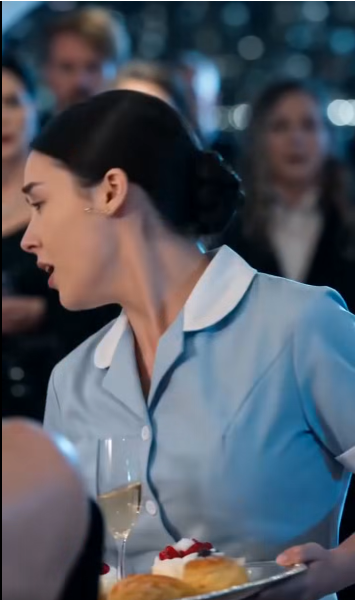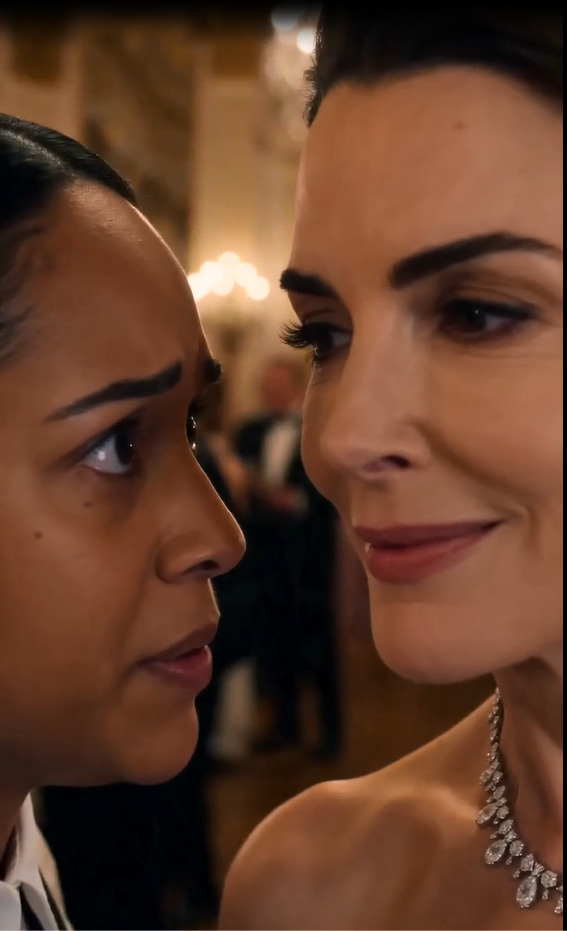
The Grand Regency Palace was a gilded cage, and tonight, the bars were made of champagne bubbles and the hollow laughter of the city’s power brokers. Eleanor, draped in a midnight-black velvet gown that clung to her silhouette like a second skin, moved through the banquet hall with the grace of a woman who had mastered the art of being seen without ever being touched. She was the wife of Julian Sterling, the city’s most visionary property developer, a man whose ambition was as vast as his appetite for the spotlight.
Eleanor lived in a world of soft lighting and softer truths. She knew Julian was a busy man; she knew his meetings ran late; she knew his work was the lifeblood of their existence. She had built a fortress out of her own ignorance, bricked with the comfort of her status and the relentless polish of her public life.
The crack in the fortress appeared not in the form of a scandal, but in the form of Maria.
Maria was a quiet, unassuming maid who had served the Sterling household for nearly a decade. She was a woman of few words and profound loyalty, the kind of person who became part of the wallpaper. As Eleanor stood by a fluted column, sipping a vintage red, Maria appeared at her side, her face drained of its usual color. She didn’t look at the crowd; she looked at the floor, her hands trembling so violently that the lace of her apron rattled.
“Madam,” Maria whispered, her voice a thin thread of terror. “Please. Come with me. At once.”
“Maria? What on earth?” Eleanor began, her smile fixed and brittle for the benefit of the onlookers. “I’m in the middle of—”
“You must see,” Maria insisted, her eyes darting toward the heavy mahogany doors that led to the service corridor, a part of the palace Eleanor rarely traversed. “Before the clock strikes midnight. Everything you think… everything you know… it’s all in that room.”
The urgency in Maria’s eyes was a physical force. Eleanor felt a cold chill bloom in the center of her chest, a premonition that her fortress was about to crumble. She set her glass down, the crystal ringing like a death knell against the silver tray, and followed Maria.
They walked through the labyrinthine halls of the palace, away from the warmth of the music and into the suffocating, dusty stillness of the service corridor. The air grew heavy, smelling of old paper and secrets. At the very end of the hall stood a heavy, oak-paneled door with a gold-plated handle that seemed to mock the darkness surrounding it.
“He’s in there,” Maria whispered, stepping back as if the door were on fire. “But he’s not who you think he is, Madam.”
Eleanor reached for the handle. Her heart hammered against her ribs, a frantic bird seeking release. She pushed the door open.
Inside, the room was a stark contrast to the opulence of the ballroom. It was an office, dark and cramped, filled with filing cabinets and a solitary desk bathed in the harsh light of a single lamp. Julian was there, his back to her, hunched over a spread of documents. Beside him stood a woman Eleanor recognized from the tabloids—the daughter of a rival developer, a woman who had been publicly “blacklisted” by Julian’s firm years ago.
“The merger is a farce, Julian,” the woman was saying, her voice sharp with desperation. “If the board finds out you’ve been funneling the funds into the offshore foundation—the one under your wife’s name—they’ll tear you apart.”
“The foundation is a failsafe,” Julian replied, his voice cold, devoid of the warmth he reserved for Eleanor. “Eleanor is the perfect face for the legal liability. She’s the anchor. If this house of cards falls, she takes the blame, and I walk away clean. She’s too busy playing the trophy wife to notice the ink on the documents.”
The truth didn’t hit Eleanor like a slap; it hit her like a demolition ball. Her husband, her life, the very foundation of her happiness—it was all a tactical maneuver. She wasn’t a partner; she was a shield.
She stepped into the light.
Julian spun around, his expression shifting from corporate menace to utter, paralyzing shock. “Eleanor. It’s… it’s not what it looks like.”
“Don’t,” she said, her voice steady, hard as flint. She walked to the desk, her fingers brushing over the documents. She saw her own forged signature on every single page. She felt a strange sense of liberation. The fortress had fallen, but in the ruins, she finally found her own voice.
Three years later.
The city had changed, and so had Eleanor. The Sterling name was no longer synonymous with vanity. After the night at the palace, Eleanor hadn’t run away. She had fought. She had taken the documents Maria had helped her gather, hired the most ruthless forensic accountants in the country, and turned Julian’s “failsafe” into his own undoing. He was currently serving a sentence that would keep him behind bars for a very long time, and the Sterling empire had been dismantled and repurposed into a series of transparent, community-focused initiatives.
Eleanor was now a high-powered consultant, specializing in corporate ethics and transparency. She sat in a sun-drenched office in the heart of the city—a space she had chosen for its windows, its light, and its absolute lack of secrets.
There was a knock at the door. Maria, who was now Eleanor’s personal assistant and her closest confidante, entered with a tray of herbal tea.
“You have a meeting with the architect, Eleanor,” Maria said, her face glowing with a quiet, genuine joy.
“Thank you, Maria,” Eleanor said, smiling.
The door opened, and in walked David, an architect she had been working with for the past year. David wasn’t a tycoon. He was a man who designed libraries and public parks, a man whose hands were always stained with graphite and whose eyes held an unwavering, honest light.
They had started as collaborators, moved to friends, and somewhere in the quiet work of rebuilding the city, they had become something more. He loved her for the way she navigated the wreckage of her old life—with a fierce, uncompromising honesty that he admired more than anything.
“I’ve finished the final schematics for the new literacy center,” David said, spreading a blueprint on her desk.
Eleanor looked at the design—a space built for everyone, built with transparency and purpose. She looked at David, and then at Maria, who stood by the window, watching the city below with a peaceful smile.
“It’s perfect,” Eleanor said.
She realized then that the door she had opened three years ago hadn’t been an end, but a threshold. She had walked through the darkness and found that the light on the other side was much more brilliant because it wasn’t manufactured.
“You know,” David said, catching her hand. “A lot of people are afraid of the truth. They spend their whole lives guarding their doors.”
“I used to be one of them,” Eleanor replied. “But I’ve learned that the truth isn’t something to hide from. It’s the only thing that can actually set you free.”
She thought of the gold-plated doorknob at the palace, the cold barrier between the lie and the life. She was glad she had turned it. She had lost her status, her husband, and her gilded cage, but she had gained a life that was finally, unequivocally, her own.
As she stood up to walk toward the future with the man who respected her strength and the woman who had helped her find it, Eleanor felt a lightness that had nothing to do with her gown and everything to do with her heart. She was no longer a trophy in someone else’s hall; she was the architect of her own integrity. And for the first time, she was exactly where she needed to be. The palace was gone, but the foundation she had built—honest, transparent, and strong—was meant to last forever.