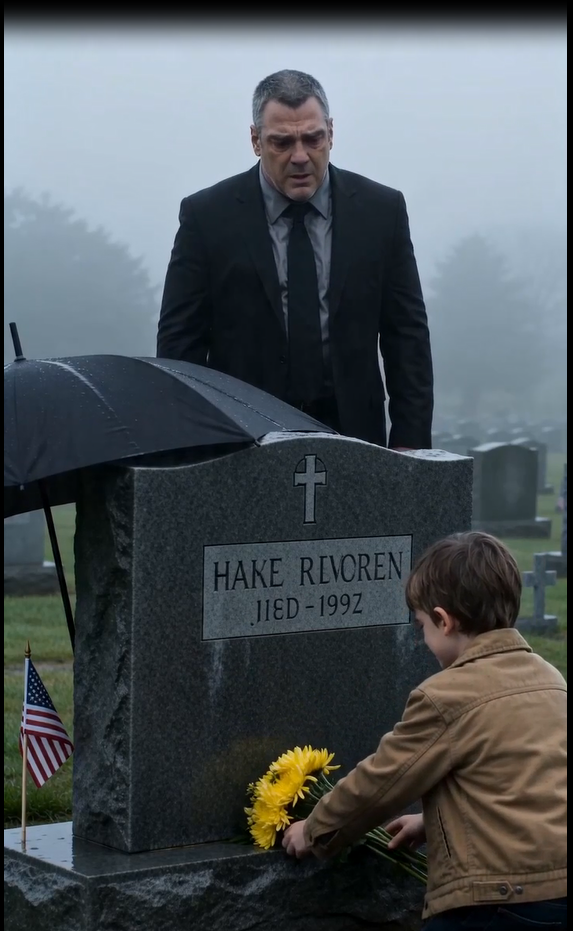
The fog in the Saint Jude Cemetery did not merely drift; it clung, wrapping around the gray tombstones like a shroud. It was the kind of cold that seeped into the marrow, numbing the grief that had lived in Arthur’s chest for twenty-two years.
Arthur stood at the edge of the path, his black suit blending into the gloom. He was a man composed of sharp angles and hidden regrets, his eyes, once bright with idealism, now dimmed by the weight of a secret he had spent two decades protecting. He had come here every year on this date, a silent penitent visiting a grave that felt more like a prison cell than a final resting place.
But today, the ritual was interrupted.
At the foot of the headstone—the stone that bore the name Julian Vane—knelt a boy. He could not have been more than nine years old. He wore a brown khaki jacket that looked a size too big, and his hair was a tousled mess of brown. He was placing small, fragile yellow flowers onto the damp earth, his shoulders trembling with the rhythmic, jagged gasps of a child trying to stifle a sob.
Arthur froze. He knew the boy’s face. It was a mirror reflecting a ghost.
As Arthur stepped closer, his own boots sounding like drumbeats on the wet grass, the boy turned. The child’s eyes were wide, glassy with tears, reflecting an innocence that Arthur had long ago forfeited.
“Who are you?” Arthur asked, his voice cracking. It was a futile question. He already knew.
The boy wiped his face with the back of a dirty sleeve, not backing away. “He’s my brother,” the boy said, his voice broken by a sob. “He’s my brother… and who are you?”
The question hung in the cold air, sharper than the winter wind. Arthur looked down at the grave. Julian Vane. Beloved Brother and Son. He had walked away from Julian twenty-two years ago, leaving his brother to face the consequences of a tragedy Arthur had inadvertently caused. He had moved across the country, changed his name, and built a life of hollow success, always believing that Julian had died in the aftermath of their falling out, fueled by his own cowardice. He had never known that Julian had survived, had married, and had left behind a son who looked exactly like the brother Arthur had failed.
“I don’t even know how to begin to say this,” Arthur whispered. The single tear that tracked down his cheek was not a sign of weakness; it was the collapse of a dam that had held back two decades of guilt.
The boy stood up, his gaze shifting from sorrow to bewilderment. “Did you know him?”
Arthur looked at the child, then at the headstone. The secret that had bound him to this cemetery for years was no longer a burden to be kept; it was a bridge.
“I didn’t just know him,” Arthur said, kneeling until he was eye-level with the boy. “I was his older brother. I was the one who left him behind. And for twenty-two years, I thought the guilt was the only thing I had left of him.”
The boy stared, his breathing hitching. The confusion in his eyes slowly gave way to a dawning comprehension. The man in the black suit, the man with the haunted eyes, was not a stranger. He was the shadow that Julian had talked about in whispered, bittersweet stories—the brother who had been lost to pride and distance.
“He talked about you,” the boy whispered, the tears finally subsiding into a quiet clarity. “He said… he said he wished he could show you how he’d changed.”
Arthur reached out, his hand hovering before he gently rested it on the boy’s shoulder. The contact felt like an anchor. The fog didn’t lift, but for the first time in two decades, Arthur could breathe.
“My name is Arthur,” he said, his voice firming. “And I have spent twenty-two years wishing I could do the same. I have a home, miles from here, that has been empty for a long time. I don’t want to be a stranger to you, and I don’t want to leave you behind ever again.”
The boy looked at the grave, then up at Arthur. He saw the genuine, raw ache of a man finally coming home. He reached out, his small, cold hand finding Arthur’s.
“Julian wanted to be forgiven,” the boy said softly. “Maybe you can start with me.”
Arthur stood up, taking the boy’s hand firmly. They walked out of the cemetery together, two figures emerging from the fog. It was not a magical ending—the grief remained, the years were still gone, and the scars of the past were still there—but as they reached the car, Arthur didn’t look back at the tombstones.
He didn’t need to. He wasn’t leaving the past behind; he was carrying it forward. As the engine started and they drove away from the somber rows of gray, the boy looked out the window, his hand still tucked into Arthur’s.
“Tell me about him,” the boy asked.
Arthur smiled, a faint, genuine expression that reached his weary eyes. “I’ll tell you everything,” he promised.
They drove into the morning light, leaving the mist of the cemetery behind. It had taken a lifetime of silence, but finally, the story had begun to be told, and for the first time in twenty-two years, Arthur Vane was not alone. The secret had been a wall, but in its revelation, it had become the foundation for a new beginning. He was going to be an uncle, a protector, and finally, a brother who stayed.