The air at the Starlight Equestrian Gala was thick with the scent of expensive perfume, freshly manicured grass, and the palpable tension of high society. Here, in the sprawling gardens of the Sterling Estate, life was curated. Every smile was rehearsed, every tuxedo pressed to a razor’s edge, and every horse was groomed to mirror the perfection of its owner.
Elara Sterling sat in the shade of a silk canopy, her wheelchair a silent, metallic anchor amidst the swirling grace of the gala. At seventeen, Elara was a masterpiece of potential gone dormant. Since the accident—a tragedy that had taken her ability to walk and, she felt, the light from her eyes—she had become a ghost in her own home. She watched the world through a veil of detachment, feeling more like a spectator at an exhibit than a participant in life.
Her father, Arthur Sterling, was nearby, shaking hands with a senator, his laughter booming with the practiced cadence of a man who owned the room. But the atmosphere shifted in a heartbeat.
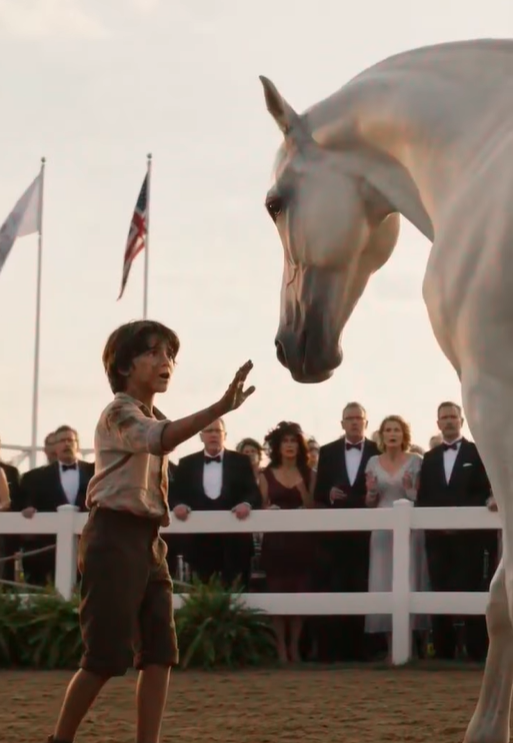
A sudden, sharp crack—perhaps a champagne bottle dropped or a carriage backfiring—shattered the polite murmurs. “Cloud Dancer,” the prize-winning stallion of the estate, snapped. The magnificent beast, a mountain of raw, white muscle, reared up. His hooves slashed the air, a terrifying display of untamed power. The crowd erupted into chaos. Silk dresses tore, chairs were upended, and the well-heeled guests scrambled for the exits like startled birds.
Arthur lunged toward Elara, his face pale with panic, but a panicked groom had inadvertently knocked over a decorative stone pillar that blocked his path. Elara sat frozen, her chair jammed against a garden bed, directly in the path of the panicked stallion as he galloped toward the perimeter fence.
She looked up. The world slowed to a crawl. She saw the whites of the horse’s rolling eyes, the foam at his mouth, and the sheer, beautiful violence of his terror. She didn’t scream. She simply closed her eyes, waiting for the impact.
It never came.
Instead, she heard a sound that didn’t belong in the garden: a low, humming vibration, like a song sung deep in the throat.
When she opened her eyes, a boy stood between her and the horse. He was no older than her, perhaps fifteen, his skin darkened by the sun and his clothes—tattered linen pants and a rough-spun tunic—caked in the very mud of the estate’s outer stables. He was barefoot. He didn’t carry a whip; he didn’t even have a rope.
He stood perfectly still, his palm outstretched toward the charging stallion. “Easy,” he whispered, a sound so grounding that it seemed to pull the very gravity back into the earth.
The stallion skidded to a halt, dust billowing around the boy’s ankles. The boy stepped forward, his eyes locked onto the horse’s trembling nostrils. He spoke in a language of clicks and soft breaths. Within seconds, the beast’s rage dissolved into a rhythmic, heavy breathing. The boy reached out and touched the horse’s forehead. The tension snapped, and the great white creature lowered its head, letting out a long, shuddering sigh of surrender.
The silence that followed was absolute. The elite crowd watched from behind overturned tables, paralyzed by the sight of the outcast—the boy they had ignored as a nuisance—taming the un-tameable.
Elara couldn’t look away from him. But then, something even more profound happened. As the boy turned his gaze toward her, a strange, electric current leaped from his eyes to hers. She felt a searing, sharp heat shoot through her spine and down into her paralyzed legs. It was an ache—a beautiful, terrifying, waking ache. Her toes, which hadn’t moved in two years, twitched against the footrests of her chair.
She gasped, her hands gripping the armrests. The boy didn’t smile; he looked at her with a knowing gravity, as if he had been waiting for this moment his entire life.
“Who are you?” she breathed.
“Someone who knows what it feels like to be trapped,” he replied, his voice raspy. Before she could ask more, the security detail swarmed the area. In the commotion of her father rushing to her side, weeping with relief and shouting orders, the boy vanished back into the shadows of the stables.
In the weeks that followed, the story of the “Miracle in the Mud” became a local legend, but the truth was buried beneath gossip. Elara, however, was obsessed. She began sneaking out of the mansion at night, her legs growing stronger with every passing day, propelled by a newfound, desperate hope. She scoured the perimeter of the estate, calling out into the darkness.
She found him a week later near the creek, tending to a wounded bird. His name was Julian. He was the son of the estate’s former farrier, a boy who had grown up in the silence of the stables, listening to the secrets the animals told the wind.
“You healed me,” Elara said, standing—truly standing—before him. The effort was immense, and her legs trembled, but she did not fall.
Julian looked at her, his eyes soft. “I didn’t heal you, Elara. You were already whole. You just needed to remember that pain isn’t a wall; it’s a door.”
They spent the summer together in the hidden corners of the world that the elite never visited. Julian taught her how to listen—not to the applause of crowds, but to the rhythm of the earth, the language of the wind, and the heartbeat of her own resilience. He showed her that the beauty of a life isn’t in its polish, but in its scars.
The miracle was not that she walked; the miracle was that she had found a soul who saw the person beneath the trauma. By the time autumn turned the leaves to gold, Elara had regained her strength, but she had lost her desire for the high-society life.
She stood at the center of the grand ballroom during a fall gala, not in a chair, but on her own feet, wearing a simple dress that caught the candlelight. Her father looked at her, tears in his eyes, realizing he finally had his daughter back—not the trophy he had groomed, but a woman who was wild, grounded, and truly alive.
In the back of the room, near the shadows of the terrace, a boy stood watching. He didn’t stay for the applause. He didn’t want the recognition of a world he didn’t belong to. He stepped into the night, but as he turned, he locked eyes with Elara one last time.
She smiled, a radiant, knowing expression. She didn’t need to chase him. She knew now that some connections are not built on proximity, but on the resonance of two souls who have walked through the mud and found the stars. She had her life back, and for the first time, she wasn’t just observing the world—she was finally ready to lead it, one step at a time.